
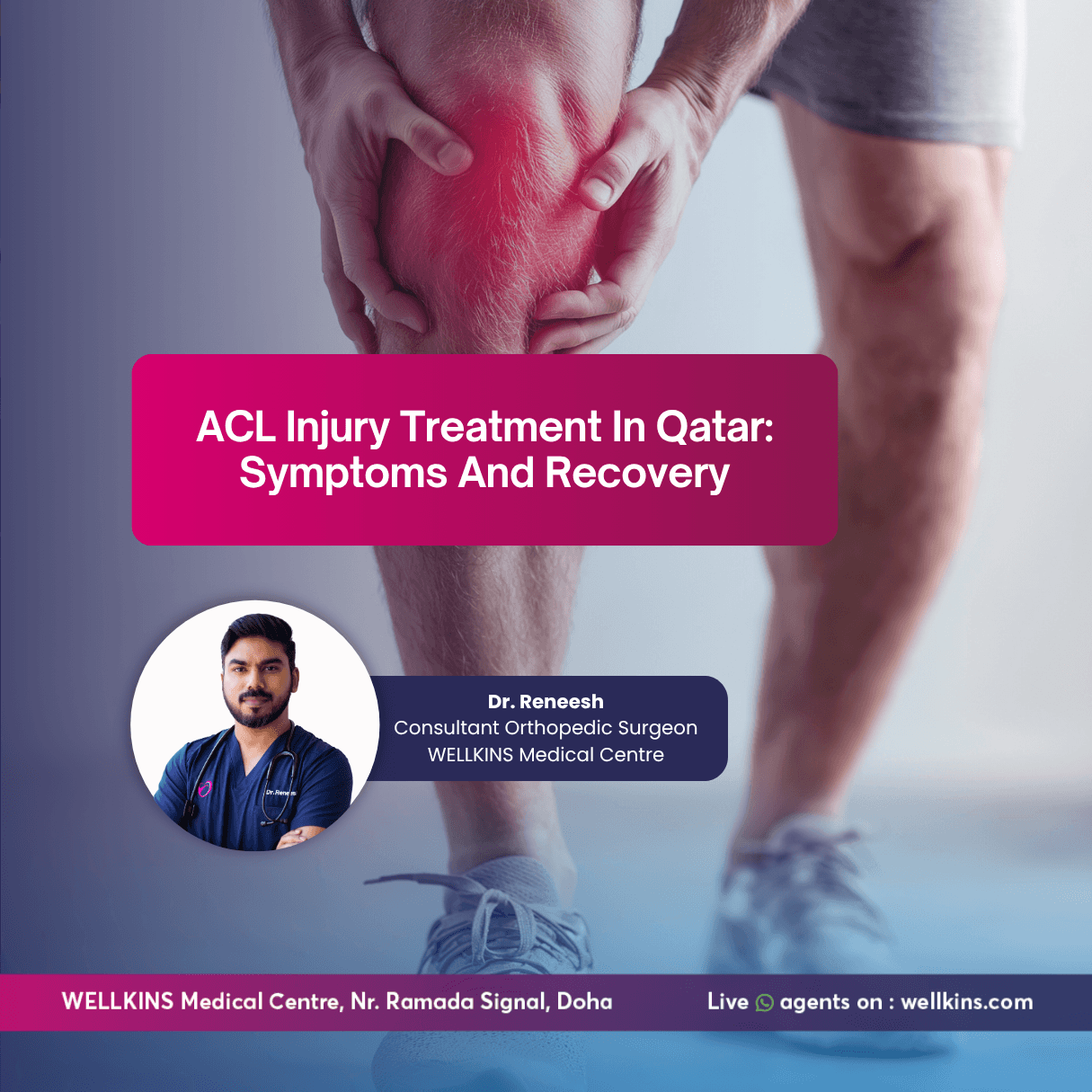
Author: Dr. Reneesh, (Consultant Orthopedic Surgeon – WELLKINS Medical Centre)
Introduction
An anterior cruciate ligament injury is one of the most common and clinically significant knee ligament injuries particularly among athletes and people participating in pivoting sports. The ACL is a strong ligament inside the knee joint that connects the femur to the tibia. It contributes to knee stability by limiting excessive forward movement of the tibia and controlling rotational movements.
ACL injuries can range from partial ligament tears to complete ruptures. They may occur during football, basketball, handball, volleyball, skiing or other activities involving sudden changes in direction, abrupt stopping, jumping and landing.
An ACL injury can cause pain, swelling, restricted movement and a feeling that the knee is giving way. Appropriate diagnosis and treatment are important for restoring knee function, reducing recurrent instability and helping the patient return safely to everyday activities and sport.
As an orthopedic surgeon, treatment decisions should be individualised according to the patient’s age, activity level, associated injuries, functional instability and future sporting or occupational goals.
“An ACL tear should not be treated according to the MRI result alone. Two patients with similar scan findings may have very different levels of instability and very different activity goals. The treatment plan should consider how the knee functions, whether it gives way, the presence of meniscal or cartilage injuries and what the patient wants to return to. Rehabilitation is essential whether treatment involves surgery or a structured nonoperative programme. The aim is not simply to reduce pain. It is to restore stability, strength, movement control and confidence in the knee.”
People Also Ask
Can you walk with a torn ACL?
Some people can walk after an ACL injury particularly after the initial pain begins to settle. Being able to walk does not rule out a partial or complete ACL tear because instability may become more noticeable during turning, running or pivoting.
Does every complete ACL tear require surgery?
No. Some patients with a complete ACL tear can function well after structured rehabilitation and suitable activity modification. Surgery may be considered when the knee remains unstable, repeatedly gives way or must tolerate high demand pivoting activities.
Can an ACL tear heal without surgery?
The potential for biological healing and useful stability varies between patients and injury patterns. Even when surgery is not selected, a structured rehabilitation programme is needed to restore strength, balance and movement control.
How long does it take to return to sport after ACL reconstruction in Qatar?
Return to high demand pivoting sports commonly takes approximately 9 to 12 months or longer. Readiness should be based on knee function, strength, movement quality, psychological confidence and sport specific testing rather than the calendar alone.

1. What Are the Causes of an ACL Injury in Qatar?
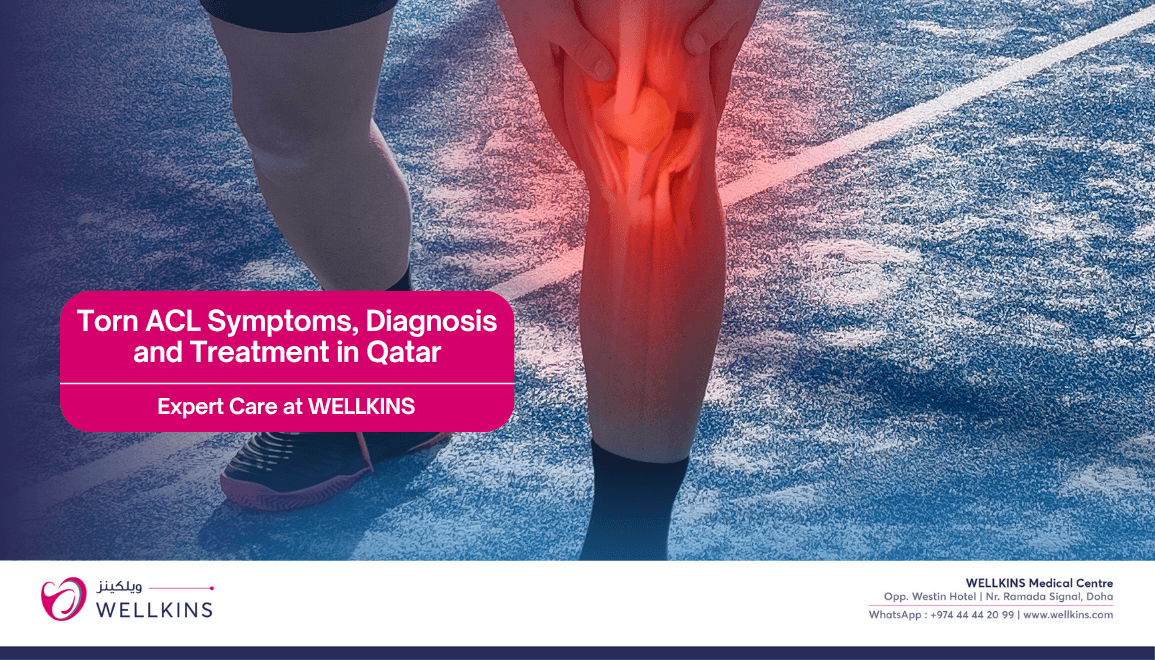
ACL injuries commonly occur through noncontact mechanisms although direct trauma can also damage the ligament. Understanding how the injury occurred helps the orthopedic specialist assess the ACL and look for associated damage within the knee.
A. Sudden Change in Direction
Rapidly changing direction while running can place substantial rotational forces on the knee. If the knee cannot adequately control these forces, the ACL may stretch or rupture.
This mechanism is frequently seen in football, basketball, handball and other pivoting sports. The injury may occur without contact from another player.
B. Sudden Stopping or Deceleration
Abruptly stopping while running can increase stress on the ACL particularly when combined with trunk movement, inward knee movement or rotational loading.
Deceleration places high demands on the quadriceps, hamstrings, hips and trunk. Fatigue or reduced movement control may make it more difficult for the body to manage these forces safely.
C. Incorrect Landing After Jumping
Landing with poor lower limb control particularly when the knee collapses inward or the body is poorly positioned may increase ACL loading.
However, ACL injuries are multifactorial and no single landing position explains every injury. Strength, coordination, fatigue, sporting exposure and individual anatomy may all influence risk.
D. Direct Trauma
A collision or blow to the knee particularly during contact sports or road traffic accidents may result in an ACL injury. Associated damage to the menisci, collateral ligaments or other structures may also occur.
A knee injury following significant trauma should be medically assessed especially when there is rapid swelling, difficulty bearing weight or visible deformity.
E. Previous ACL Injury
A previous ACL tear increases the risk of another ACL injury including injury to the opposite knee. Rehabilitation quality, neuromuscular control, sporting exposure and other individual factors influence this risk.
Completing rehabilitation and meeting objective return to sport criteria can help reduce avoidable risk. Clearance should not be based only on the number of months since the injury or surgery.
F. Risk Factors
Factors associated with ACL injury include:
- Participation in sports involving jumping, pivoting and rapid changes in direction
- Previous ACL injury
- Inadequate neuromuscular control during landing and deceleration
- Fatigue and high sporting exposure
- Individual anatomical and biomechanical characteristics
- Certain hormonal and sex associated factors particularly in female athletes participating in comparable sports
ACL injury risk is influenced by multiple interacting factors. An injury should not be attributed to one anatomical characteristic or training factor alone.
Understanding How ACL Injuries Occur
Some ACL injuries occur during a direct collision while many happen during a sudden pivot, landing or change in speed without contact. The patient may feel the knee shift even when there has been no visible impact.
Explaining the exact movement that caused the injury can help the orthopedic specialist evaluate the ACL, menisci, collateral ligaments and other structures that may have been affected.
2. What Are the Symptoms of an ACL Injury in Qatar?
The symptoms depend on the severity of the tear and whether other knee structures are injured. Not every patient experiences the same combination of pain, swelling and instability.
A. Sudden Knee Pain
Patients often report sudden pain at the time of injury. Pain severity varies and some patients can initially continue walking despite a significant ACL tear.
Pain may be felt deep within the knee or may be difficult to localise. Associated bone bruising, meniscal damage or collateral ligament injury can influence the location and severity of discomfort.
B. A Popping Sensation
Some patients describe hearing or feeling a “pop” when the injury occurs. This is a common feature but is not specific to an ACL rupture.
A popping sensation can also occur with other knee injuries. It should therefore be considered together with swelling, instability, the injury mechanism and examination findings.
C. Rapid Knee Swelling
Swelling developing within the first few hours may indicate bleeding inside the knee joint which is known as haemarthrosis. An ACL rupture is one possible cause although patellar dislocation and intra articular fractures can produce a similar presentation.
Rapid swelling after an injury should be assessed because it may indicate significant damage inside the joint. The timing of swelling can provide useful information during diagnosis.
D. Knee Instability
Patients may experience a sensation that the knee is giving way particularly during turning, pivoting, descending stairs or walking on uneven surfaces.
Repeated episodes of instability can interfere with sport and daily activity. They may also place the menisci and joint cartilage at risk of further injury.
E. Restricted Range of Motion
Pain and swelling may limit knee flexion and extension. Some patients develop difficulty fully straightening the knee.
A knee that remains locked or cannot fully extend requires prompt assessment. This may indicate a displaced meniscal tear or another mechanical obstruction within the joint.
F. Difficulty Walking or Participating in Sports
Weight bearing may be uncomfortable immediately after injury. Persistent instability can prevent safe participation in running, jumping or pivoting activities.
Important: The ability to walk after a knee injury does not exclude an ACL tear or another significant knee injury.
3. What Are the Types of ACL Injury?
ACL injuries are commonly classified according to the degree of ligament damage.
- Grade I sprain: The ligament is stretched but remains functionally intact
- Grade II sprain: The ligament is partially torn
- Grade III sprain: The ligament is completely torn which results in significant structural disruption
Clinical stability does not always correspond precisely to the apparent severity of a tear on MRI. Treatment decisions should therefore consider symptoms, examination findings, associated injuries and functional requirements.
The location and pattern of the tear may also influence treatment planning. A complete assessment is needed before deciding whether rehabilitation alone or surgical reconstruction is the more suitable approach.
4. How Is an ACL Injury Diagnosed in Qatar?
Accurate diagnosis requires a detailed history, systematic knee examination and appropriate imaging. Diagnosis should not rely on symptoms or an MRI report alone.
A. Medical History
The orthopedic surgeon will assess:
- The mechanism and timing of injury
- Whether a pop or immediate swelling occurred
- The ability to bear weight after injury
- Episodes of giving way or recurrent instability
- Previous knee injuries or surgery
- Sporting participation and occupational demands
- Associated locking, catching or restricted movement
The patient’s preferred sport and future activity goals are also important. A person returning to competitive football may require a different treatment strategy from someone whose regular activities do not involve pivoting.
B. Physical Examination
The examination should include assessment of swelling, tenderness, range of motion and ligament stability.
1. Lachman test
The Lachman test evaluates anterior translation of the tibia relative to the femur with the knee flexed approximately 20 to 30 degrees. Increased translation and a soft endpoint may suggest ACL insufficiency.
2. Anterior drawer test
This test assesses anterior translation of the tibia with the knee flexed to approximately 90 degrees. Its diagnostic usefulness may be reduced during the acute phase by pain, swelling or muscle guarding.
3. Pivot-shift test
The pivot shift test evaluates rotational instability associated with ACL deficiency. It is particularly useful when assessing functional instability although an acutely painful knee may limit examination.
The Lachman, anterior drawer and pivot shift tests should be interpreted together with the injury history and other findings. No single examination test should be used in isolation.
The clinician should also assess the medial and lateral collateral ligaments, menisci, extensor mechanism, distal circulation and neurological function as indicated.
C. X-ray Examination
X rays do not directly demonstrate an ACL tear, but they are useful for identifying fractures, avulsion injuries and other bony abnormalities.
Radiographs are particularly important after significant trauma or when clinical findings suggest a fracture. A normal X ray does not exclude an ACL tear.
D. MRI Scan
MRI is the principal imaging investigation for evaluating the ACL and associated internal knee injuries when imaging is indicated.
It can help identify:
- Partial or complete ACL tears
- Meniscal tears
- Bone bruising and occult fractures
- Collateral ligament injuries
- Articular cartilage damage
- Other associated soft tissue abnormalities
MRI findings should be correlated with the clinical examination. A complete ACL tear on MRI does not automatically mean every patient requires surgery.
Patients can also read about meniscal injuries in Qatar because ACL and meniscal injuries can occur together.
ACL Examination and Knee Imaging
A clinical examination provides information that an MRI cannot show by itself including the patient’s functional stability, pain response and ability to control the knee. Imaging then helps identify the tear pattern and associated injuries.
The results of the history, examination and imaging should be considered together. This allows treatment to be based on the patient rather than only on the appearance of the ligament in a scan.
5. What Is the Treatment for an ACL Injury in Qatar?
Treatment depends on the type of tear, associated injuries, knee stability, age, activity level and the patient’s goals.
Both nonsurgical treatment and ACL reconstruction may be appropriate in selected patients. The plan should be individualised after the knee has been properly assessed.
A. Initial Management
During the acute phase, treatment aims to reduce pain and swelling while protecting the knee.
Recommended measures may include:
- Relative rest and temporary avoidance of pivoting activities
- Ice application with a protective cloth barrier
- Compression when appropriate
- Elevation of the affected leg
- Temporary use of crutches if walking is painful or the knee is unstable
- Appropriate pain medication based on the patient’s medical history
- Clinical assessment to exclude fracture and other significant injuries
A knee brace may be useful in selected circumstances, but it is not routinely necessary for every ACL injury. Prolonged immobilisation should generally be avoided unless another injury requires it.
B. Physiotherapy and Rehabilitation in Qatar
Rehabilitation is essential whether the patient undergoes surgery or follows a nonoperative treatment plan.
The initial objectives include reducing swelling, restoring full knee extension, improving flexion, reactivating the quadriceps and restoring normal gait.
A progressive rehabilitation programme may include:
Phase 1: Acute rehabilitation
- Pain and swelling management
- Restoration of full knee extension
- Gentle knee flexion exercises
- Quadriceps activation and straight leg raises when appropriate
- Gait training and gradual weight bearing according to clinical status
Phase 2: Strength and mobility
- Progressive quadriceps and hamstring strengthening
- Hip and core strengthening
- Stationary cycling when tolerated
- Balance and proprioceptive training
- Restoration of functional knee range of motion
Phase 3: Neuromuscular and functional training
- Single leg control and balance exercises
- Progressive resistance training
- Landing mechanics and movement control training
- Running progression when appropriate
- Sport specific drills under supervision
Phase 4: Return-to-sport preparation
- Progressive acceleration and deceleration
- Cutting and pivoting drills
- Jumping and landing assessment
- Strength and functional performance testing
- Psychological readiness assessment
Progression should be based on objective functional milestones rather than time alone. Rehabilitation protocols must also be modified if there is an associated meniscal repair, cartilage procedure, fracture or another injury requiring additional protection.
For more information about rehabilitation, read the WELLKINS guide to ACL physiotherapy after surgery in Qatar.
C. Non-Surgical Treatment
Nonoperative treatment may be appropriate for selected patients including those who:
- Have a partial ACL injury without significant instability
- Have an ACL deficient knee that remains functionally stable
- Participate mainly in straight line activities rather than high demand pivoting sports
- Prefer to avoid surgery after understanding the benefits and limitations
- Can complete a structured rehabilitation programme and modify activities when necessary
The programme focuses on restoring strength, balance, neuromuscular control and confidence in the knee.
However, recurrent giving way episodes may increase the risk of additional meniscal or cartilage injury. Persistent instability warrants reassessment and discussion of surgical options.
D. ACL Reconstruction Surgery
ACL reconstruction is commonly considered for patients with symptomatic instability, high demand pivoting sport requirements or associated injuries that influence treatment.
The operation generally involves replacing the torn ACL with a tendon graft rather than simply stitching the torn ligament together.
Common graft options include:
- Hamstring tendon autograft: Uses the patient’s own hamstring tendon
- Bone–patellar tendon–bone autograft: Uses the central portion of the patellar tendon with bone plugs
- Quadriceps tendon autograft: Uses a portion of the quadriceps tendon
- Allograft: Uses donor tissue in selected patients
Graft selection depends on age, activity level, occupation, associated injuries, previous surgery, surgeon expertise and patient preference.
ACL reconstruction aims to improve knee stability and enable a safe return to desired activities. It does not guarantee that the patient will return to the same sporting level or prevent all future osteoarthritis.
E. Is Surgery Always Necessary for a Complete ACL Tear?
No. A complete ACL tear on MRI does not automatically require reconstruction.
Some patients achieve satisfactory function with structured rehabilitation and activity modification. Others experience recurrent instability particularly during pivoting sports and may benefit from surgery.
The decision should be based on the patient’s functional instability, activity goals, associated injuries, response to rehabilitation and informed preference.
The WELLKINS article about ligament injury diagnosis and treatment in Qatar provides additional information about how ligament injuries are assessed and managed.
ACL Rehabilitation and Return to Sport
Successful ACL rehabilitation is a progressive process that begins with controlling swelling and restoring movement. It later advances to strengthening, balance, running, jumping and sport specific movement.
Each stage should be completed without significant pain, swelling or instability before the patient progresses. This criteria based approach helps prepare the knee for the actual demands of the patient’s sport.
6. How Long Does Recovery Take After ACL Reconstruction?
Recovery varies according to the graft used, associated injuries, rehabilitation progress and sporting demands.
Broadly, rehabilitation progresses over several months. Return to high demand pivoting sports commonly requires approximately 9 to 12 months or longer and some patients need additional time.
The calendar alone should not determine readiness to return to sport.
Before returning to unrestricted sport, the patient should generally demonstrate:
- Full or near full knee range of motion
- No significant effusion
- Adequate quadriceps and hamstring strength
- Good single leg balance and movement control
- Acceptable performance on suitable hop and functional tests
- Psychological readiness and confidence
- Successful completion of sport specific training
Many rehabilitation protocols use strength and hop test limb symmetry targets of approximately 90% or greater, but these thresholds should not be interpreted in isolation. Absolute strength, movement quality, the condition of the opposite limb, sport demands and other clinical criteria also matter.
Returning too early may increase the risk of another ACL injury. Patients should follow the individual return to sport plan provided by their orthopedic specialist and physiotherapist.
7. Can ACL Injuries Be Prevented?
Although ACL injuries cannot be completely prevented, structured injury prevention programmes can reduce risk particularly in athletes participating in pivoting sports.
Effective programmes commonly incorporate:
- Neuromuscular warm up routines
- Lower limb strength training
- Balance and proprioception exercises
- Jumping and landing technique training
- Controlled deceleration and cutting drills
- Trunk and hip control exercises
- Appropriate training progression and recovery
These programmes are most useful when performed consistently as part of regular sports training rather than only occasionally.
Athletes returning after ACL injury should also complete an individualised rehabilitation and return to sport programme. Additional guidance about managing athletic injuries is available through the WELLKINS article on sports injury treatment in Qatar.
8. When Should You Seek Urgent Medical Attention?
Prompt medical assessment is recommended after a significant knee injury particularly when there is rapid swelling or instability.
Seek urgent assessment if you experience:
- Inability to bear weight after the injury
- Severe pain or rapidly developing swelling
- Obvious deformity or suspected fracture
- A locked knee or inability to fully extend it
- A cold, pale, numb or weak foot
- An open injury or signs of infection
A cold or pale foot, loss of circulation or major deformity requires emergency assessment.
Symptoms should not be ignored simply because the patient can still walk. Early assessment can identify associated fractures, meniscal tears or other injuries that may require prompt treatment.
Conclusion
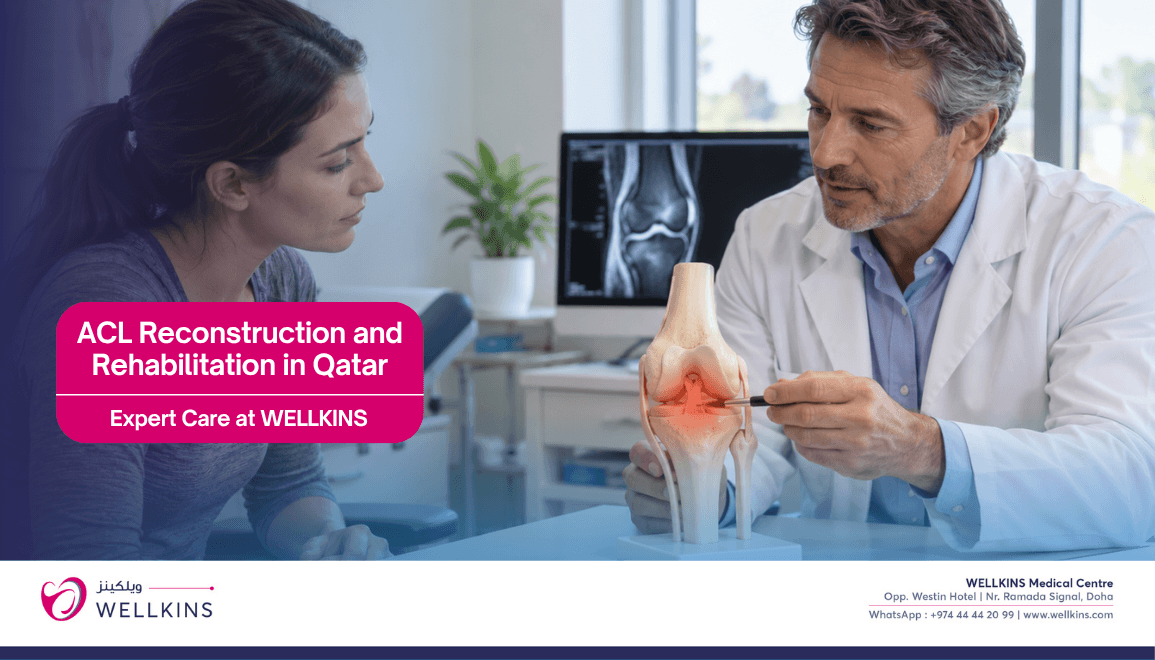
An ACL injury is a significant knee ligament injury that commonly occurs during sudden changes in direction, abrupt stopping, jumping or landing. Typical symptoms include a popping sensation, rapid swelling, pain, restricted movement and knee instability.
Diagnosis is based on the injury history, clinical ligament examination and appropriate imaging particularly MRI when indicated.
Treatment may involve structured physiotherapy and activity modification or ACL reconstruction depending on functional instability, sporting demands, associated injuries and patient preference.
Successful recovery requires progressive rehabilitation, restoration of strength and movement control and a criteria based return to sport assessment.
If you experience knee swelling, instability or a giving way sensation after a sports injury, consult an orthopedic specialist for an accurate diagnosis and an individualised treatment plan.
At the Orthopedics Department at WELLKINS Medical Centre, Dr. Reneesh provides assessment and treatment for ACL injuries, knee instability, meniscal injuries and other sports related orthopedic conditions.
To book an appointment with Dr. Reneesh at Wellkins Medical Centre: https://wellkins.com/drreneesh
To know more about the Orthopedic services at Wellkins Medical Centre: https://wellkins.com/orthopedics
To arrange a consultation with Dr. Reneesh, visit the WELLKINS appointment page
This article is intended for general education and does not replace an individual medical assessment. Seek urgent care after a knee injury if you cannot bear weight or have major swelling, deformity, loss of sensation or changes in the colour or temperature of the foot.