
Author: Dr. Reneesh, (Consultant Orthopedic Surgeon – Wellkins Medical Centre)
Ligament injuries are among the most common musculoskeletal problems encountered in orthopedic practice, particularly in individuals involved in sports or physically demanding activities. They are also among the most frequently mismanaged, either undertreated by patients who assume a sprain will resolve on its own or overtreated with unnecessary interventions when conservative management would have been entirely sufficient.
In Qatar, where football is a national passion, gym culture is deeply embedded in daily life and artificial turf sports facilities are used intensively throughout the year, ligament injuries represent a consistent and significant proportion of the orthopedic workload at Wellkins Medical Centre. The combination of high sporting participation, demanding physical activity levels and the specific mechanical demands of Qatar’s most popular sports creates a population that is both highly active and regularly exposed to the forces that cause ligament damage.
Understanding what ligament injuries are, how they are properly diagnosed and what treatment genuinely looks like is the foundation of getting the right outcome from one.
The most important thing I want patients to understand about ligament injuries is that the grade of the injury determines almost everything about management. A Grade I sprain and a Grade III complete tear look superficially similar in the acute phase, both painful and swollen, but they require fundamentally different approaches. Treating a complete tear conservatively when surgery is indicated leads to chronic instability that is far harder to address later. Treating a partial tear surgically when it would have healed with structured rehabilitation is an unnecessary intervention. Accurate grading through clinical assessment and appropriate imaging is where every ligament injury management plan must begin.
People Also Ask
How do I know if I have torn a ligament?
The most common indicators of a significant ligament injury are sudden onset pain immediately following a specific mechanism of injury such as a twist, pivot or direct impact, rapid swelling around the affected joint, bruising in the hours following the injury, a sensation of instability or giving way and difficulty bearing weight in lower limb injuries. A popping or snapping sound at the moment of injury strongly suggests a significant ligament disruption. However symptoms alone cannot reliably distinguish between a partial and a complete tear and clinical examination combined with MRI is required for accurate diagnosis.
Can a ligament injury heal without surgery?
Many ligament injuries heal very well without surgery. Grade I and Grade II injuries involving partial stretching or tearing of the ligament fibres typically respond excellently to structured conservative management including physiotherapy, bracing and activity modification. Grade III complete tears require surgical assessment but even among complete tears not all require operative intervention. The decision depends on which ligament is involved, the patient’s activity demands and whether instability persists following a structured rehabilitation trial. ACL tears in high-demand athletes are the most common context in which surgery is consistently recommended.
How long does it take to recover from a ligament injury?
Recovery time varies significantly depending on the grade of injury and the specific ligament involved. Mild Grade I sprains typically recover within two to four weeks. Moderate Grade II injuries require four to eight weeks of structured rehabilitation. Severe Grade III tears that are managed conservatively may take three to six months. Those requiring surgical reconstruction, particularly ACL reconstruction, involve a rehabilitation period of six to nine months before a safe return to full sporting activity. Adherence to the rehabilitation programme is the single most important factor determining how completely and how quickly function is restored.
Which ligament injuries are most common in Qatar?
Ankle ligament injuries, particularly to the anterior talofibular ligament, are the most frequently seen ligament injuries overall at Wellkins given how commonly ankle sprains occur during everyday activity and sport. Among sporting injuries, ACL tears are the most clinically significant and most commonly requiring surgical management. The prevalence of football and padel in Qatar creates a consistent pattern of knee and ankle ligament presentations driven by the cutting, pivoting and high-speed contact mechanics of these sports.
What Causes Ligament Injuries?
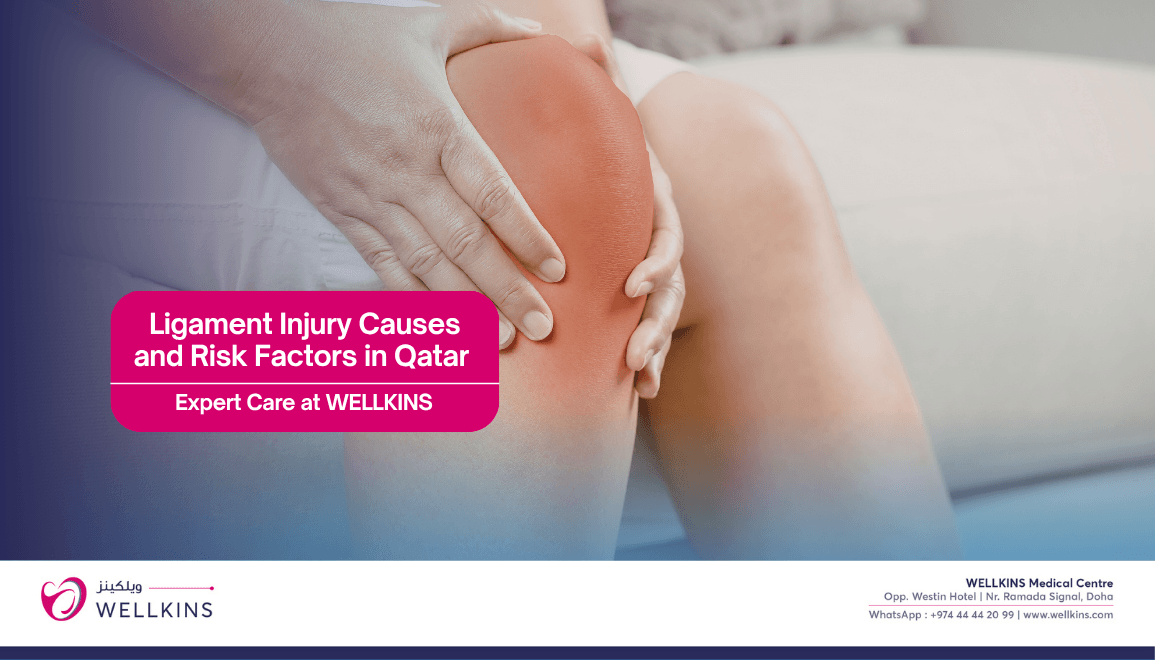
Ligaments are strong bands of connective tissue that connect bone to bone and provide the passive stability that keeps joints functioning within their normal range of motion. When force applied to a joint exceeds what the ligament can withstand, the fibers stretch beyond their elastic limit, partially tear or rupture completely.
Ligament injuries typically occur due to excessive force applied to a joint. Common causes include the following.
- Sports Injuries: Football, basketball, cricket, padel, tennis and skiing are among the most common sporting contexts for ligament injuries. The combination of high speed, sudden direction changes, physical contact and technically demanding movement patterns creates consistent exposure to the forces that exceed ligament tolerance. In Qatar, football and padel are particularly significant given their widespread participation across all age groups and the intensity at which they are played.
- Sudden Twisting or Pivoting Movements: The rotational force generated when the foot is planted and the body changes direction suddenly is the primary mechanism behind the majority of knee and ankle ligament tears. This mechanism is particularly common in field sports and racket sports.
- Direct Trauma or Impact: A direct blow to a joint, whether from a tackle in football, a fall from height or a road traffic accident, can apply forces to ligaments that exceed their structural tolerance regardless of whether the surrounding musculature is well conditioned.
- Falls and Accidents: Domestic falls, workplace accidents and road traffic injuries are significant causes of ligament injury outside the sporting context, particularly affecting the ankle and knee in the general adult population.
- Improper Landing Techniques: Landing from a jump with the knee in valgus, the knee caving inward, is one of the most consistently identified biomechanical risk factors for ACL injury. Training to correct this landing pattern is a cornerstone of ACL injury prevention programmes.
- Weak Musculature or Poor Conditioning: Strong muscles around a joint share the mechanical load that would otherwise fall entirely on the passive stabilizers including the ligaments. Weakness of the quadriceps, hamstrings, hip abductors and calf muscles significantly increases ligament injury risk during demanding activity.
The knee, specifically the ACL, PCL and MCL, the ankle, specifically the ATFL and the lateral ligament complex, and the wrist ligaments are the most frequently affected structures in the clinical population at Wellkins.
Symptoms to Watch For
The clinical presentation of a ligament injury varies depending on the severity of the damage, the specific ligament involved and the time elapsed since the injury. Recognizing the pattern of symptoms helps determine the urgency of assessment.
- Sudden Onset of Pain Following Injury: Pain that begins immediately at the moment of the injuring event rather than developing gradually over hours is characteristic of a ligament disruption. The intensity of pain does not reliably predict the severity of the tear.
- Swelling Around the Joint: Joint swelling that develops within the first few hours of injury suggests significant tissue disruption including possible bleeding within the joint. Swelling that develops more slowly over twenty-four to forty-eight hours may reflect a less severe injury with more gradual inflammatory response.
- Bruising: Ecchymosis developing in the hours and days following injury reflects bleeding from the damaged tissue migrating toward the skin surface. The distribution of bruising can provide useful clinical information about the location and extent of the ligament disruption.
- Instability or Giving Way Sensation: A feeling that the joint cannot be trusted to hold during weight bearing or activity is one of the most diagnostically significant symptoms of significant ligament disruption and warrants urgent clinical assessment regardless of other symptom severity.
- Restricted Range of Motion: Inability to move the joint through its normal range due to pain, swelling or mechanical disruption reflects the severity of the injury and its impact on joint function.
- Difficulty Bearing Weight: Particularly relevant for lower limb injuries. Inability to bear weight immediately after an ankle or knee injury significantly increases the clinical suspicion for a complete ligament tear or an associated fracture.
- A Popping Sound at the Time of Injury: Reported by a significant proportion of patients with complete ACL tears and other major ligament disruptions. The pop represents the mechanical failure of the ligament fibers and is a clinically important historical detail in any assessment of joint injury.
How Are Ligament Injuries Diagnosed?
Accurate diagnosis is the essential foundation of effective ligament injury management. At Wellkins, Dr. Reneesh uses a structured assessment process that combines detailed clinical examination with targeted imaging.
1. Clinical Examination
- Joint Stability Tests: Specific provocative tests assess the integrity of individual ligaments by applying controlled stress to the joint and evaluating the quality and quantity of movement produced. The Lachman test and anterior drawer test assess ACL integrity. The valgus and varus stress tests assess the MCL and LCL respectively. The anterior drawer and talar tilt tests assess the lateral ankle ligament complex. A positive test finding, particularly when it reproduces the patient’s instability symptoms, is clinically highly significant.
- Assessment of Swelling, Tenderness and Range of Motion: Systematic palpation identifies the specific anatomical structures that are tender, distinguishing ligament injury from associated bone, tendon or cartilage pathology. Range of motion assessment quantifies the functional limitation and guides the urgency and nature of the imaging requested.
- Neurovascular Assessment: In severe injuries, particularly those involving significant trauma, assessment of the circulation and nerve function distal to the injury site ensures that vascular or neurological complications are identified promptly.
2. Imaging Studies
- X-Rays: Plain radiographs are the first-line investigation for any significant joint injury to rule out associated fractures. Avulsion fractures, where the ligament pulls a fragment of bone from its attachment site rather than tearing through its midsubstance, are a specific finding that changes management significantly.
- MRI: Magnetic resonance imaging is the gold standard for ligament injury diagnosis. It provides detailed visualization of the ligament structure, the grade of disruption, the zone of injury within the ligament and any associated intra-articular pathology including meniscal tears and cartilage damage that frequently accompany significant ligament injuries.
- Ultrasound: Useful in selected cases particularly for superficial ligaments where dynamic assessment during movement provides additional clinical information. Ultrasound is operator-dependent and most valuable when MRI is not immediately available or when dynamic imaging adds specific diagnostic value.
- CT Scan: Occasionally used for complex injuries particularly where bony anatomy requires detailed three-dimensional assessment for surgical planning or where fracture characterization is the primary investigation need.
Treatment Options
Treatment depends on the severity of the injury graded from Grade I to Grade III, the specific ligament and joint involved and the patient’s activity level and functional demands. No single treatment protocol applies to all ligament injuries and individualized assessment is the only appropriate starting point.
1. Conservative Management
Conservative management is appropriate for Grade I and Grade II injuries and for selected Grade III injuries in lower-demand patients or in ligaments with documented capacity for non-operative healing.
- RICE Protocol: Rest, ice, compression and elevation form the immediate management of an acute ligament injury. Reducing swelling and pain in the acute phase creates a better environment for healing and allows earlier engagement with rehabilitation.
- Immobilization: A brace or splint provides external stability to the injured joint during the initial healing phase, protecting the ligament from further stress while early repair processes are underway. The duration of immobilization is determined by the grade of injury and the specific ligament involved.
- Anti-Inflammatory Medications: Non-steroidal anti-inflammatory drugs reduce pain and swelling in the acute and subacute phases and support the patient’s ability to engage with early rehabilitation exercises. They are most appropriate in the initial weeks of management rather than as a long-term strategy.
- Physiotherapy: Structured rehabilitation addressing range of motion recovery, progressive strengthening of the muscles surrounding the injured joint and proprioceptive training to restore the joint’s position sense and neuromuscular control is the cornerstone of conservative ligament injury management. Proprioceptive training is particularly important because ligament injury disrupts the sensory nerve endings within the ligament that contribute to joint stability and this deficit must be specifically rehabilitated.
2. Surgical Management
Surgical management is indicated in specific and well-defined clinical circumstances.
- Complete Tears (Grade III): Not all Grade III tears require surgery but complete disruption of a ligament that is critical to joint stability in an active individual generally does. The ACL is the most common ligament for which surgery is recommended in the context of a complete tear in a physically active patient.
- High-Demand Athletes: Athletes who participate at a level that demands full joint stability for return to sport are more likely to require surgical reconstruction than recreational or sedentary individuals with the same injury.
- Persistent Instability Despite Rehabilitation: When a structured and complete course of conservative management fails to restore adequate functional stability, surgical assessment is appropriate regardless of the initial grade of injury.
- Ligament Repair: Direct surgical repair is appropriate for specific ligament tears, particularly those with good tissue quality and a recent injury pattern that allows the torn ends to be brought together and secured.
- Ligament Reconstruction: For ligaments that cannot be directly repaired, reconstruction using a graft taken from another tissue in the body or from a donor source recreates the ligament’s mechanical function. ACL reconstruction is the most commonly performed ligament reconstruction procedure and involves replacing the torn ligament with a tendon graft, typically from the patient’s own patellar tendon or hamstring.
Possible Complications
Ligament injuries that are not treated appropriately carry a meaningful risk of progression to more significant and difficult-to-address conditions.
- Chronic Joint Instability: An incompletely healed or untreated ligament tear leaves the joint without adequate passive stabilization, producing episodes of giving way that impair function and quality of life and that increase the risk of further injury with each episode.
- Recurrent Injuries: A joint that has sustained one ligament injury is at significantly elevated risk of subsequent injuries to the same or adjacent structures if the original injury is not properly managed and the contributing biomechanical factors are not addressed.
- Early Osteoarthritis: Chronic instability following ligament disruption alters the mechanical loading of the joint’s articular surfaces, accelerating cartilage wear and increasing the risk of early-onset osteoarthritis. This is particularly well documented following ACL injury and is one of the strongest arguments for appropriate surgical and rehabilitative management in active patients.
- Persistent Pain and Stiffness: Inadequate rehabilitation following ligament injury allows the joint to develop scar tissue, lose range of motion and maintain a chronic pain pattern that is significantly harder to address once established.
- Reduced Functional Capacity: Long-term reduction in the ability to perform activities that were previously unrestricted, whether sporting activities, occupational demands or everyday movement, is a consistent consequence of poorly managed ligament injury that is entirely avoidable with appropriate care.
How to Prevent Ligament Injuries
While not all ligament injuries are preventable, a structured approach to injury prevention significantly reduces both the frequency and severity of ligament damage, particularly in active individuals in Qatar’s sports-focused environment.
- Regular Strength and Conditioning: Strengthening the muscles that surround the most injury-prone joints, particularly the quadriceps and hamstrings for the knee and the peroneals and calf muscles for the ankle, reduces the mechanical load transmitted to the ligaments during dynamic activity and improves the joint’s overall injury resilience.
- Proper Warm-Up and Stretching: An adequate warm-up that prepares the neuromuscular system for the specific demands of the activity being undertaken reduces the risk of the sudden uncoordinated movements that most commonly produce ligament injuries.
- Appropriate Sports Gear and Footwear: Footwear matched to the playing surface, appropriate ankle support for high-risk sports and protective bracing following a previous ligament injury all contribute meaningfully to injury prevention in Qatar’s active population.
- Training in Correct Techniques and Biomechanics: Neuromuscular training programmes that specifically address landing mechanics, cutting patterns and the movement quality that protects ligaments during sport have strong evidence supporting their effectiveness in reducing ACL and ankle ligament injury rates.
- Avoiding Overtraining and Ensuring Adequate Rest: Fatigue is a significant risk factor for ligament injury because tired muscles are less responsive and less protective of the joints they surround. Structured training loads with adequate recovery built into the programme reduce injury risk substantially compared to unmanaged high-volume training.
Prognosis and Recovery
The prognosis for ligament injuries is closely linked to the severity of the injury, the appropriateness of the management and the quality of the rehabilitation undertaken.
- Mild Sprains (Grade I): Recovery within two to four weeks with appropriate initial management and progressive return to activity. These injuries heal reliably with conservative care and do not typically leave lasting functional deficits.
- Moderate Injuries (Grade II): Recovery within four to eight weeks with structured physiotherapy and appropriate protection of the healing tissue. Some patients experience residual symptoms including mild stiffness or aching with activity for several months beyond the formal recovery period.
- Severe Tears (Grade III): Recovery of six to nine months when surgical reconstruction is required, encompassing the surgical procedure, the post-operative rehabilitation programme and the graduated return to full sporting activity. Conservative management of selected Grade III injuries may produce functional recovery within three to six months with a rigorous rehabilitation programme.
With proper treatment and guided physiotherapy, most patients regain near-normal function and return to their previous activity levels. The key factors that determine the quality of the final outcome are early and accurate diagnosis, appropriate treatment selection and consistent adherence to the rehabilitation programme throughout the recovery period.
When to Book an Orthopedic Consultation at Wellkins
Ligament injuries should never be underestimated and early consultation consistently produces better outcomes than delayed assessment. You should seek specialist review at Wellkins Medical Centre if:
- You experienced a popping sensation at the moment of injury followed by rapid swelling and difficulty bearing weight.
- Your joint feels unstable, gives way or cannot be trusted during normal activity following an injury.
- Pain and swelling from a joint injury have not settled meaningfully within forty-eight to seventy-two hours of the initial RICE management.
- You have been told you have a ligament sprain but have not had imaging to confirm the grade of injury.
- You have completed a course of conservative management but continue to experience instability or significant functional limitation.
- You are an active athlete who has sustained a knee or ankle injury and wants a clear assessment of what the injury means for your return to sport.
The joint you are trying to protect today is the one that determines how freely you move for the next decade. Do not leave a ligament injury to chance and do not accept persistent instability as simply something you have to manage around. The difference between a correctly and an incorrectly managed ligament injury is a difference that compounds over years.
To book an appointment at Wellkins Medical Centre: https://wellkins.com/drreneesh
To know more about Orthopedic department at WELLKINS Medical Centre: https://wellkins.com/orthopedics