
Author: Dr. Asha Anne Jacob, (Consultant Ophthalmologist – Wellkins Medical Centre)
If your child has been squinting at the TV, sitting too close to the tablet or coming home from school saying the whiteboard looks blurry, you are not alone. Children’s vision is one of the most common reasons parents visit us at Wellkins Medical Centre in Doha. The good news is that a children’s eye test is gentle, quick and genuinely interesting for them. The even better news is that catching a refractive error early can change how well a child reads, learns and plays.
In Qatar, where screen time is high, school hours are long and outdoor play is limited during the intense summer months, the conditions that drive childhood short-sightedness and other refractive errors are present in abundance. Understanding how children’s eye tests work, why we sometimes use a drop test and what to expect at each stage from age five right up to sixteen gives every parent in Doha the knowledge they need to act confidently and early.
A child’s eye is not just a smaller adult eye. It is still developing and it has an extremely strong focusing muscle that can hide the true prescription during a standard test. This means a child with significant long-sightedness can look through the test and appear to see almost normally, when in fact they are working their eyes enormously hard every single day. The drop test gives us the accurate picture we need to correct the prescription properly and protect a visual system that is still forming. I would rather explain this gently to a worried parent in the clinic than miss a correction that affects a child’s learning for years.
People Also Ask
At what age should a child have their first eye test?
A baseline comprehensive eye examination at around five years of age is recommended for all children even when there are no obvious symptoms. Young children rarely report blurred vision because they have no reference point for what clear vision feels like. They assume everyone sees the way they do. Earlier assessment is advised if there is a family history of eye problems, if a squint is noticed at any age or if there are specific concerns about the child’s vision or development before school age.
What is the drop test for children’s eyes?
The drop test, known clinically as cycloplegic refraction, uses medicated eye drops to temporarily relax the strong focusing muscle inside a child’s eye. This prevents the child from unconsciously compensating for their prescription during the test and allows us to measure the eye’s true refractive state accurately. The drops cause a brief mild sting for a second or two, enlarge the pupils and make the eyes sensitive to light for several hours. They are safe and routinely used in pediatric eye care worldwide. The accuracy they provide is essential for a developing visual system.
Can a child’s short-sightedness be slowed down?
Yes, in many cases. Myopia management is one of the most actively developing areas in eye care and several evidence-supported approaches can slow the rate at which short-sightedness progresses in children. These include daily time outdoors in natural light, specialized spectacle lenses designed to reduce myopia progression, low-dose atropine eye drops used at night under clinical supervision and specific contact lens designs for suitable older children. Not every child requires myopia management and the right approach depends on age, current prescription and lifestyle factors.
How often should children have eye tests?
Most children benefit from a comprehensive eye examination every one to two years. Children who already wear glasses or whose prescription is changing quickly benefit from more frequent reviews, typically every six to twelve months. Regular monitoring during the school years from five to sixteen is particularly important because this is the period when refractive errors most commonly develop and when myopia tends to progress most rapidly.
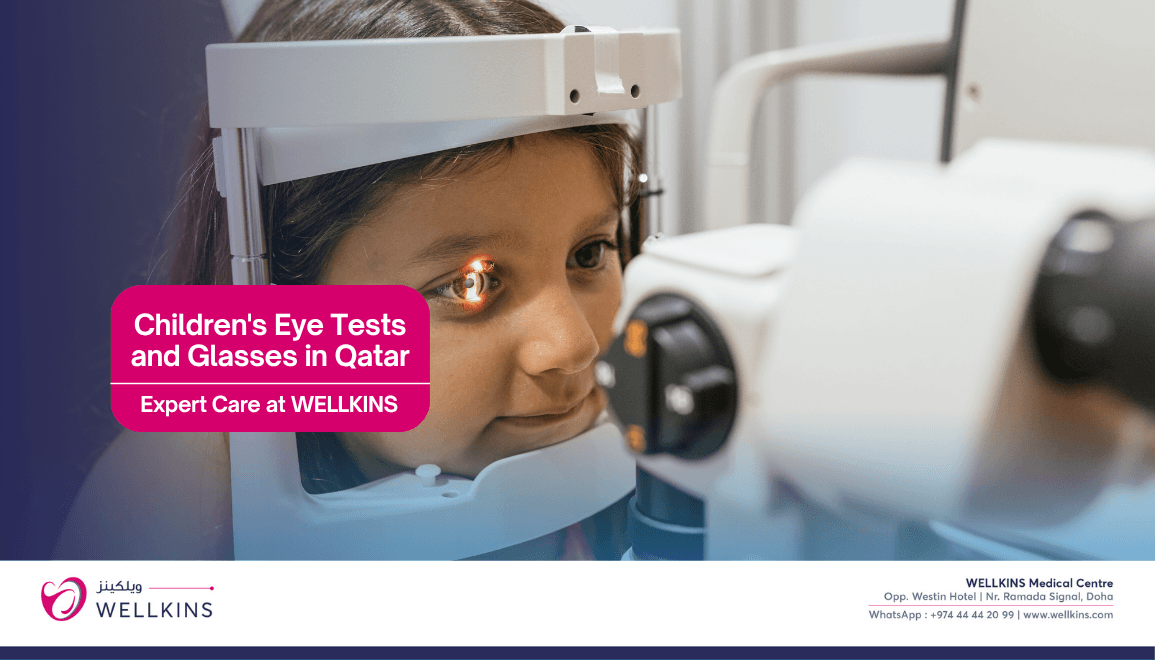
Why Are Children’s Eye Tests Different From Adults’?
Here is something many parents do not realize before their first visit to the pediatric ophthalmology clinic. A child’s eye is not simply a smaller version of an adult eye. It is still growing and the focusing muscle inside the eye, called the ciliary muscle, is extremely strong and very active throughout childhood and adolescence.
That focusing power is wonderful for everyday life. It allows children to switch rapidly between near and distance tasks and to maintain clear vision across a wide range without effort. But it creates a significant problem during an eye examination. A child can unconsciously force-focus through a real prescription and give us readings that appear almost normal even when a significant refractive error is present. This is especially common with long-sightedness, which is very prevalent in younger children. If we relied only on a standard test we could easily miss the true prescription or under-correct it with real consequences for the child’s visual development and learning.
The solution is to switch off that overactive focusing muscle temporarily during the test so the eye’s true optical state can be measured accurately. That is exactly what the drop test achieves.
What Is the Drop Test (Cycloplegic Refraction)?
Cycloplegic refraction, commonly called the drop test, uses medicated eye drops to relax the child’s focusing muscle so that the eye’s true prescription can be measured without any masking effect from the child’s own accommodation.
The concept is straightforward. Specialized drops are placed into each eye. They gently and temporarily relax the focusing muscle so it cannot compensate for the underlying prescription. Once the muscle is fully relaxed we measure the eyes again and obtain an accurate reading of how the eye actually focuses light without any active adjustment from the child.
Here is what parents typically want to know before the appointment.
- Does it hurt? No. There can be a very brief sting for a second or two when the drops first go in, similar to a small splash of water. Most children settle within moments and are comfortable throughout the remainder of the visit.
- How long does it take? The drops need approximately thirty to forty-five minutes to work fully. We typically complete the first part of the examination, instil the drops and then allow a short rest period before completing the final measurements. The total visit takes a little longer than a standard adult appointment but the time is well spent.
- Will my child look different? Yes and this is completely normal. The pupils become visibly larger and the eyes become more sensitive to bright light. Near vision will also be blurry for a period because the focusing muscle that handles near tasks has been temporarily relaxed.
- How long do the effects last? Depending on which drop is used, light sensitivity and blurry near vision can last from several hours to a day or two. We will tell you exactly what to expect for the specific drop used at your child’s appointment.
- What should I bring? Sunglasses or a cap with a brim help significantly with the light sensitivity on the journey home. It is also wise to plan a quiet afternoon rather than returning directly to homework or close screen work immediately after the visit.
The drop test is a routine, safe and well-established component of pediatric eye care worldwide. We use it because it gives your child the most accurate prescription possible and accuracy matters enormously for a visual system that is still developing and that will be shaped by the correction it receives during these formative years.
What Happens During a Children’s Eye Exam at Wellkins?
Every child is different so the examination is adapted to their age, attention span and comfort level. The team at Wellkins keeps the entire visit calm and unhurried because a relaxed child gives us the most reliable responses and leaves with a positive experience that makes the next visit easier.
The examination typically includes the following components.
- A Friendly History: We begin with a conversation about symptoms, school performance, screen habits and any family history of glasses, squint or eye conditions. This context shapes the entire assessment that follows.
- Vision Testing: Younger children use picture charts or simple matching games that do not require letter recognition. Older children progress to standard letter charts. The format is always chosen to match the child’s developmental stage so results are reliable.
- Eye Alignment and Movement Checks: We assess for squint and evaluate how well the two eyes work together as a team. Subtle squints that are not obvious to parents can be identified at this stage.
- Objective Measurement: A painless instrument shines a beam of light into the eye to estimate the prescription independently of the child’s responses. This gives us a starting point before the drop test refines the picture further.
- The Drop Test When Indicated: Applied as described above to obtain an accurate cycloplegic refraction in children whose focusing muscle might otherwise mask the true prescription.
- A Full Eye Health Check: We examine the front and back of the eye using appropriate instruments to confirm that all structures are developing normally and to identify any pathology that requires attention beyond the refractive prescription.
What Do the Numbers on My Child’s Prescription Mean?
When you receive the written prescription the numbers can appear confusing. Here is a plain language explanation of the three main optical conditions we commonly correct in children.
- Myopia (Short-Sightedness): Distance vision is blurry while near vision remains clear. This is the prescription that most commonly appears when a child cannot read the whiteboard from the back of the classroom. It tends to emerge and progress during the school years and is the primary target of myopia management strategies.
- Hyperopia (Long-Sightedness): The eye has to work harder than it should to focus, particularly on near tasks. Mild amounts of hyperopia are normal in younger children and are often outgrown as the eye develops. Larger amounts can cause tired eyes, headaches and in some cases a squint that develops because of the excessive focusing effort required.
- Astigmatism: The eye’s surface or the lens inside the eye is shaped slightly more like an oval than a perfect sphere, causing images to appear stretched or blurred at all distances. Glasses correct this comfortably and children generally adapt to astigmatism correction very quickly.
The specific numbers on your child’s prescription will always be explained in clinic so you understand exactly what is being corrected and why. No parent should leave an appointment with numbers they do not understand.
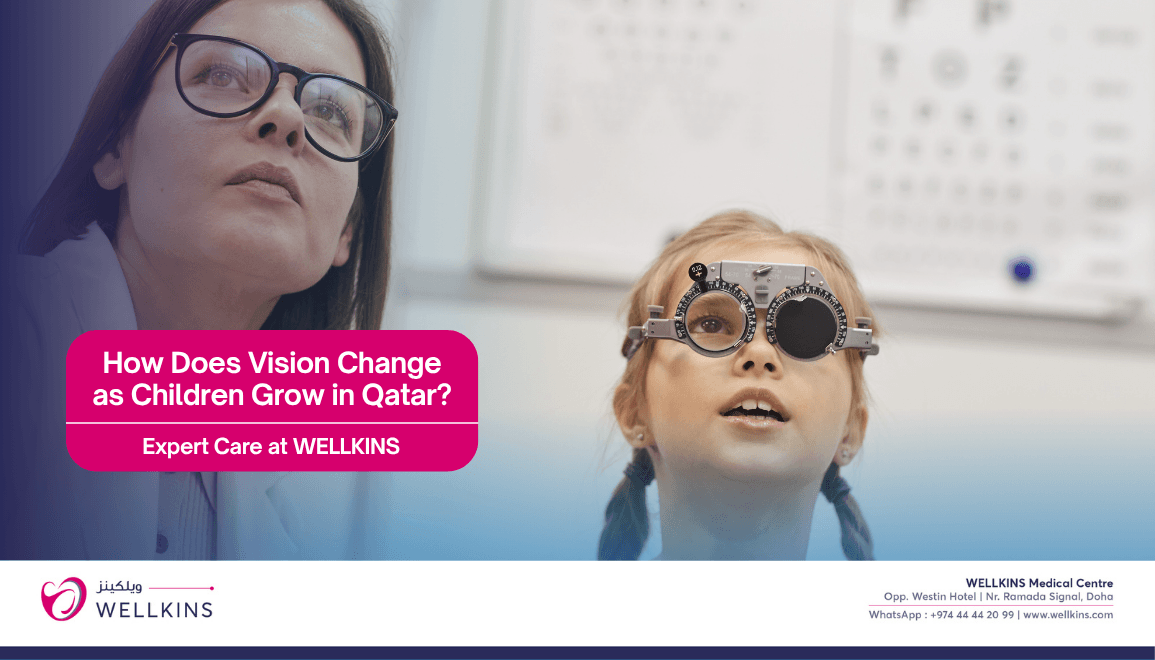
What to Expect at Each Age From Five to Sixteen
Children’s eyes change continuously as they grow and what we watch for during an examination shifts accordingly at each developmental stage.
Ages Five to Seven
This is the school entry period and the point at which clear vision suddenly matters every single day. Long-sightedness and squint are the most common concerns at this stage. Even a child who appears to see perfectly should have a baseline eye examination because young children almost never complain about blur. They have no comparison and simply assume that the way they see is how everyone sees. A squint that develops because of uncorrected long-sightedness can affect the development of vision in the affected eye if it is not identified and corrected promptly.
Ages Eight to Eleven
This is the window when short-sightedness most commonly appears and begins to progress. If your child is moving closer to screens, complaining that the board at school is difficult to read, rubbing their eyes frequently or starting to squint when looking into the distance, do not wait. This is the prime window for both accurate correction and for beginning myopia management if the progression rate warrants it.
Ages Twelve to Sixteen
Prescriptions can change quite quickly during the adolescent growth spurt as the eyeball continues to lengthen. Teenagers are also spending significantly more time on screens and studying under closer visual demands. They may be resistant to wearing glasses due to self-consciousness, which makes the frame selection process particularly worth investing time in. Regular reviews during this period keep the prescription accurate and ensure that learning and performance are not being limited by uncorrected or under-corrected vision.
A note on Qatar specifically: The Ministry of Public Health runs school vision screening in selected grades across Qatar, which plays a valuable role in identifying children who need further assessment. A school screening is an important filter but it is not a comprehensive clinical eye examination. If your child is referred following a screening or if you have any independent concern about their vision, a full clinical assessment is the appropriate next step rather than relying on the screening result alone.
Which Glasses Work Best for Children?
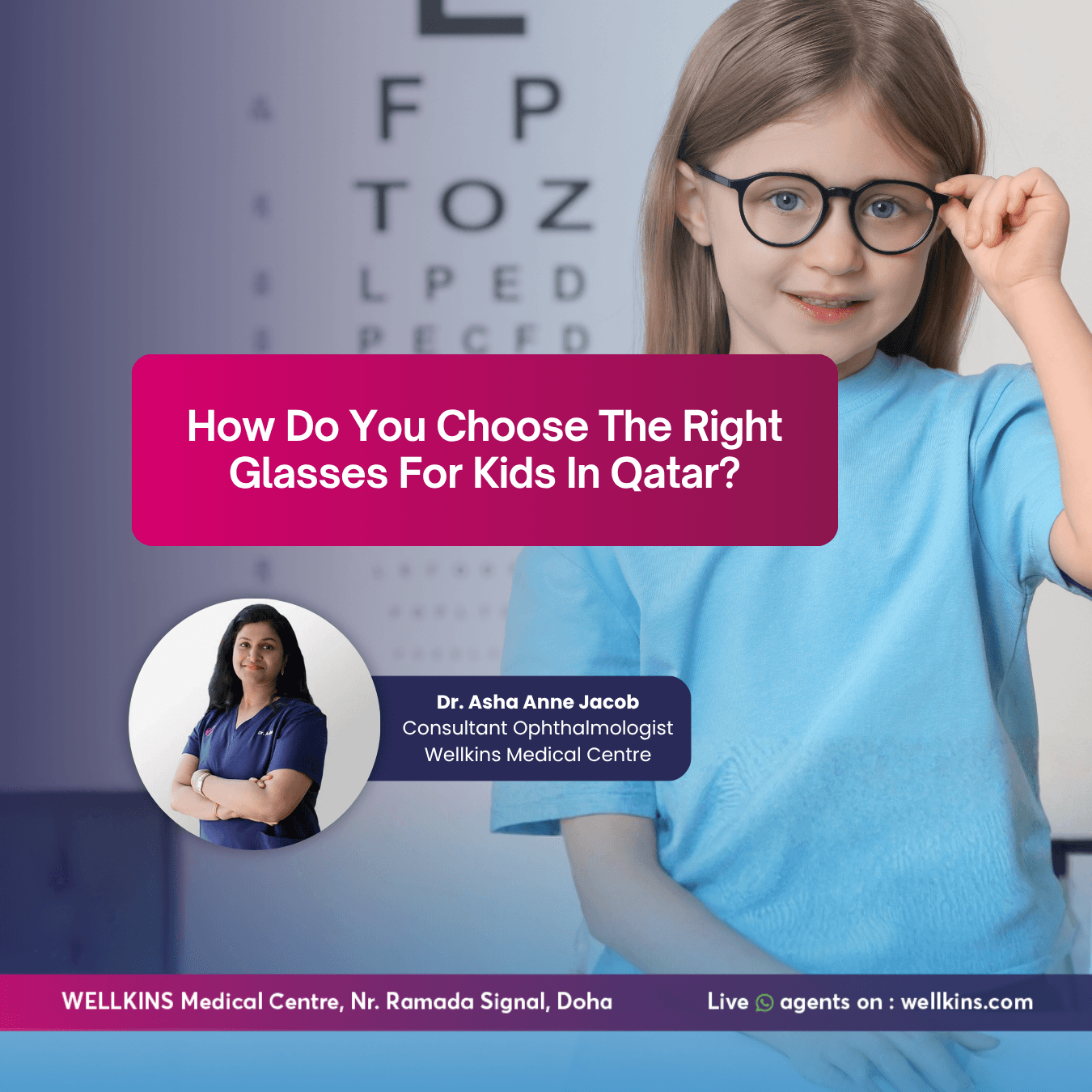
A prescription is only useful if a child actually wears the glasses. This makes the frame and lens selection as clinically important as the prescription itself.
- Lightweight Flexible Frames: Frames that flex and return to shape rather than snapping are far better suited to the daily demands of an active child. They survive the schoolbag, the playground and the moments of careless handling that are simply part of childhood.
- Impact-Resistant Lenses: Polycarbonate or Trivex lenses are significantly harder to break than standard lenses and provide a degree of safety protection that matters for children involved in sport and physical play.
- A Comfortable and Secure Fit: Glasses that slip down the nose or feel uncomfortable will not be worn consistently. The fitting process at Wellkins ensures that the frame sits correctly and that the optical centers of the lenses align with the child’s pupils.
- A Spare Pair: For children who depend on their glasses for daily vision a spare pair is a sensible practical investment. Children are children and glasses do get lost or damaged.
When glasses feel good and look good children wear them consistently. When they wear them consistently their visual system develops as it should and their performance at school reflects that.
Can My Child’s Short-Sightedness Be Slowed Down?
This is one of the most exciting and most clinically significant areas in modern eye care and it is particularly relevant for the five to sixteen age group in Qatar where short-sightedness rates are rising alongside increasing screen time and reduced outdoor activity.
We cannot cure short-sightedness once it has developed but for many children we can meaningfully slow the rate at which it progresses. This is called myopia management and the evidence supporting several specific approaches is now well established.
- More Time Outdoors: Daily exposure to natural outdoor light has a genuine and well-documented protective effect against myopia progression. The mechanism involves the broad spectrum of daylight and the greater viewing distances involved in outdoor activity. It is the single most accessible and most cost-effective myopia management strategy available and is relevant for every child in Qatar, particularly during the cooler months when extended outdoor time is practical.
- Specialized Spectacle Lenses: Certain lens designs, including defocus-incorporated multiple segment lenses and other myopia-control optical designs, have demonstrated significant reductions in myopia progression rates in clinical trials. These are worn in the same way as standard glasses.
- Low-Dose Atropine Eye Drops: Used at low concentrations applied at night under clinical supervision, these drops have a strong evidence base for slowing myopia progression in children. They are generally well tolerated at the low doses used for myopia management.
- Specialized Contact Lenses: Orthokeratology lenses worn overnight and certain soft contact lens designs worn during the day have demonstrated myopia control effects in appropriate older children and adolescents.
Not every child requires myopia management and the right approach depends on age, current prescription, rate of progression and lifestyle. If your child’s short-sightedness is increasing noticeably between appointments this is a conversation well worth having with us at your next visit.
Which Everyday Habits Protect Your Child’s Eyes?
Small consistent daily habits make a genuine and measurable difference to long-term visual health in children.
- Get Outside Daily: Meaningful time in natural daylight is the most accessible myopia prevention tool available. In Qatar’s cooler months from October to April this is entirely practical for most families.
- Use the 20-20-20 Rule: Every twenty minutes of near screen work, encourage your child to look at something approximately six meters away for twenty seconds. This brief break allows the focusing system to relax and reduces the sustained near visual demand that is associated with myopia progression.
- Keep Screens at a Sensible Distance: Reading and screen use at very close distances increases the demand on the focusing system. Encouraging children to hold devices at a comfortable arm’s length and avoiding screen use in dark environments both reduce visual strain.
- Watch for Warning Signs: Squinting when looking at distant objects, sitting closer to screens than usual, tilting the head, frequent eye rubbing, headaches after school or reading and losing their place while reading are all signals that deserve an eye examination rather than a watch-and-wait approach.
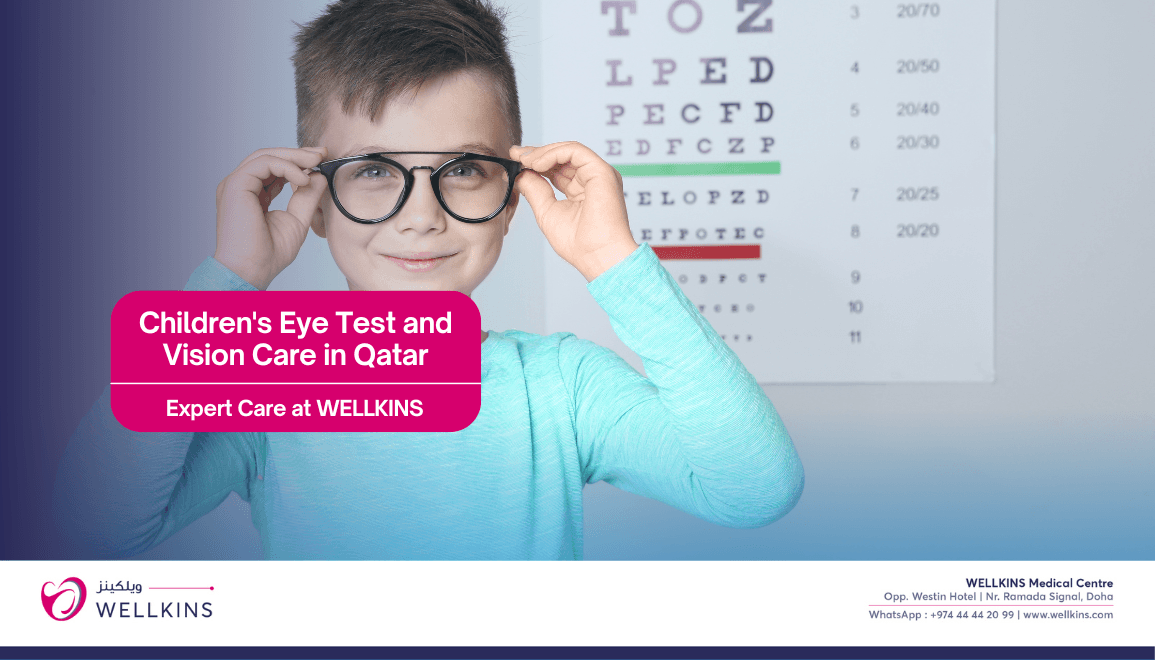
When Should You Book an Eye Test for Your Child?
Book a comprehensive eye examination at Wellkins Medical Centre if your child shows any of the following.
- Any of the warning signs described above including squinting, moving closer to screens or complaining about the whiteboard.
- Has been referred following a school vision screening in Qatar.
- Has a family history of short-sightedness, squint or other eye conditions.
- Has never had a full clinical eye examination, regardless of how well they appear to see.
- Wears glasses already and has not had a prescription review within the last year.
At Wellkins Medical Centre we make children’s eye care thorough, gentle and reassuring for the whole family. Early care protects a lifetime of clear sight and the visit is always easier than parents expect it to be.
To book an appointment with Dr. Asha Anne Jacob at Wellkins Medical Centre: https://wellkins.com/drasha
To know more about the Ophthalmology services at Wellkins Medical Centre: https://wellkins.com/ophthalmology