
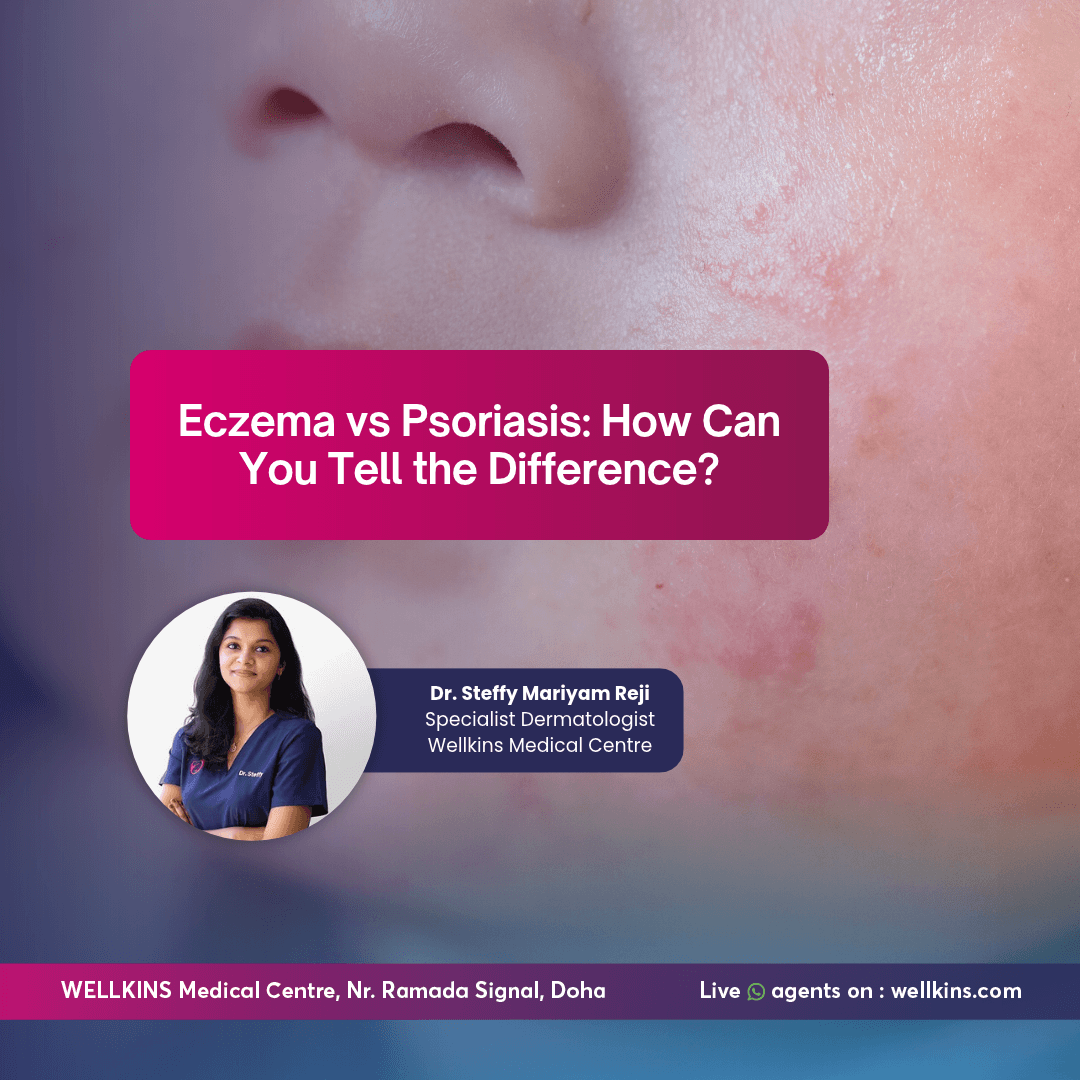
Author: Dr. Steffy Mariyam Reji, (Specialist Dermatologist – WELLKINS Medical Centre)
Introduction
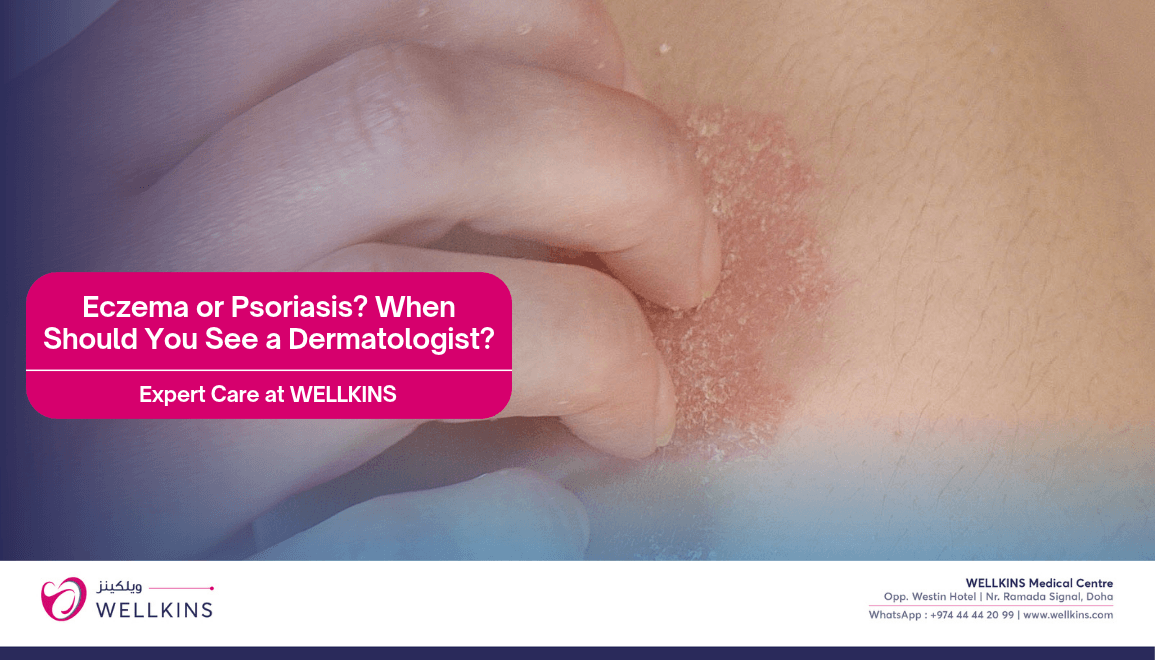
Eczema and psoriasis are chronic inflammatory skin conditions that can cause itching, dryness, redness, scaling and recurring flare ups. Because they share several visible features, it can be difficult to tell them apart without a dermatological examination.
The location of the rash, appearance of the borders, thickness of the scale, intensity of itching and changes affecting the nails or joints can provide useful clues. However, these clues do not replace an accurate diagnosis because eczema, psoriasis, fungal infections and contact dermatitis can sometimes look remarkably similar.
Correct diagnosis matters because the conditions have different causes, triggers and treatment pathways. A product that helps one rash may irritate another or temporarily change its appearance without addressing the underlying condition.
“Eczema and psoriasis can both produce dry, inflamed and itchy skin, but they behave differently. Eczema is often linked to an impaired skin barrier and tends to produce intense itching while psoriasis usually forms more clearly defined and thicker plaques. Location, scale, nail changes, family history and associated joint symptoms all help guide the diagnosis. When a rash keeps returning or does not improve with basic care, it should be examined rather than repeatedly treated through trial and error.”
People Also Ask
Which is itchier, eczema or psoriasis?
Eczema often causes more intense itching which can disturb sleep and lead to repeated scratching. Psoriasis can also itch, burn or feel painful, so symptom intensity alone cannot confirm the diagnosis.
Can eczema turn into psoriasis?
Eczema does not normally transform into psoriasis. They are different inflammatory skin conditions, although one person can have features of both or develop both conditions.
Is psoriasis contagious?
No. Psoriasis cannot be spread through touching, sharing towels, swimming or close contact. Eczema is also not contagious.
Can a fungal infection look like eczema or psoriasis?
Yes. Ringworm and other fungal infections can resemble eczema or psoriasis. Using an inappropriate steroid cream may change the rash and allow the fungal infection to spread, so persistent or unusual rashes should be assessed.
Should I see a dermatologist for eczema or psoriasis?
A dermatology consultation is appropriate when the diagnosis is unclear, the rash is widespread, symptoms disturb sleep or normal activities or treatment is not working. Nail changes, joint symptoms and signs of infection also require medical assessment.
What Is Eczema?
Eczema is a broad term describing several conditions that cause skin inflammation. Atopic dermatitis is one of the most common forms and is often what people mean when they use the word eczema.
Atopic eczema is associated with a weakened skin barrier. The skin loses moisture easily and becomes more vulnerable to irritation, allergens and infection.
Eczema can begin during infancy or childhood, but it may continue into adulthood or appear for the first time later in life. It often occurs in people with a personal or family history of asthma, allergic rhinitis or other allergic conditions.
The Dermatology Department at WELLKINS Medical Centre provides assessment and long term management for eczema, dermatitis and other inflammatory skin conditions.
What Does Eczema Look and Feel Like?
Eczema commonly produces dry and intensely itchy skin. Scratching can make the inflammation worse and may lead to cracked, bleeding or thickened areas.
Possible signs include:
- Dry or very sensitive skin
- Intense itching
- Red, brown, purple or grey areas depending on skin tone
- Small bumps or areas that ooze fluid
- Crusting after scratching or infection
- Cracks in the skin
- Thickened skin after repeated rubbing
- Lighter or darker marks after a flare settles
Eczema can look different across skin tones. Redness may be less obvious on darker skin while inflammation may appear purple, grey, deep brown or darker than the surrounding area.

Where Does Eczema Usually Appear?
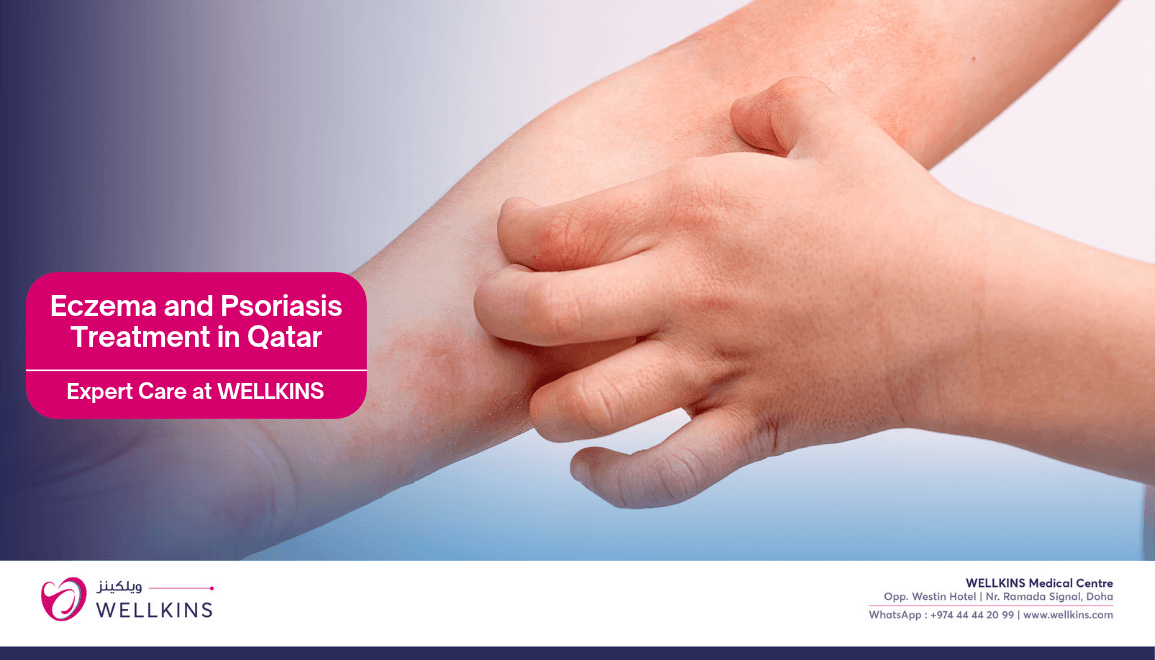
The location of eczema can change with age. Babies often develop it on the cheeks, scalp, forehead, arms or legs.
In older children and adults it commonly affects:
- The creases of the elbows
- The backs of the knees
- The hands and wrists
- The neck
- The ankles
- The eyelids or area around the eyes
- The face
Hand eczema is common among people who frequently wash their hands or work with cleaning products, chemicals or gloves. Irritant and allergic contact dermatitis can also affect the hands and may require a different management plan.
What Is Psoriasis?
Psoriasis is a chronic immune mediated condition that causes skin cells to build up more quickly than usual. This produces raised and well defined patches known as plaques.
The condition can begin at any age and often follows a pattern of flare ups followed by periods of improvement. It may run in families, although having a family member with psoriasis does not mean that someone will definitely develop it.
Psoriasis can affect more than the skin. Some people develop nail changes or inflammation in the joints known as psoriatic arthritis.
What Does Psoriasis Look and Feel Like?
Plaque psoriasis often forms clearly defined and raised patches covered by dry scale. The scale may look silvery white on lighter skin and may appear grey, purple or dark brown on deeper skin tones.
Possible signs include:
- Raised and thickened plaques
- Clear borders between affected and unaffected skin
- Dry or flaky scale
- Itching, burning or soreness
- Cracks that may bleed
- Scalp scaling that extends beyond the hairline
- Small pits or dents in the nails
- Thickened or lifting nails
- Joint pain, stiffness or swelling in some patients
Not every person develops classic thick plaques. Guttate, inverse, pustular and other forms of psoriasis can have different appearances.
Where Does Psoriasis Usually Appear?
Psoriasis commonly affects the outer or extensor surfaces of the body. Frequent locations include:
- The elbows
- The knees
- The scalp
- The lower back
- The area behind the ears
- The palms or soles
- The nails
- The buttocks
Inverse psoriasis occurs inside body folds such as the armpits, groin or under the breasts. It may look smooth and inflamed rather than thick and scaly because moisture and friction alter its appearance.
Eczema vs Psoriasis: Key Differences
The following comparison describes common patterns. Individual cases may not follow every feature and some rashes have overlapping characteristics.
| Feature | Eczema | Psoriasis |
|---|---|---|
| Typical appearance | Dry, inflamed, cracked or oozing skin with less sharply defined borders | Raised and well defined plaques with thicker scale |
| Itching | Often intense and may disturb sleep | Can itch, burn or feel painful but intensity varies |
| Common locations | Elbow creases, backs of knees, neck, hands and face | Elbows, knees, scalp, lower back and nails |
| Common age of onset | Frequently begins during infancy or childhood | Can begin at any age and often appears during adolescence or adulthood |
| Skin surface | May be dry, cracked, blistered, crusted or weeping | Often dry, raised and covered by a more noticeable scale |
| Nail involvement | Less characteristic but hand eczema can affect surrounding nail skin | Nail pitting, thickening, discoloration or lifting may occur |
| Joint symptoms | Not a typical feature | Joint pain, stiffness or swelling may suggest psoriatic arthritis |
| Associated conditions | May occur with asthma, allergic rhinitis or food allergy | May occur with psoriatic arthritis and certain metabolic or cardiovascular conditions |
The Location of the Rash Can Provide a Clue
Eczema often appears inside the elbow and knee creases while psoriasis more commonly affects the outer surfaces of the elbows and knees. This pattern is useful but not absolute.
Either condition can affect the scalp, hands, face, body folds or genital area. Inverse psoriasis in skin folds may be mistaken for eczema, irritation or a fungal infection because it may have little visible scale.
A dermatologist considers the complete distribution rather than examining only one patch.
The Type of Itching Can Be Different
Eczema is often described as an itch that produces a rash. The urge to scratch may be intense and scratching further damages the skin barrier which creates an itch and scratch cycle.
Psoriasis can also itch significantly. Some people describe burning, tightness, stinging or pain rather than itch alone.
The severity of itching does not reliably indicate how extensive the skin inflammation is. A small area of eczema may be extremely itchy while widespread psoriasis may produce less itching in another patient.
The Borders and Scale May Look Different
Psoriasis plaques often have clearer borders and thicker scale. Eczema may blend more gradually into the surrounding skin and may look cracked, crusted or moist during an active flare.
These differences can become less obvious after the patient has applied moisturizers, steroid creams or other treatments. Scratching and infection can also change the appearance.
Photographs taken before starting a product may help the dermatologist understand how the rash originally appeared.
Nail Changes Can Point Toward Psoriasis
Psoriasis can affect the fingernails and toenails. Possible changes include small pits, discoloration, thickening, crumbling or separation of the nail from the nail bed.
Nail fungus can produce similar changes. Testing may be required before oral or long term treatment is considered.
Nail psoriasis can also be associated with psoriatic arthritis. Patients should mention any morning stiffness, swollen fingers or toes, heel pain or persistent joint symptoms.
Can You Have Both Eczema and Psoriasis?
Yes. Although eczema and psoriasis are different conditions, one person can have both. Some rashes also display overlapping features and may be described as psoriasiform dermatitis or another mixed inflammatory pattern.
A diagnosis may become clearer over time as the rash changes or responds to treatment. In uncertain cases a skin biopsy or other investigation may occasionally be considered.
Patients should not combine multiple creams in an attempt to treat every possible diagnosis. This can irritate the skin and make clinical assessment more difficult.
Can Eczema Turn Into Psoriasis?
Eczema does not normally change into psoriasis. They involve different inflammatory pathways and have different patterns of skin involvement.
A person originally diagnosed with eczema may later be found to have psoriasis if the early rash did not have typical features. Another possibility is that the person has developed both conditions.
A changing rash should be reassessed rather than assumed to represent the same condition becoming more severe.
Conditions That Can Resemble Eczema or Psoriasis
Several skin conditions can produce itchy, red or scaly patches. These include:
- Fungal skin infections
- Contact dermatitis
- Seborrhoeic dermatitis
- Scabies
- Pityriasis rosea
- Drug related skin eruptions
- Lichen planus
- Cutaneous lupus
- Other inflammatory skin disorders
Fungal infections are particularly important because they may worsen when treated with an inappropriate steroid cream. Patients can read the WELLKINS guide to fungal skin infection treatment in Qatar to understand why accurate diagnosis matters.
How Qatar’s Climate Can Affect Eczema and Psoriasis
Qatar’s climate does not directly cause eczema or psoriasis, but environmental conditions can influence symptoms. Heat, perspiration, dust, frequent showering and movement between outdoor humidity and cooled indoor air may affect the skin barrier.
Strong air conditioning can contribute to dryness while heat and sweating may increase itching and irritation. Swimming pool chlorine, fragranced products and repeated washing may also trigger symptoms in susceptible skin.
Patients should identify their own pattern rather than assuming every flare has the same cause. A trigger diary can help record changes in weather, products, clothing, stress, illness and treatment use.
Common Eczema Triggers
Eczema triggers vary between individuals. Possible triggers include:
- Soaps and strongly fragranced body products
- Detergents and cleaning products
- Hot showers
- Dry air
- Heat and perspiration
- Rough or irritating fabrics
- Dust and environmental allergens
- Skin infection
- Stress
- Contact allergens
Food should not automatically be removed from a child’s or adult’s diet because of eczema. Unnecessary restriction can cause nutritional problems and does not help when food is not a relevant trigger.
Common Psoriasis Triggers
Psoriasis flare ups may be associated with:
- Skin injury, scratching or sunburn
- Stress
- Certain infections
- Smoking
- Excessive alcohol intake
- Some medications
- Changes in climate
- Stopping certain treatments suddenly
A medication should not be discontinued without advice from the prescribing doctor. The dermatologist can review whether the timing of a flare could be connected with a new treatment.
Are Eczema and Psoriasis Contagious?
No. Neither eczema nor psoriasis is contagious. They cannot be passed through touching, hugging, swimming, sharing a room or sitting beside someone.
However, an area of eczema can develop a secondary bacterial or viral infection. A fungal rash that resembles eczema or psoriasis may also be contagious depending on the organism.
Assessment is important when a rash spreads quickly or develops crusting, pus, pain or other signs of infection.
How Does a Dermatologist Diagnose the Difference?
Diagnosis usually begins with a detailed medical history and skin examination. The dermatologist may ask about when the rash began, where it first appeared, how much it itches and which treatments have been tried.
The examination may include the scalp, nails, skin folds and other areas even when the patient has noticed only one main patch. The pattern across the body can provide valuable diagnostic information.
The dermatologist may also ask about:
- A personal or family history of eczema or psoriasis
- Asthma or allergic rhinitis
- Possible irritants or workplace exposure
- Recent infections
- New medicines
- Joint pain or morning stiffness
- Previous fungal infections
- The effect on sleep and daily activities
Will You Need a Skin Test or Biopsy?
Most cases can be diagnosed through history and examination. Additional testing may be considered when the appearance is unusual or the rash does not respond as expected.
Possible investigations include:
- Skin scraping to check for fungal infection
- A swab when bacterial or viral infection is suspected
- Patch testing for possible contact allergy
- A small skin biopsy when the diagnosis remains uncertain
- Blood tests when another condition or treatment requirement is being assessed
Tests are selected according to the clinical concern rather than performed routinely for every rash.
How Is Eczema Treated?
Eczema treatment focuses on repairing the skin barrier, controlling inflammation, reducing itching and preventing infection. The plan depends on age, location and severity.
Management may include:
- Regular use of suitable moisturizers
- Soap substitutes or gentle cleansers
- Identification and reduction of relevant irritants
- Prescription anti inflammatory creams or ointments
- Treatment of secondary infection when present
- Additional medicines or advanced therapy for more severe eczema
The strength and duration of prescription creams should be guided by a doctor. Treatment suitable for thicker skin on the body may not be appropriate for the face, eyelids or genital area.
How Is Psoriasis Treated?
Psoriasis treatment depends on the type of psoriasis, affected body area, severity and impact on quality of life. Nail and joint involvement may also influence the plan.
Management may include:
- Moisturizers to reduce dryness and scaling
- Prescription topical treatments
- Scalp solutions or medicated preparations
- Phototherapy in selected patients
- Oral or injectable medicines for moderate to severe disease
- Assessment for psoriatic arthritis
- Support for associated health risks when relevant
Psoriasis is a long term condition. Treatment aims to control inflammation, reduce plaques and maintain improvement rather than provide an instant permanent cure.
Why You Should Avoid Self Diagnosis
Photographs online can show common examples, but real skin conditions do not always look identical. Lighting, skin tone, treatment use and scratching can alter the appearance.
Using an antifungal product on eczema may irritate the skin while using a steroid on an undiagnosed fungal infection may allow it to spread. Strong treatment used on sensitive areas can also cause avoidable side effects.
A dermatologist can determine whether the rash is inflammatory, infectious, allergic or related to another condition before recommending treatment.
Daily Skin Care While Waiting for Assessment
Gentle skin care may reduce irritation while waiting for a routine dermatology appointment. Patients can consider:
- Using lukewarm rather than very hot water
- Keeping showers brief
- Avoiding harsh scrubs and strongly fragranced products
- Applying a simple moisturizer suitable for sensitive skin
- Wearing soft and breathable clothing
- Avoiding scratching where possible
- Keeping fingernails short
- Not sharing medicated creams with another person
- Recording products or situations that seem to trigger symptoms
Do not apply a new prescription product that was provided for another person or for a previous unrelated rash.
When Should You See a Dermatologist?
Arrange a dermatology consultation when:
- The diagnosis is unclear
- The rash keeps returning
- Symptoms disturb sleep, work or daily activities
- The rash is spreading or becoming thicker
- Over the counter products have not helped
- The face, eyelids, genitals, palms or soles are affected
- There are changes in the fingernails or toenails
- There is joint pain, stiffness or swelling
- The rash is affecting confidence or emotional wellbeing
- A child has a persistent or widespread rash
The Dermatology Department at WELLKINS Medical Centre provides diagnosis and personalized treatment for eczema, psoriasis, dermatitis, fungal infections and other skin conditions.
When Does a Skin Rash Need Urgent Care?
Seek prompt medical attention if a rash occurs with:
- Fever or a person who appears seriously unwell
- Rapid spreading across a large area of the body
- Widespread redness with peeling skin
- Numerous pus filled blisters
- Severe pain
- Swelling of the face or difficulty breathing
- Painful blisters near the eyes
- Increasing warmth, swelling, pus or crusting
- Red streaks extending from the affected area
- A rapidly worsening rash in someone with reduced immunity
Widespread pustular psoriasis and erythrodermic psoriasis can be medical emergencies. Severe infection involving eczematous skin may also require urgent treatment.
Conclusion
Eczema and psoriasis can both cause dry, itchy and inflamed skin, but they usually follow different patterns. Eczema often produces intense itching and commonly affects skin creases while psoriasis more often causes well defined plaques on the elbows, knees, scalp or lower back.
Nail changes and joint symptoms can point toward psoriasis. Oozing, crusting and an association with allergic conditions may be more suggestive of eczema, although these features are not absolute.
Because fungal infections, contact dermatitis and other conditions can look similar, a persistent rash should be examined before repeated self treatment.
Dr. Steffy Mariyam Reji, (Specialist Dermatologist – WELLKINS Medical Centre) provides diagnosis and treatment for eczema, psoriasis and other inflammatory or infectious skin conditions.
To book an appointment with Dr. Steffy Mariyam Reji at Wellkins Medical Centre: https://wellkins.com/drsteffy
To know more about the dermatology services at Wellkins Medical Centre: https://wellkins.com/dermatology
This article is intended for general education and does not replace an individual dermatology consultation. Skin conditions that look similar may require different treatments, so persistent or worsening symptoms should be professionally assessed.