

Author: Dr. Reneesh, (Consultant Orthopedic Surgeon – WELLKINS Medical Centre)
Many athletes come to an orthopedic consultation with the same frustrating story. Their heel, knee, elbow or shoulder has been painful for weeks or months. They rested for a few days, felt better, returned to training and found that the pain came straight back.
This pattern is common among runners, football players, padel enthusiasts, gym-goers and other active people in Qatar. Tendon pain often appears after a sudden increase in training, a return to sport after a break or repeated high-intensity sessions without enough time for the body to adapt.
Rest may calm symptoms temporarily, but complete rest alone rarely improves the tendon’s ability to tolerate sporting load. In many cases, the more effective approach is to reduce aggravating activity, identify contributing factors and rebuild tendon capacity through a carefully progressed rehabilitation programme.
“A tendon is not a muscle that needs to be switched off. It is a tissue that needs to be loaded wisely. The aim is not simply to wait until pain disappears, but to rebuild the tendon’s capacity so that it can tolerate the demands of training and sport again. Complete rest may temporarily reduce pain without preparing the tendon for future activity. A carefully progressed rehabilitation programme helps restore strength, confidence and tolerance to sporting load.”
People Also Ask
Should I stop exercising completely if I have tendon pain?
Not always. Complete rest may be necessary for certain acute injuries, but many tendinopathies respond better to temporary load modification followed by structured strengthening. An assessment can determine which activities are safe and which should be reduced.
How long does tendon pain take to improve?
Recovery time depends on the tendon involved, how long symptoms have been present and the physical demands of the person’s sport. Meaningful improvement commonly takes several weeks and longer-standing cases may require a few months of consistent rehabilitation.
Can I continue playing sport with tendinopathy?
Some athletes can continue modified training when pain remains within an agreed level and settles appropriately afterwards. Continuing full training through worsening pain or loss of function may increase the problem, so return-to-sport decisions should be individualised.
When does tendon pain need urgent medical assessment?
Sudden sharp pain with a pop or snap, visible deformity, rapid swelling or an immediate loss of strength may indicate a tear or rupture. Stop the activity and seek prompt medical assessment rather than trying to stretch or test the injured area.

What Is Going On Inside a Painful Tendon?

Tendons connect muscle to bone and transmit force every time we run, jump, throw or lift. When the load placed on a tendon repeatedly exceeds what it has adapted to tolerate, the tendon may become painful and its structure can change. It may thicken, become sensitive and lose some of its normal capacity to manage force.
For years this was commonly called tendonitis, which suggests that inflammation is the entire problem. In many persistent cases, the condition is better described as tendinopathy because it involves changes in tendon structure, pain sensitivity and load tolerance rather than simple inflammation alone.
This distinction affects treatment. Pain-relieving or anti-inflammatory medication may help selected patients for a short period, but medication does not rebuild the tendon’s capacity. Recovery usually depends on identifying the source of overload and gradually preparing the tendon to handle force again.
Understanding Tendon Load and Recovery
A painful tendon is not necessarily a permanently damaged tendon. Pain can reflect a combination of local tissue changes, sensitivity and a mismatch between current capacity and the demands of activity.
This is why rehabilitation is based on progression rather than a quick return to the previous training level. The tendon needs enough stimulus to adapt without being repeatedly overloaded.
Where It Commonly Strikes
- Achilles tendon: Pain around the heel and lower calf, commonly experienced by runners, football players and people who suddenly increase walking or court sports. Read more about Achilles tendinitis treatment in Qatar.
- Patellar tendon: Pain just below the kneecap, often associated with jumping sports such as basketball and volleyball.
- Rotator cuff: Shoulder pain that may affect swimmers, throwers, gym-goers and people performing repeated overhead work.
- Elbow tendons: Tennis elbow and golfer’s elbow can affect racquet-sport players, weightlifters and people who perform repetitive gripping or keyboard work.
- Hip and gluteal tendons: Pain on the outside of the hip that may be mistaken for a hip-joint problem.
Typical Warning Signs
Tendon pain often follows a recognisable pattern, although symptoms differ according to the tendon involved and the severity of the condition.
- Pain when activity begins: Symptoms may ease as the body warms up before returning during or after training.
- Morning stiffness: The tendon may feel stiff and sore after waking, particularly when the Achilles tendon is involved.
- Localised tenderness: Pain is often concentrated around a specific area that can be identified with one finger.
- Load-related pain: Symptoms are aggravated by a movement that places force through the affected tendon.
- Reduced performance: The athlete may notice less strength, speed or confidence during sport.
Sudden sharp pain accompanied by a pop or snap is different from a gradual tendinopathy pattern. An immediate loss of strength or inability to use the limb normally can indicate a partial tear or complete rupture and requires urgent assessment.
Why Tendons Flare Up
Most cases involve a mismatch between the load placed on the tendon and its current ability to tolerate that load. The trigger is not always one dramatic incident. It may be the accumulated effect of several changes.
- Sudden training increases: Adding too much distance, weight, speed or frequency before the tendon has adapted.
- Returning after a break: Resuming the previous training level after illness, travel or a period of inactivity.
- Changes in footwear or surface: New shoes, artificial turf or hard training surfaces may alter the forces passing through the body.
- Reduced muscle capacity: Weakness in surrounding muscles can leave the tendon managing more demand.
- Age and health factors: Tendon tolerance can change with age and may also be influenced by medical conditions or certain medicines.
- Limited recovery: Repeated hard sessions without adequate recovery may exceed the tendon’s ability to adapt.
Weekend athletes are particularly vulnerable. A tendon that receives little preparation during the working week and then faces a long football, running or padel session may be asked to manage far more load than it is ready for. Athletes returning after travel may also benefit from a gradual return to exercise.
How We Assess It
Assessment begins with a detailed history and physical examination. The clinician identifies the precise location of pain, movements that reproduce it, changes in training and any sudden loss of strength or function. The examination also considers nearby joints, muscle capacity, flexibility and movement patterns.
Imaging is not required for every case. It may be used when the diagnosis is uncertain, symptoms are not improving or a tear or another condition is suspected.
- Ultrasound: Can show tendon thickening, structural changes and some tears. Dynamic scanning can assess the tendon during movement.
- MRI: Provides detailed images of the tendon and surrounding structures, particularly in complex shoulder or hip presentations and when a tear is suspected.
- X-rays: Do not show the tendon clearly but can help identify bony causes such as arthritis, calcification or a prominent spur.
Scan findings must be interpreted alongside the athlete’s symptoms and examination. Tendon changes can appear on imaging in people who have no pain, so an abnormal scan does not automatically determine the treatment plan.
Orthopedic Assessment for Persistent Tendon Pain

An assessment should identify both the painful structure and the reason it became overloaded. This may involve training errors, weakness, movement mechanics, equipment or recovery habits.
The findings can then be used to create a rehabilitation plan with measurable stages. Progress is based on symptoms, strength and function rather than time alone.
Treatment: Load It, Don’t Lose It
Load management. The first step is to adjust activity so that the tendon is not repeatedly provoked. This does not always require complete rest. Training volume, intensity, speed, jumping or other aggravating elements may be temporarily reduced while tolerable activity is maintained.
Progressive strengthening. Structured tendon-loading exercise is the foundation of treatment for many tendinopathies. Depending on the tendon and stage of recovery, a programme may include isometric exercise, slow resistance work, eccentric loading and later sport-specific drills. A physiotherapist can tailor the programme and progress it according to symptoms and function.
Pain relief and supportive measures. Short-term pain relief, heel lifts, bracing, taping or footwear changes may make rehabilitation more comfortable for selected patients. These measures generally support rehabilitation rather than replace strengthening.
Shockwave therapy. Extracorporeal shockwave therapy may be considered for certain persistent tendinopathies when an appropriate exercise programme has not provided enough improvement. Suitability depends on the tendon, diagnosis and individual clinical circumstances.
Injections. Corticosteroid injections may provide short-term relief in some tendon-related conditions, but they are not suitable for every tendon and repeated use can carry risks. They require particular caution around load-bearing tendons. Platelet-rich plasma and other injection options have condition-specific and sometimes mixed evidence, so expected benefits, limitations and costs should be discussed before treatment.
Surgery. Most tendinopathies are managed without surgery. An operation may be considered for a significant tear or rupture and for persistent symptoms that have not improved after a well-delivered rehabilitation programme over an appropriate period.
What Happens If It Is Ignored?
Continuing to overload a painful tendon without addressing the cause may lead to persistent pain, reduced performance and declining tolerance for everyday activity. Some tendons can develop partial tearing, although chronic tendon pain does not mean that a rupture is inevitable.
Athletes may also change the way they run, jump or lift to protect the painful area. These compensations can place additional stress on nearby muscles and joints. Early assessment often allows training to be modified before the problem becomes more limiting.
Protecting Your Tendons
- Increase training gradually: Avoid sudden jumps in distance, intensity, frequency or weight.
- Build strength: Include progressive exercises for the muscles supporting commonly loaded tendons.
- Warm up properly: Prepare for the speed and movement demands of the planned activity.
- Review footwear and equipment: Replace worn footwear and choose equipment appropriate for the sport and surface.
- Plan recovery: Allow sufficient recovery between demanding sessions and avoid repeatedly training through worsening pain.
- Respond to early symptoms: Reduce excessive load and seek advice when pain persists or repeatedly returns.
There is no single perfect training rule for every athlete. Previous injuries, age, competition schedule, overall health and the demands of the sport all affect how quickly load should be progressed. Related injuries may also involve ligaments rather than tendons, so persistent joint instability or swelling requires the right diagnosis. Learn more about ligament injury diagnosis and treatment in Qatar.
Building a Safe Return to Sport
Returning to sport should be a progression rather than a single date. The tendon may need to tolerate strength work, faster movements, jumping, direction changes and full training before competition is resumed.
Some discomfort may be acceptable during rehabilitation, but pain that progressively increases or remains significantly worse afterwards may indicate that the current load is too high. The rehabilitation plan should be adjusted according to the tendon involved and the athlete’s response.
Final Thoughts
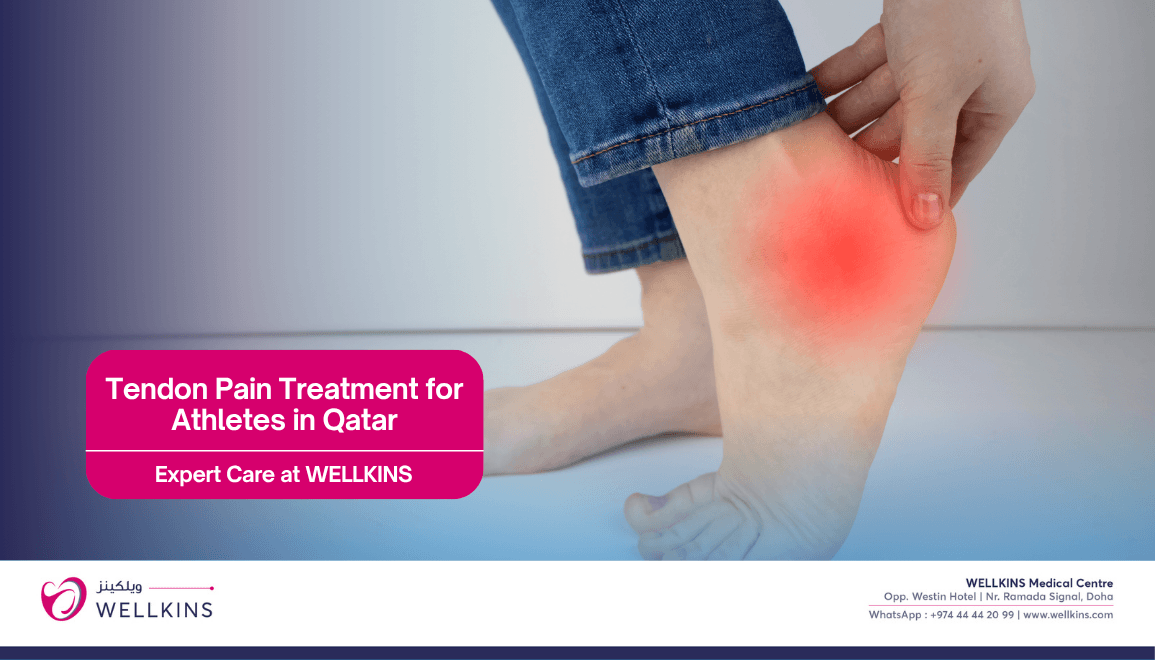
A painful tendon is often a signal that load and capacity are out of balance. It usually responds better to a structured plan than to repeated cycles of complete rest followed by an immediate return to full training.
If tendon pain has lasted more than a few weeks, repeatedly returns or is affecting sporting performance, an orthopedic assessment can help identify the cause and outline a clear rehabilitation pathway. Sudden pain with a pop, immediate weakness or loss of normal function should be assessed promptly.
To book an appointment with Dr. Reneesh at Wellkins Medical Centre: https://wellkins.com/drreneesh
To know more about the Orthopedic services at Wellkins Medical Centre: https://wellkins.com/orthopedics
This article is intended for general education and does not replace an individual medical assessment. Treatment and return-to-sport recommendations depend on the tendon involved, the severity of symptoms and the athlete’s overall health.