
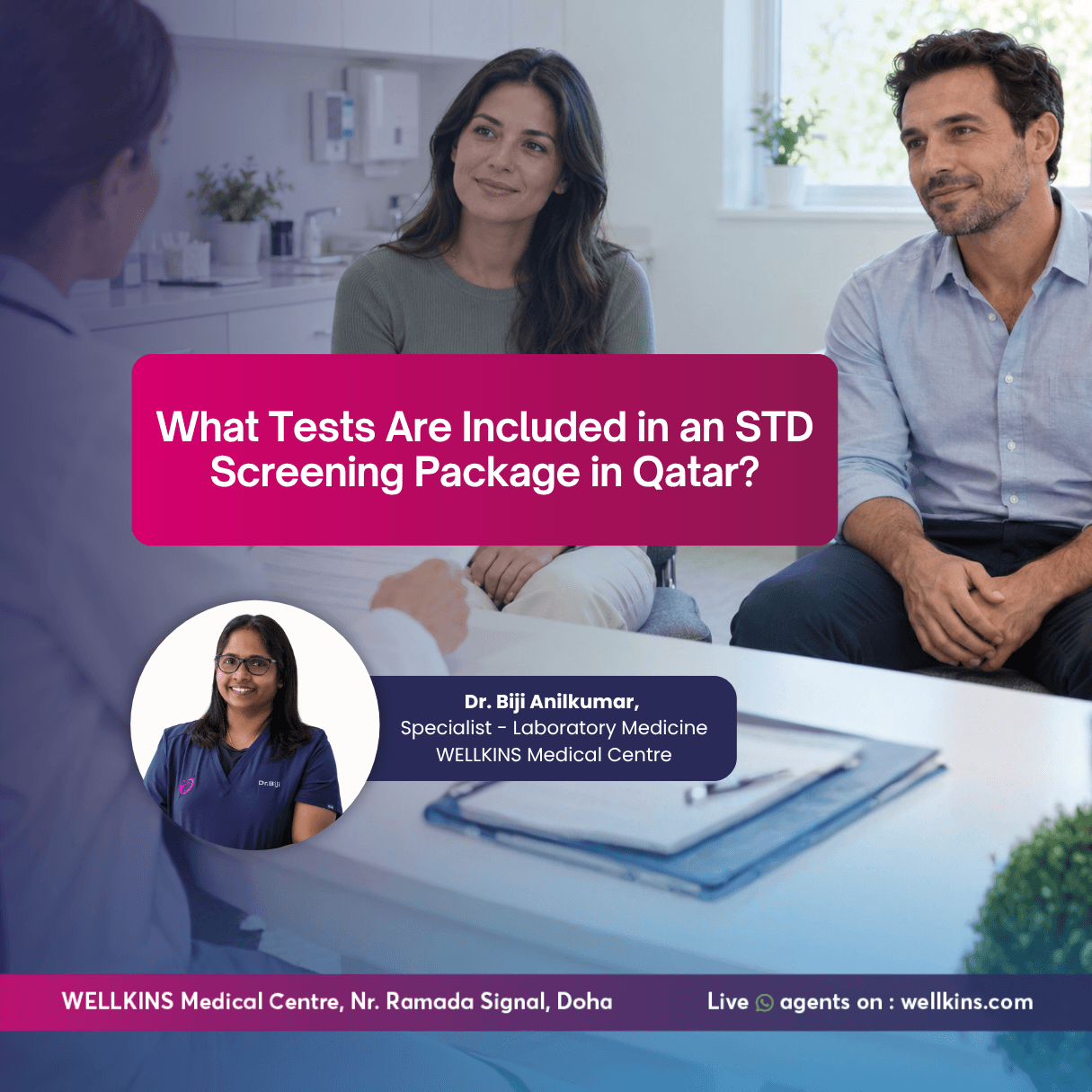
An STD screening package in Qatar may include a combination of blood tests and molecular tests for commonly screened sexually transmitted infections. The exact infections covered vary between packages, so it is important to check the test list rather than assuming that one panel screens for every possible infection.
The Basic STD Screening Panel currently listed by WELLKINS Medical Centre includes screening for HIV 1 & 2, hepatitis B, hepatitis C, syphilis, chlamydia, gonorrhoea and trichomonas. A confidential report review is also included to help patients understand the findings and whether further testing or medical care may be required.
Testing can be appropriate even when a person feels completely well because several sexually transmitted infections may not cause noticeable symptoms. Test selection should still consider the type of exposure, the time since exposure, symptoms, pregnancy status and whether oral or anal exposure occurred.
“An STD screening package can provide a convenient starting point, but the names of the tests are only one part of accurate screening. The timing of the sample and the type of exposure can affect what should be tested and how a result is interpreted. A negative result obtained too early may need to be repeated while symptoms or exposure involving the throat or rectum may require additional samples. Confidential report review helps connect the laboratory result with the individual patient’s history and appropriate next steps.”
People Also Ask
What tests are usually included in an STD screening package in Qatar?
A screening package may cover HIV, hepatitis B, hepatitis C, syphilis, chlamydia, gonorrhoea and trichomonas. Packages differ between healthcare providers, so patients should review the named tests before booking.
Can an STD screening package detect every STI in Doha?
No. A standard panel does not necessarily test for herpes, HPV, Mycoplasma genitalium or every other sexually transmitted infection. Symptoms and exposure history may indicate that additional testing is appropriate.
Can I have an STI without symptoms?
Yes. Chlamydia, gonorrhoea, HIV, hepatitis and syphilis may be present without obvious symptoms. Screening is therefore based on risk and exposure as well as symptoms.
When should I take an STD test after exposure?
The appropriate time depends on the infection and laboratory method. Testing immediately after exposure may be too early, so a clinician may recommend an initial test followed by repeat testing after the relevant window period.

What Is Included in the WELLKINS Basic STD Screening Panel?
The current WELLKINS health packages page lists the Basic STD Screening Panel with seven infection categories and a confidential report review. The estimated visit time is 20 to 30 minutes.
- HIV 1 & 2: Screening for the two main types of human immunodeficiency virus.
- HBsAg: Hepatitis B surface antigen testing used to help identify a current hepatitis B infection.
- HCV: Screening related to hepatitis C infection.
- RPR/VDRL: Blood screening tests used in the assessment of syphilis.
- Chlamydia: Molecular testing used to look for genetic material from Chlamydia trachomatis.
- Gonorrhoea: Molecular testing used to look for genetic material from Neisseria gonorrhoeae.
- Trichomonas: Testing for Trichomonas vaginalis, a sexually transmitted parasite.
- Confidential report review: Guidance on the meaning of the results and any recommended next steps.
The package is designed as a practical screening option rather than a universal test for every sexual-health concern. A healthcare professional may recommend different or additional tests based on the person’s history.
STD Screening Tests Available in Qatar
Different infections require different laboratory methods. Some are primarily assessed through blood while chlamydia, gonorrhoea and trichomonas are commonly investigated using urine or swab samples.
Understanding which test corresponds to each infection makes the package easier to evaluate. It also helps patients recognize why an additional sample may occasionally be needed.
HIV 1 & 2 Screening
HIV testing looks for evidence of infection with human immunodeficiency virus. Depending on the laboratory method, a test may detect antibodies alone or a combination of HIV antigen and antibodies.
No HIV test can detect infection immediately after exposure. This period before a test can reliably detect infection is called the window period. A negative result from an early test may need to be repeated according to clinical guidance.
Hepatitis B Surface Antigen (HBsAg)
HBsAg testing checks for hepatitis B surface antigen in the blood. A detected result can be associated with a current hepatitis B infection and usually requires clinical review with further tests to clarify the stage of infection.
This test does not by itself show whether a person is protected through vaccination. Tests for hepatitis B antibodies may be requested separately when the purpose is to assess immunity.
Hepatitis C Screening
Hepatitis C screening commonly begins with a blood test related to antibodies against the hepatitis C virus. A reactive screening result does not by itself confirm an active infection.
Further testing may be required to determine whether hepatitis C virus is currently present. Recent exposure may also require carefully timed follow-up because antibodies can take time to become detectable.
Syphilis Screening With RPR or VDRL
RPR and VDRL are blood tests used to screen for syphilis. A reactive screening result normally needs to be interpreted with a confirmatory treponemal test and the patient’s clinical history.
Syphilis can pass through stages and may be present without visible symptoms. Testing too soon after an exposure can miss early infection, so repeat testing may be advised when recent exposure remains a concern.
Blood Tests Used in STD Screening
Blood testing forms an important part of the WELLKINS Basic STD Screening Panel because HIV, hepatitis B, hepatitis C and syphilis are assessed through blood-based methods. The sample collection itself is usually brief.
The result must still be understood alongside the timing of possible exposure. A confidential review provides an opportunity to discuss whether the result is conclusive or whether repeat or confirmatory testing is needed.
Chlamydia Testing
Chlamydia frequently causes no noticeable symptoms. When symptoms occur they may include discomfort while urinating, genital discharge, pelvic discomfort or testicular pain.
A nucleic acid amplification test is commonly used because it can detect genetic material from the bacterium. Depending on anatomy and exposure, the test may use first-catch urine or a swab from the relevant site.
Gonorrhoea Testing
Gonorrhoea may also be present without symptoms. Possible symptoms include burning during urination, genital discharge, pelvic pain, bleeding between periods or testicular discomfort.
Molecular testing is commonly performed using urine or a swab. A urine-only approach may not assess infection in the throat or rectum, so the exposure site should be discussed confidentially before samples are collected.
Trichomonas Testing
Trichomoniasis is caused by the parasite Trichomonas vaginalis. Some people develop irritation, discharge or discomfort during urination while others have no symptoms.
Testing may use a suitable genital or urine sample depending on the patient and the laboratory method. A clinician can advise whether the included test is appropriate for the person’s anatomy and exposure history.
Which Samples Are Needed for STD Screening?
The package may require more than one type of sample because no single specimen is suitable for every infection. Blood is used for the listed HIV, hepatitis and syphilis screening while urine or a genital swab may be used for chlamydia, gonorrhoea and trichomonas.
Patients who have had oral or anal exposure should mention this during the confidential assessment. Throat or rectal swabs may be considered separately because an infection at one body site is not always detected by testing another site.
Confidential Sample Collection and Report Review
Confidentiality is an important part of sexual-health testing. Patients should provide accurate information about symptoms, possible exposure sites and timing so the most appropriate samples can be selected.
A report review is valuable because screening results are not always simply positive or negative. Reactive findings may require confirmation while an early negative result may need repeat testing.
What Is Not Automatically Included in a Basic STD Screening Package?
The current WELLKINS Basic STD Screening Panel does not list every infection that can be transmitted through sexual contact. Tests for genital herpes, HPV and Mycoplasma genitalium are not automatically part of the named panel.
Routine herpes blood screening is not suitable for everyone without symptoms. HPV testing also serves a different purpose and is commonly connected with cervical-screening pathways rather than being automatically included in a general STI panel.
Additional testing may be considered when a patient has sores, blisters, discharge, pelvic pain, urethral symptoms, a partner with a diagnosed infection or exposure involving the throat or rectum. The correct investigation should be chosen after clinical discussion rather than by adding tests without a clear reason.
When Should You Consider an STD Screening Package?
Screening may be worth discussing after unprotected sexual contact, when beginning a new relationship, after a partner reports an STI or when symptoms raise concern. It can also be relevant during pregnancy and as part of ongoing sexual healthcare for people with continuing exposure risks.
Seek prompt medical advice rather than waiting for routine screening if you develop genital sores, severe pelvic or testicular pain, fever, a new rash, unusual discharge or painful urination. Urgent assessment is also important after a recent potential HIV exposure because post-exposure prophylaxis is time-sensitive.
Patients can read more about STI testing without symptoms and what to do after a positive STI screening result in Qatar.
STD Screening Package Price at WELLKINS Medical Centre
The WELLKINS Basic STD Screening Panel is currently listed at QR 800. The listed price for eligible WELLKINS Protect members is QR 297.5. The estimated visit time is 20 to 30 minutes.
Health packages are listed as self-pay services. Prices, availability, eligibility and package inclusions may change, so patients should confirm the current details when booking.
Book Confidential STD Screening in Doha
The Medical Laboratory at WELLKINS Medical Centre provides confidential laboratory testing in Doha. Test selection and result interpretation can be supported by Dr. Biji Anilkumar, Specialist in Laboratory Medicine/Anatomical & Clinical Pathology.
View the current WELLKINS STD Screening Package or contact WELLKINS Medical Centre to confirm the package details and arrange testing.
This article is intended for general education and does not replace medical advice, diagnosis or treatment. The appropriate tests depend on symptoms, anatomy, exposure type and time since exposure. Seek immediate medical advice after a recent high-risk HIV exposure because preventive treatment must be started promptly.