

Author: Hafisa Hassankutty (Clinical Psychologist – WELLKINS Medical Centre)
Every child and every adult think, learns and solves problems in a unique and distinct way. Sometimes, parents and individuals find themselves grappling with difficult questions:
- “Why is my child struggling even with regular practice and tutoring? Is it effort, or ability?”
- “Is my child gifted or highly capable but not showing their full potential in the traditional school setting?”
- “Is this difficulty related to core intellectual ability, or something else like attention or anxiety?”
- “What is the right academic path, university major, or career direction that matches my natural strengths?”
An IQ test provides objective, data driven answers to these questions. It is not about labelling anyone it is fundamentally about understanding how an individual’s unique brain works so that learning strategies, school choices and career decisions become easier, more accurate and significantly less stressful.
At Wellkins Medical Centre, we specialize in complete cognitive assessments, utilizing the Stanford–Binet-5 (SB-5), a highly trusted, scientifically validated and research-based tool, to reliably evaluate a person’s cognitive abilities across the lifespan, from age 2 to 85+.
1. What Does IQ Actually Measure?
IQ, or Intelligence Quotient, is a score derived from standardized tests designed to reflect a person’s intellectual potential and abilities relative to their age group. It reflects how well a person can execute key intellectual functions, including:
- Understand and use information: The ability to grasp complex ideas and concepts.
- Reason through new situations: Solving novel problems without relying on prior learned knowledge (Fluid Reasoning).
- Remember and process details: The efficiency of short term memory and mental manipulation.
- Identify patterns and relationships quickly and accurately.
- Solve problems effectively using various intellectual tools.
- Apply logic and accumulated knowledge efficiently in daily life.
Understanding your or your child’s IQ profile helps identify a person’s inherent thinking strengths and precisely where additional support, accommodation, or intellectual challenge may be needed both within the educational environment and in the complex decision-making required in adulthood.
“It is essential that patients presenting with symptoms like academic underachievement, difficulties in executive functioning, social communication deficits, or suspected giftedness be evaluated using formal Intelligence Quotient (IQ) testing. This is a psychological assessment requiring standardized administration and interpretation by a qualified professional to effectively identify and characterize specific cognitive strengths and weaknesses.”
2. The Stanford–Binet-5 (SB-5): A Complete and Reliable IQ Test
The Stanford–Binet-5 (SB-5) is widely regarded as one of the most complete, gold-standard intelligence assessments available globally. Its power lies in its ability to break down global intelligence into core components, providing a highly nuanced picture.
It evaluates five major areas of thinking, ensuring a holistic assessment:
- Fluid Reasoning: The ability to solve new problems that are not based on previously learned facts (pure logic and abstract thinking).
- Knowledge: The accumulation of general factual information, vocabulary and cultural knowledge.
- Quantitative Reasoning: The ability to understand and manipulate numbers and numerical concepts (e.g., mathematical reasoning).
- Visual–Spatial Processing: The ability to see patterns, understand the relationships between objects in space and correctly assemble visual information.
- Working Memory: The capacity to hold and manipulate information mentally over short periods (essential for reading comprehension, following multi step directions and mental math).
The test provides three major composite scores, which offer immense diagnostic value:
Verbal IQ (V-IQ): Measures reasoning abilities that rely on language skills, vocabulary and verbal expression.
Non-Verbal IQ (NV-IQ): Measures reasoning abilities that rely on visual spatial skills, abstract problem-solving and non-language-based logic.
Full-Scale IQ (FSIQ): The complete score representing global intellectual functioning.
This detailed breakdown allows our specialists to see whether a person reasons better through language based tasks or through visual-spatial and abstract tasks giving a balanced and complete picture of cognitive strengths and weaknesses.
The SB-5 is highly flexible and ideal for a wide age range:
- Preschool children (identifying early strengths and potential delays).
- School-age students and adolescents (for educational and placement decisions).
- University students (for career path clarity).
- Adults seeking clarity about their professional abilities or cognitive changes.
Critically, it provides detailed subtest scores identifying specific strengths and weaknesses, making it exceptionally valuable for personalized educational planning and intervention strategies.
3. Quick Non-Verbal IQ Tools: Useful, But Not Detailed
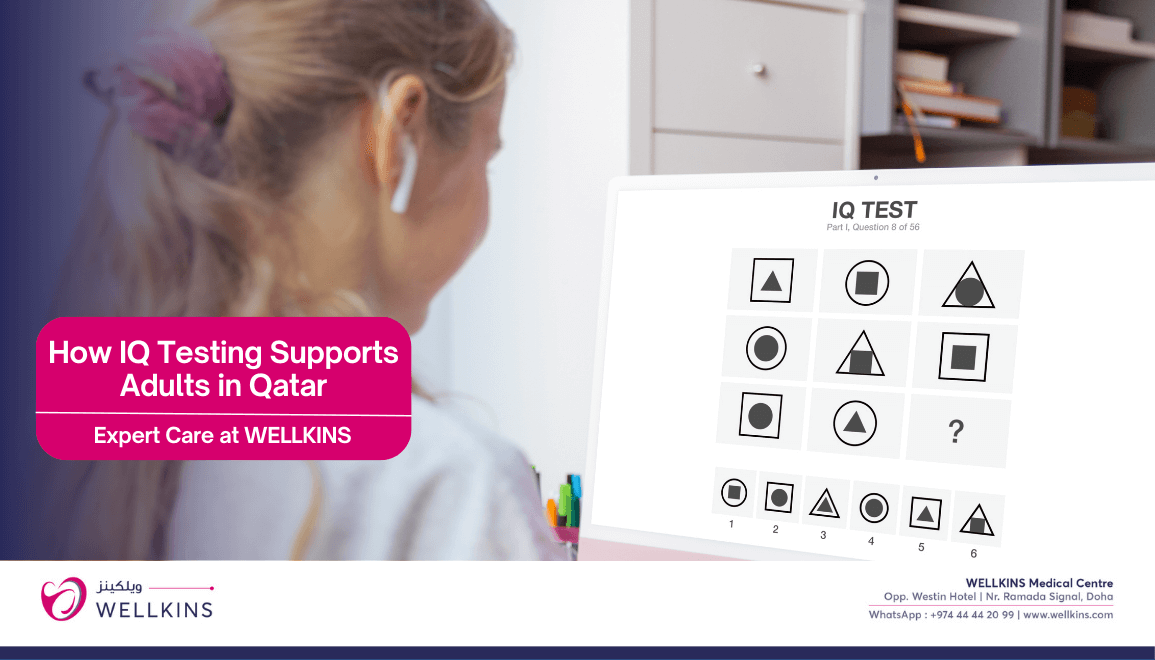
At Wellkins, we sometimes integrate simple non-verbal IQ assessments when a full SB-5 is not immediately practical or necessary. These tests are designed primarily to evaluate fluid intelligence (pure visual problem solving) and are particularly helpful for specific populations:
- Bilingual or multilingual children who are not yet fully fluent in the testing language.
- Children with speech or language delays where verbal tasks may mask true cognitive ability.
- People who feel anxious or inhibited during language-based or timed verbal tasks.
- As a quick screening tool to estimate intellectual capacity.
While they are quick and language free, these tools do not offer the detailed cognitive profile that the Stanford–Binet-5 provides across the five major areas. For a complete, actionable understanding of a child’s or adult’s complete cognitive abilities, the SB-5 remains the most thorough and informative assessment available.
4. How IQ Testing Guides School Decisions
For students, a complete IQ test is a powerful tool for academic advocacy and planning. It helps answer vital questions that shape their educational experience:
- Ability vs. Effort: Is poor academic performance primarily related to a genuine cognitive gap in certain areas, or is it due to other factors like motivation, attention deficits, or emotional challenges?
- Identifying Giftedness: Is the child truly gifted in specific areas (e.g., non-verbal reasoning) and simply under-challenged or bored in the standard curriculum? This prevents frustration and supports appropriate advanced placement.
- Setting Realistic Expectations: What subjects, pace, or learning expectations are truly realistic based on the child’s unique profile, allowing parents to apply fair and appropriate pressure.
- Learning Style Preference: Does the child show a significantly stronger verbal reasoning or visual–non-verbal reasoning ability? This informs teaching methods (e.g., using visuals vs. verbal instructions).
- Processing Skills: Are key foundational skills like attention, working memory, or processing speed significantly lower than overall ability, indicating specific needs that affect schoolwork efficiency?
Although the SB-5 does not officially diagnose conditions like Dyslexia or Dyscalculia, the specific pattern of scores (e.g., a discrepancy between V IQ and NV-IQ) can strongly indicate when further Learning Disability (LD)-specific assessments or Attention Deficit Hyperactivity Disorder (ADHD) evaluations are critically needed. This helps parents and teachers make informed decisions early, reducing years of unnecessary academic pressure, frustration and eventual burnout.
5. How IQ Testing Supports Adults
IQ testing is not just for children. Adults benefit significantly from this type of assessment when they need objective insight to navigate professional and personal life transitions:
- Understanding Cognitive Strengths: It provides a clear mapping of a person’s natural intellectual gifts, such as superior quantitative skill or strong verbal comprehension, which is highly useful for career satisfaction and growth.
- Exploring Suitable Career Paths: It helps individuals align their inherent cognitive profile with suitable professions, moving beyond interest to focus on aptitude for roles requiring specific skills (e.g., engineering vs. law).
- Clarifying Learning or Memory Concerns: Adults who suspect declining memory, focus issues, or have difficulty mastering new complex skills can use the data to pinpoint the source of their concerns.
- Understanding Cognitive Changes: It offers a crucial baseline and objective measurement to understand cognitive changes following periods of severe stress, burnout, long-term illness, or certain medical conditions.
- Planning Further Studies or Career Transitions: It clarifies the individual’s optimal learning style and ability to handle the cognitive load of advanced degrees or a significant professional pivot.
IQ testing gives adults a clear, validated sense of how they process complex information, which helps them make confident, long-term decisions in their professional and personal lives, leveraging their natural talents.
6. Why IQ Testing Reduces Stress for Families
The primary stress relief provided by IQ testing comes from replacing guessing with certainty.
When parents have an objective understanding of their child’s cognitive profile:
- Expectations become fair and realistic, avoiding setting the child up for failure or, conversely, failing to provide enough challenge.
- Strengths receive proper encouragement and resources (e.g., specialized tutoring, advanced classes).
- Weaknesses receive early support and accommodation through specific, targeted strategies.
- School decisions regarding placement, curriculum and classroom strategies
become grounded in data, not emotion. - Communication with teachers becomes clearer and more effective, as parents can advocate using specific data points (e.g., “His working memory score suggests he needs written instructions for multi-step tasks”).
Many families feel profoundly relieved after a cognitive assessment because they finally understand the “why” behind their child’s struggles or unique success and, more importantly, how to support them appropriately for optimal development and happiness.
Conclusion: IQ Testing Brings Clarity for Smarter Educational, Career and Life Decisions
Understanding IQ is not about comparison; it is fundamentally about insight and personalized strategy. A well-conducted, complete IQ test, such as the Stanford-Binet-5, provides objective clarity for parents, teachers, students and adults helping them set the right, achievable goals, reduce counterproductive stress and make informed choices that align with natural intellectual ability.
At Wellkins Medical Centre, all cognitive assessments are conducted by licensed psychologists in a calm, supportive and confidential environment. We provide detailed feedback reports that are easy to understand and, most importantly, contain practical, actionable advice that you can immediately apply to your home, school, or career planning. If your child is struggling, gifted, confused, or in need of academic direction or if you, as an adult, want objective clarity about your own thinking and strengths a professional IQ assessment at Wellkins Medical Centre can be the first essential step toward making confident and informed decisions for a better future.
Read more: https://wellkins.com/mentalhealth
Disclaimer: This blog is for informational purposes only and should not replace professional medical advice.