
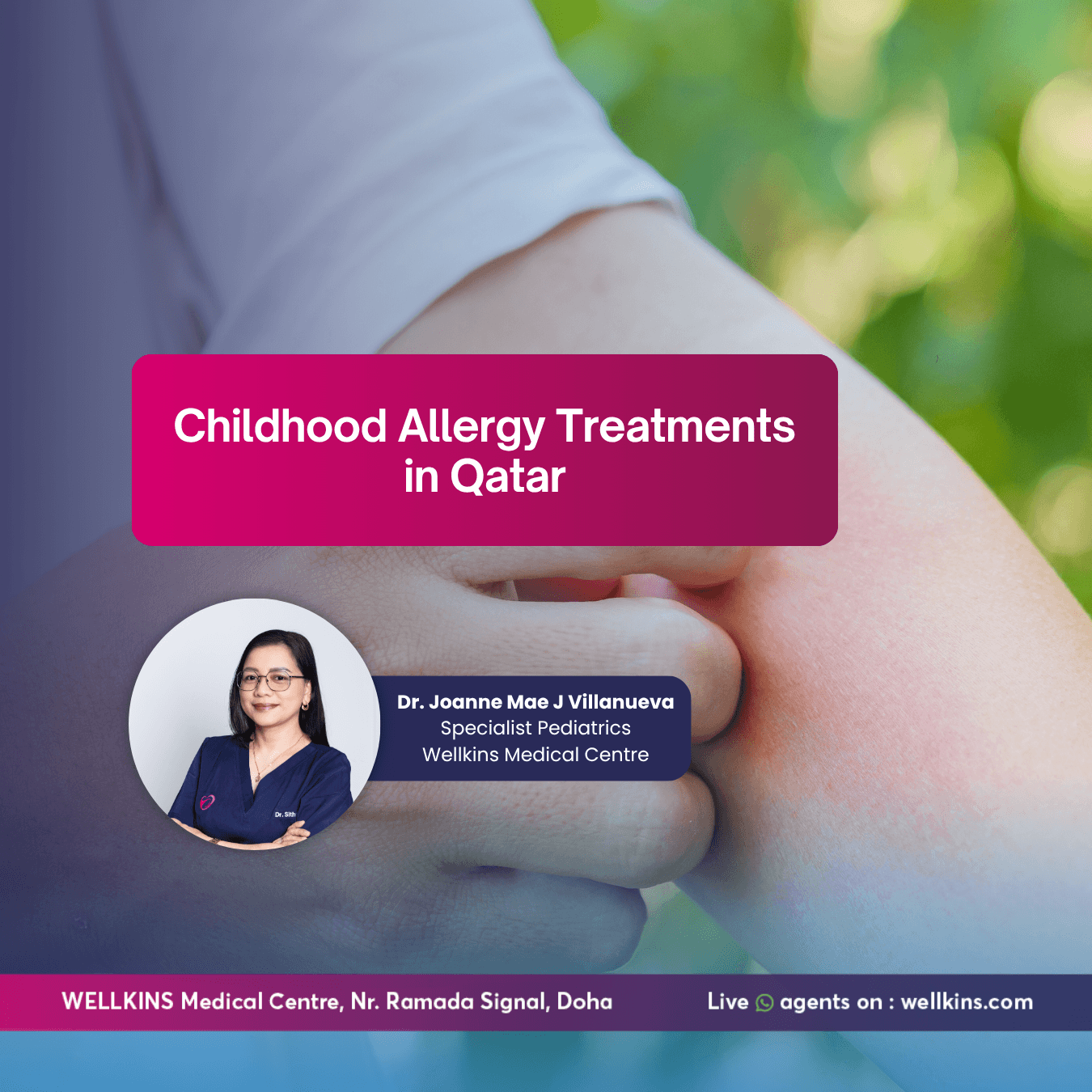
Author: Dr. Joanne Mae J Villanueva, (Specialist Pediatrics – Wellkins Medical Centre)
Allergies in children are not simply a matter of sneezing in spring or avoiding peanut butter sandwiches. For a significant and growing proportion of children in Qatar and worldwide, allergic disease is a lifelong journey that begins in infancy, evolves through childhood and adolescence and shapes daily life in ways that go far beyond occasional discomfort. Understanding how childhood allergies develop, how Qatar’s specific environment influences that journey and what parents need to know about recognizing and responding to allergic emergencies gives every family in Doha a meaningful advantage in managing this increasingly common set of conditions.
At Wellkins Medical Centre, childhood allergies are one of the most frequently managed conditions in the pediatric clinic across every age group from newborns with suspected milk protein allergy to teenagers managing multiple environmental sensitivities. The conversations that matter most are not the ones that happen during an acute reaction but the ones that happen before, when there is still time to prepare, to educate and to put a plan in place.
What I want every parent in Qatar to understand is that allergic disease in children rarely stays still. A baby with eczema may develop food allergy. A toddler with food allergy may develop asthma. A school-age child with asthma may develop hay fever. This progression is called the atopic march and recognizing it changes everything about how we monitor and manage allergic children over time. We do not treat each condition in isolation. We treat the whole child across the whole journey and we stay ahead of the next step wherever possible.
People Also Ask
What is the atopic march in children?
The atopic march refers to the typical progression of allergic conditions that occurs in genetically predisposed children over time. It usually begins with eczema in infancy, followed by food allergies in toddlerhood, then allergic asthma in the preschool and early school years and finally allergic rhinitis in older children and adolescents. Not every atopic child follows this exact sequence and not every condition develops in every child, but the pattern is well documented and clinically important because it guides how pediatricians monitor and manage allergic children proactively rather than reactively. Early identification of a child on the atopic march allows preventive steps and early intervention at each stage.
What are the most common food allergies in children in Qatar?
The most common food allergens in children globally and in Qatar are cow’s milk, hen’s eggs, peanuts, tree nuts, wheat, soy, fish and shellfish. In Qatar’s diverse multicultural population, sesame allergy is also particularly prevalent given its significant presence across many of the cuisines represented in Doha’s communities. Cow’s milk and egg allergy are most common in infants and young children and are outgrown by most children during the school years. Peanut, tree nut and seafood allergies tend to be more persistent into adolescence and adulthood.
What should I do if my child has an allergic reaction?
The response depends on the severity of the reaction. Mild reactions including a localized rash or mild itching can be managed with an antihistamine as directed by your pediatrician. A severe allergic reaction, anaphylaxis, is a medical emergency. Signs include difficulty breathing, throat tightening or swelling, a sudden drop in blood pressure or loss of consciousness alongside skin symptoms. If anaphylaxis is suspected, administer the prescribed adrenaline auto-injector immediately, call for emergency services and take the child to the nearest emergency department without delay even if they appear to improve after the adrenaline injection. A single dose of adrenaline does not end the emergency.
Does Qatar’s environment make childhood allergies worse?
Yes, significantly. Qatar’s specific allergen landscape including year-round high concentrations of house dust mites in air-conditioned indoor environments, desert particulate matter from Shamal winds, a rapidly expanding and diverse urban tree and grass planting programme that introduces new pollen varieties and the high UV and heat environment that affects skin barrier function all contribute to a higher allergen burden for children than they would experience in many other climates. Children who were manageable in their home country often find their allergic conditions worsen after relocating to Qatar, and children born in Qatar are exposed to this allergen environment from birth.

Understanding the Atopic March
The atopic march is one of the most important concepts in pediatric allergy medicine and one of the least understood by families managing allergic children. It describes the tendency of allergic disease to evolve and transition through different clinical expressions over a child’s development rather than remaining static or resolving and being done with.
Stage One: Eczema (Atopic Dermatitis) in Infancy
The atopic march most commonly begins with eczema, the dry itchy inflamed skin condition that affects an estimated 20 percent of infants and young children. In genetically predisposed children the skin barrier is structurally weaker than in non-atopic children, allowing allergens and irritants to penetrate more easily and triggering an inflammatory immune response.
Eczema typically appears in the first weeks to months of life, affecting the cheeks, scalp and body creases initially. Beyond the immediate discomfort of itching and skin inflammation, eczema carries a clinical significance that extends beyond the skin itself: the impaired skin barrier allows sensitization to food allergens and environmental allergens through the skin surface, establishing the immune foundation for food allergy and later respiratory allergies. This is why managing eczema effectively in infancy is not just about skin comfort but about potentially reducing the risk of subsequent steps on the atopic march.
In Qatar, the combination of intense air conditioning, which dries and irritates the skin barrier, high UV exposure during outdoor time and the allergen-rich indoor and outdoor environment creates conditions that make eczema harder to manage and more persistent than in more moderate climates.
Stage Two: Food Allergy in Toddlerhood
Food allergy typically emerges in the first one to three years of life, most commonly to cow’s milk, eggs, peanuts and tree nuts. The immune sensitization established through the impaired skin barrier in eczema is one of the mechanisms through which food allergy develops in atopic children, which is why early and consistent eczema management is now understood to have a potential protective role against food allergy development.
Food allergies in young children range in severity from mild reactions including hives and vomiting to severe systemic anaphylaxis. Distinguishing between food intolerance, which does not involve the immune system and is not life-threatening, and true IgE-mediated food allergy, which can be, is a clinically important distinction that requires proper assessment rather than self-diagnosis.
Many common childhood food allergies including cow’s milk and egg allergy are outgrown during the school years as the immune system matures. Peanut, tree nut and seafood allergies are more frequently persistent. Regular follow-up with a pediatrician allows the child’s allergy status to be reviewed and updated as they grow.
Stage Three: Allergic Asthma in Preschool and School Age
As the atopic march progresses, children who had eczema and food allergy in early childhood have a significantly elevated risk of developing allergic asthma during the preschool and early school years. Asthma in atopic children is driven by the same underlying immune sensitivity that produced the earlier skin and food manifestations, now expressing itself in the bronchial airways.
Allergic asthma in children presents as recurrent episodes of wheeze, cough and breathing difficulty triggered by allergen exposure, respiratory infections, exercise or cold air. In Qatar, house dust mites in air-conditioned homes and desert dust particles are among the most consistent asthma triggers for children in Doha. Early identification and appropriate preventive inhaler therapy significantly reduce the frequency and severity of asthma episodes and protect long-term lung development.
Stage Four: Allergic Rhinitis in Older Children and Adolescents
Allergic rhinitis, the sneezing, runny nose, nasal congestion and itchy eyes that most people associate with hay fever, is typically the final major expression of the atopic march in older children and adolescents. It is driven by sensitization to environmental allergens including house dust mites, pollens and mold spores and its impact on quality of life, sleep and academic performance in school-age children is significant and consistently underestimated.
In Qatar, allergic rhinitis is year-round rather than strictly seasonal for many children because house dust mite sensitization, which drives perennial symptoms, is highly prevalent in air-conditioned environments and because the outdoor allergen landscape including desert pollens is present throughout much of the year.
Qatar’s Allergen Landscape: What Every Family Should Know
Qatar’s specific geographic, climatic and built environment creates an allergen profile that is distinct from what most expatriate families encountered in their countries of origin and different from what textbooks written for temperate climates describe.
- House Dust Mites: The dominant indoor allergen in Qatar. Air-conditioned environments maintain the temperature and humidity conditions that house dust mites prefer and the intensive use of air conditioning across Doha’s homes, schools and community spaces means children are exposed to high mite concentrations consistently throughout the year. Bedding, soft furnishings and carpeted floors are the primary mite reservoirs. Dust mite-proof mattress and pillow covers, weekly hot washing of bedding and minimizing carpet in children’s bedrooms are the most effective mitigation measures.
- Desert Particulate Matter: Qatar’s desert geography produces ambient particulate matter year-round and dramatically elevated dust concentrations during Shamal wind events. Fine particulate matter from desert dust is a potent non-specific respiratory irritant that worsens asthma and allergic rhinitis in sensitized children and can trigger symptoms even in children who are not classically allergic. Keeping windows closed during dust events, using air purifiers with HEPA filtration and staying indoors during peak Shamal periods significantly reduces particulate exposure.
- Pollen: Qatar’s rapid urban greening programme over recent decades has introduced a large and diverse range of tree, grass and weed species to Doha’s streets, parks and residential areas. These plants produce pollen that sensitized children react to with allergic rhinitis and asthma symptoms. The pollen season in Qatar is less sharply defined than in temperate climates due to year-round warmth allowing extended plant growth but peaks of tree and grass pollen occur in the cooler months from October through April when outdoor activity is also highest.
- Sesame: Sesame seed is a significant food allergen in Qatar’s context given its widespread presence across Arabic, South Asian and Middle Eastern cuisines that form a large part of the food environment in Doha. Sesame allergy is increasingly recognized as a major food allergen and families managing sesame allergy face a specific challenge in Qatar’s food environment where sesame is present in a very wide range of prepared foods, condiments and bakery products.
- Mold Spores: While Qatar is dry outdoors, the air-conditioned indoor environment creates localized humidity conditions around air conditioning units, bathroom spaces and indoor plants that support mold growth. Mold spore sensitization contributes to both respiratory allergies and eczema flares in susceptible children and addressing mold sources within the home is an important component of allergen reduction in Doha.
Food Allergy Emergency Action: What Every Parent in Qatar Must Know
The most important thing any parent of a food-allergic child can do is understand the difference between a mild allergic reaction and anaphylaxis and know exactly what to do in each situation before an emergency occurs. Anaphylaxis is a medical emergency that can progress from first symptoms to life-threatening airway compromise within minutes. Preparation saves lives.
Recognizing Anaphylaxis
Anaphylaxis typically involves symptoms across two or more body systems simultaneously following allergen exposure. Any of the following combinations should raise immediate concern.
- Skin symptoms: Hives, generalized flushing, swelling of the lips, tongue or face alongside any respiratory, cardiovascular or gastrointestinal symptom.
- Respiratory symptoms: Throat tightening, hoarse voice, stridor, wheeze, difficulty breathing or a barking cough.
- Cardiovascular symptoms: Sudden pallor, limpness, loss of consciousness, drop in blood pressure or rapid weak pulse.
- Gastrointestinal symptoms: Sudden severe vomiting or abdominal cramping occurring alongside skin or respiratory symptoms.
A child who has eaten a known allergen and develops any respiratory symptom, any cardiovascular symptom or any combination of symptoms across two body systems is experiencing anaphylaxis until proven otherwise.
The Emergency Action Plan
- Step 1 — Administer adrenaline (epinephrine) auto-injector immediately: If your child has been prescribed an adrenaline auto-injector, this is the first-line treatment for anaphylaxis. It should be administered to the outer mid-thigh immediately when anaphylaxis is suspected. Do not wait to see if symptoms worsen. Do not try antihistamine first. Adrenaline is the treatment and it must come first.
- Step 2 — Call emergency services: Call 999 in Qatar immediately after administering adrenaline. Anaphylaxis requires emergency medical assessment even if the child appears to improve after the injection.
- Step 3 — Position correctly: Lay the child flat with their legs elevated unless they are having difficulty breathing, in which case allow them to sit upright in the position most comfortable for breathing. Do not allow them to stand or walk as cardiovascular collapse can occur suddenly.
- Step 4 — A second adrenaline dose if needed: If symptoms do not improve or worsen within five to fifteen minutes and a second auto-injector is available, administer a second dose while continuing to wait for emergency services.
- Step 5 — Do not go home after the reaction: Every child who has experienced anaphylaxis and received adrenaline must be assessed in an emergency department. Biphasic reactions, in which symptoms return hours after the initial reaction without further allergen exposure, occur in a significant proportion of anaphylaxis cases. Emergency observation for a minimum of four to six hours is standard clinical practice.
Prevention and Daily Management for Allergic Children in Qatar
- Carry the adrenaline auto-injector at all times: At school, at restaurants, at birthday parties, at sports activities and during travel. The auto-injector that is not with the child is the one that cannot save them. Schools in Qatar increasingly require a copy of the allergy action plan and a school-kept auto-injector for children with known severe allergies and parents should ensure this is in place.
- Provide a written allergy action plan to all caregivers: Every adult who cares for an allergic child including grandparents, teachers, school bus drivers and domestic staff should have a written action plan in a language they can read that clearly specifies the child’s allergens, the signs of a reaction, the steps to take and the emergency contacts.
- Read food labels consistently: In Qatar’s diverse food retail environment, product formulations change and imported products may have labelling in languages unfamiliar to the family. Developing the habit of checking every food label every time rather than relying on memory of a previously safe product is an essential food allergy management skill.
- Communicate clearly when eating out in Doha: Doha’s restaurant scene is diverse and wonderful but communicating an allergy clearly enough to be safe requires specific language. Saying a child “cannot eat” something is less effective than communicating “my child has a life-threatening allergy to X and any contact with X including trace contamination through shared equipment could cause a medical emergency.” Carrying a written allergy card in Arabic and English is helpful for communicating in Qatar’s multilingual restaurant environment.
When to See a Pediatrician at Wellkins Medical Centre
You should book a pediatric consultation at Wellkins Medical Centre for your child’s allergies if any of the following apply.
- Your infant has eczema that is not responding to standard moisturizing and topical treatment and you want to understand whether food triggers or environmental factors are contributing.
- Your child has had any allergic reaction to a food, medication or insect sting and you have not had a formal allergy assessment to confirm the trigger and receive an emergency action plan.
- Your child has been prescribed an adrenaline auto-injector but you are not fully confident in when and how to use it.
- Your child’s eczema, asthma or allergic rhinitis has worsened since moving to Qatar and you want to understand which specific local allergens are driving the change.
- You have a family history of severe allergy and want to understand the risk for your child and the preventive steps available.
- Your child is approaching school age in Qatar and you want to ensure the school has an appropriate allergy management plan in place.
Childhood allergy is manageable. With the right knowledge, the right preparation and the right clinical support, allergic children in Qatar live full active and safe lives. The goal of allergy care at Wellkins is not simply to treat reactions when they happen but to equip every family to prevent them and to respond confidently when they cannot be prevented.
To book an appointment with Dr. Joanne Mae J Villanueva at Wellkins Medical Centre: https://wellkins.com/drjoanne
To know more about the Pediatric services at Wellkins Medical Centre: https://wellkins.com/pediatrics