
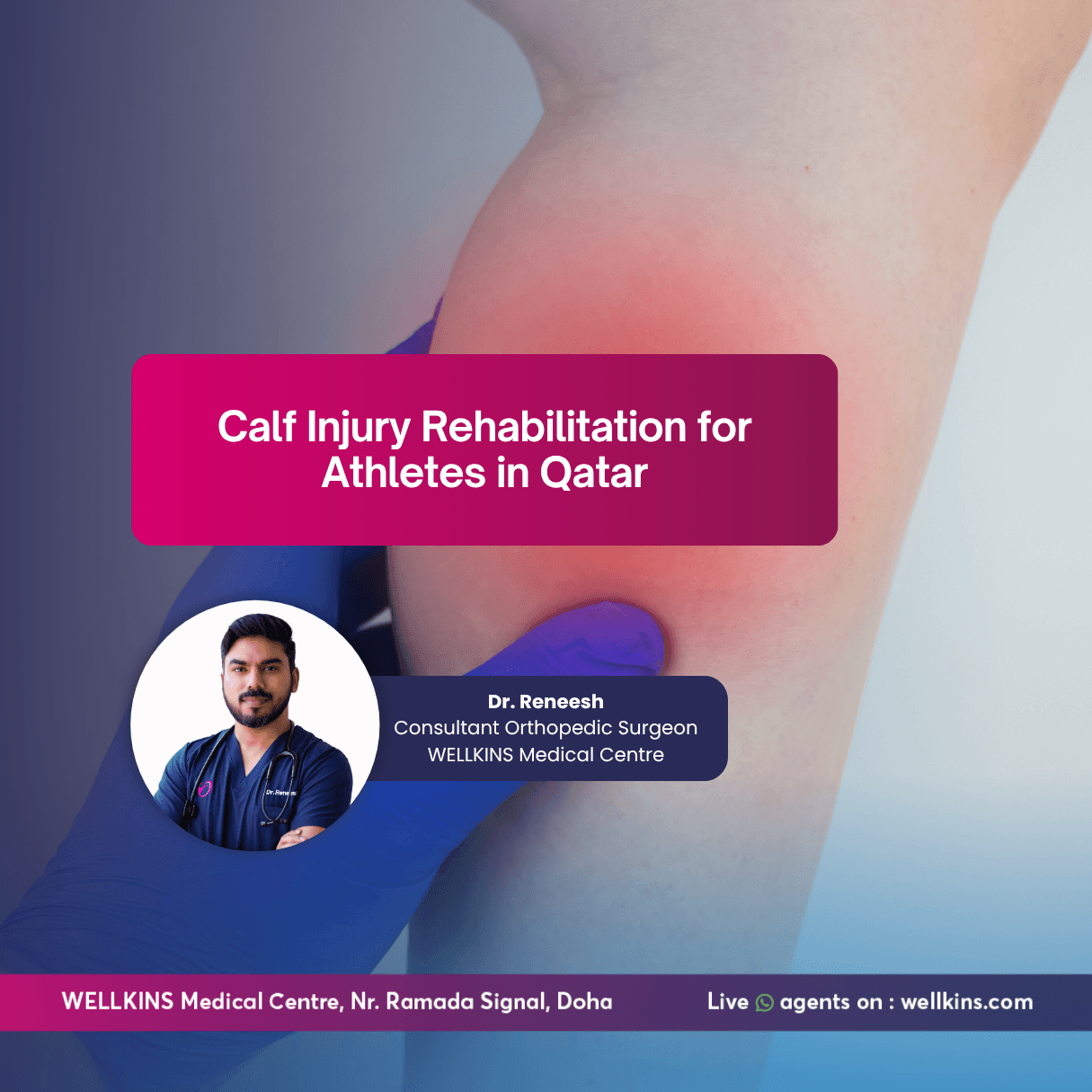
Author: Dr. Reneesh, (Consultant Orthopedic Surgeon – WELLKINS Medical Centre)
Introduction
Most patients ask the same question at their first visit after a calf injury: “When can I play again?” It is a fair question, but the safest answer is rarely a date alone. Return to sport should be guided by what the calf can do, how it responds to increasing load and whether it is prepared for the demands of the patient’s activity.
The calf is made up mainly of the gastrocnemius and soleus muscles. Together they absorb and produce substantial force during walking, running, jumping, sprinting and changing direction. A strain may feel much better after a short period while the muscle still lacks the strength, endurance or power required for sport.
Walking without pain is an important early milestone, but it does not prove readiness for repeated sprints, hard deceleration or court-based movement. This is especially relevant for football, running, padel and other popular activities in Qatar where the calf may be exposed to repeated high-speed loading.
“The calendar can tell us how long it has been since the injury, but it cannot tell us whether the calf is ready for sport. I look for pain-free movement, restored strength, impact tolerance, running progression and confidence during sport-specific drills. Returning too early because normal walking feels comfortable can expose the healing muscle to forces it has not yet rebuilt the capacity to handle.”
People Also Ask
How long does a calf strain take to heal?
Recovery varies according to the muscle involved, severity and location of the injury, previous calf problems and rehabilitation progress. A general timeline can guide expectations, but clearance should be based on function and sport-specific testing.
Can I play sport if my calf no longer hurts when walking?
Pain-free walking does not confirm that the calf is ready for sprinting, jumping or sudden changes of direction. Strength, hopping, running and sport-specific drills should also be completed without concerning symptoms.
How do I know whether my calf injury is serious?
A sudden pop, major bruising, inability to walk normally or inability to rise onto the toes may indicate a more significant muscle or tendon injury. Increasing swelling, warmth or redness requires assessment because a blood clot can produce similar symptoms.
Can a calf injury come back after returning to sport?
Yes. Reinjury can occur when strength and high-speed tolerance have not been restored or when training load increases too quickly. A staged return allows the calf’s response to be checked before full competition.

Why Timelines Alone Can Mislead
General recovery windows describe averages rather than an individual athlete’s readiness. Two people with injuries given the same grade may recover at different speeds because the injured structure, tear location, rehabilitation quality and sporting demands are not identical.
- Which muscle is involved: Medial gastrocnemius injuries may have a sudden and obvious onset. Soleus injuries can feel less dramatic initially but may become noticeable during prolonged running and can require careful endurance rebuilding.
- The size and location of the tear: Injuries involving an aponeurosis or the musculotendinous region may require a more cautious progression than a small muscle-fibre strain.
- Rehabilitation quality: Consistent and progressive loading helps restore capacity. Rest alone may reduce symptoms without preparing the calf for sporting force.
- The demands of the sport: Jogging on a flat surface is different from repeated sprints, jumps, lunges and sudden stops during football or padel.
- Previous calf injuries: A history of recurrent injury may indicate unresolved weakness, insufficient load tolerance or a return that progressed too quickly.
Return-to-sport decisions should therefore combine symptoms, clinical examination, strength and functional testing. No single test can guarantee that another injury will not occur.
Recovery Is Based on Function, Not Time Alone
A rehabilitation programme usually progresses from controlled calf loading to faster and more demanding movement. Each stage should prepare the muscle for the forces expected at the next level.
If symptoms increase during a stage or remain noticeably worse the following day, the progression may have been too fast. The load can then be adjusted before the athlete advances.
The Return-to-Sport Checklist
Before an athlete returns to unrestricted sport, the following milestones may be considered during orthopedic and physiotherapy assessment. The exact criteria should be adapted to the injury and sport.
1. Normal movement without pain. Walking should be symmetrical and comfortable. Ankle movement should be close to the uninjured side without marked pulling, pain or protective limping.
2. No tenderness on examination. The injured area should no longer have significant tenderness during palpation or controlled stretching. Mild awareness and sharp pain should not be treated as the same finding.
3. Strength close to the other leg. Single-leg heel raises should be completed through an appropriate range without pain or major compensation. Testing with the knee straight and bent helps assess the gastrocnemius and soleus under different conditions.
4. Tolerance of impact. The athlete may progress through controlled hopping and bounding drills. Height, distance, landing control and confidence can be compared with the uninjured side.
5. Running progression completed. Return to running should move gradually from walking and jogging to faster running, striding and sprinting. The calf should tolerate the session without pain that increases during activity or a significant reaction later that day or the next morning.
6. Sport-specific confidence. Cutting, deceleration, lunging, jumping and repeated efforts should reflect the athlete’s actual sport. Full-intensity practice should generally be restored before competition.
An athlete should demonstrate control at one stage before advancing to the next. If pain, swelling or loss of performance returns, the programme can step back rather than pushing through worsening symptoms.
Testing Calf Strength and Impact Tolerance
A comparison with the uninjured leg can help identify remaining differences, but perfect symmetry is not the only consideration. The athlete’s pre-injury ability, technique and overall conditioning should also guide interpretation.
Testing should progress from strength and endurance to elastic tasks such as hopping and sprinting. This sequence provides more useful information than asking only whether normal walking is pain-free.
Special Considerations in Qatar
Training conditions in Qatar can influence fatigue, recovery and how rehabilitation should be progressed. The plan should reflect the environment in which the athlete will actually train and compete.
- Heat and hydration: Outdoor heat can increase fluid loss and overall fatigue. Return sessions may need planned hydration, appropriate timing, gradual heat exposure and shorter initial workloads.
- Indoor, hard-court sports: Padel and indoor football involve repeated acceleration, abrupt stopping and direction changes on firm surfaces. These demands should be introduced deliberately rather than all at once.
- Weekend-warrior patterns: Training lightly during the week and playing a demanding match at the weekend creates a sudden load spike. A more even weekly programme can prepare the muscle more effectively.
- Air-conditioned environments: Athletes moving from cooled indoor spaces into outdoor heat still need an adequate warm-up and gradual exposure to sporting intensity.
Hydration is important, but calf cramping or pain should not automatically be blamed on fluid or electrolyte loss. Recurrent symptoms may reflect fatigue, insufficient conditioning, medication effects or another medical problem that needs assessment.
Warning Signs During Recovery
Some symptoms should not be dismissed as a slow recovery or another muscle flare. A calf injury, deep vein thrombosis and other conditions can share symptoms, so increasing or unusual swelling needs careful evaluation.
Seek prompt medical assessment for:
- Increasing one-sided calf swelling, warmth or redness
- Unexplained pain or tenderness that is worsening rather than settling
- A calf that appears noticeably larger than the other side
- Severe pain with tense swelling, numbness or increasing weakness
- Fever or feeling generally unwell
Sudden shortness of breath, chest pain, coughing blood, fainting or a fast irregular heartbeat may indicate a pulmonary embolism and requires immediate emergency medical care. Do not attempt to exercise, massage or stretch the calf while waiting for assessment.
When to Come In for Assessment
A specialist review is appropriate after a sudden pop, major bruising, difficulty walking, inability to rise onto the toes or symptoms that are not improving as expected. Repeated calf injuries also deserve assessment because the original deficit or training-load problem may still be present.
Ultrasound can identify many gastrocnemius injuries and associated fluid collections. MRI may be helpful for deeper soleus injuries, complex tears, uncertain diagnosis or symptoms that do not match the initial clinical findings. Imaging is used to support the assessment rather than to set the return date by itself.
Treatment usually centres on structured rehabilitation. Platelet-rich plasma may be discussed in selected circumstances, but evidence varies according to the specific injury and it should not replace progressive loading. Patients can also read the WELLKINS guide to calf muscle sports injury treatment in Qatar.
Progressing From Rehabilitation to Full Sport
Returning to full sport should normally include exposure to the speed, surface and movement patterns used during competition. A runner needs repeated faster efforts while a padel or football player also needs controlled stopping, cutting and reactive movement.
Training response should be reviewed during the session and over the following day. This helps distinguish a tolerable workload from a progression that exceeds the calf’s current capacity.
Conclusion
A calf that has recovered enough for daily life has not necessarily recovered enough for sport. Measurable milestones provide more useful information than a date alone and allow strength, impact tolerance, running capacity and confidence to be rebuilt in stages.
If you are recovering from a calf injury, repeatedly experiencing the same problem or are uncertain whether you are ready to return, an assessment can identify remaining deficits and guide a safer progression.
At the Orthopedics Department at WELLKINS Medical Centre, Dr. Reneesh assesses calf injuries, sports-related pain and return-to-activity concerns.
To book an appointment with Dr. Reneesh at Wellkins Medical Centre: https://wellkins.com/drreneesh
To know more about the Orthopedic services at Wellkins Medical Centre: https://wellkins.com/orthopedics
This article is intended for general education and does not replace an individual medical assessment. Return-to-sport decisions should be personalised according to the injury, examination findings, rehabilitation progress and demands of the sport.