

Author: Dr. Reneesh, (Consultant Orthopedic Surgeon – WELLKINS Medical Centre)
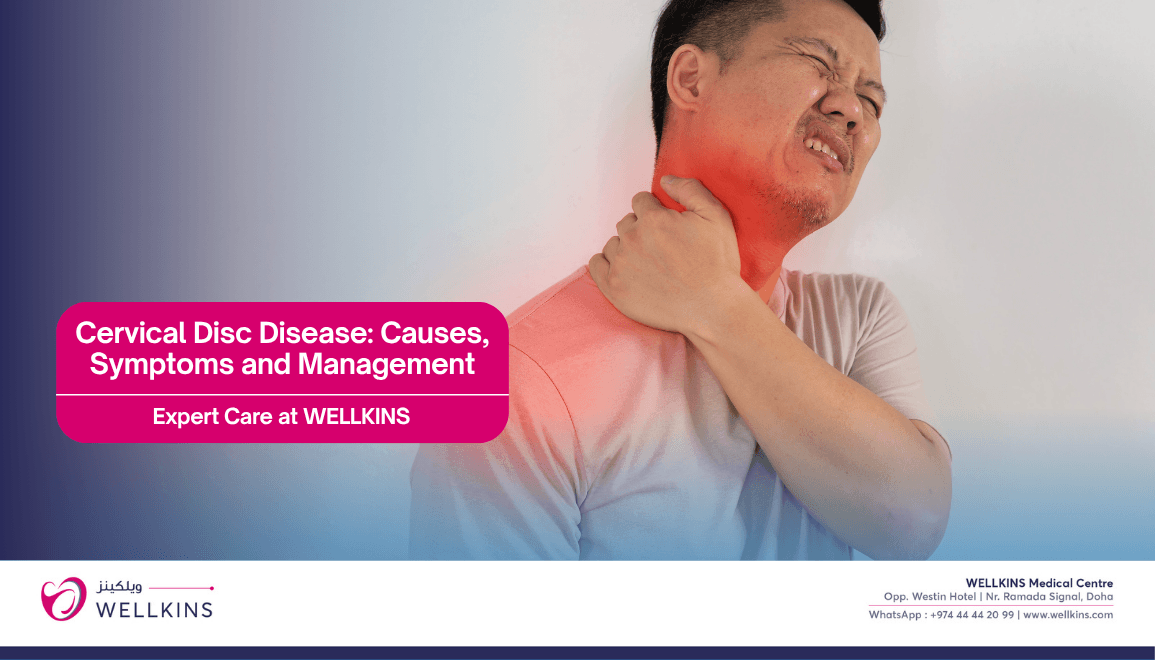
Neck pain is common, but pain that spreads into the shoulder, arm or hand may indicate irritation or compression of a nerve in the cervical spine. Some patients also develop numbness, tingling or weakness that affects work, sleep, driving and ordinary daily activities.
The cervical spine contains seven vertebrae. Intervertebral discs sit between most of these bones and help absorb force while allowing the neck to move. As a disc degenerates, loses height or herniates, it may reduce the space available for a nearby nerve root. In more serious cases, degenerative changes can narrow the spinal canal and compress the spinal cord.
Cervical disc disease is a broad term rather than one single diagnosis. Local neck pain, cervical radiculopathy and cervical myelopathy can arise from related structures but they do not carry the same level of urgency or require identical treatment. A careful clinical assessment is therefore more useful than interpreting an MRI report in isolation.
“Many patients become worried as soon as an MRI mentions a disc bulge or degeneration. These findings are common and do not automatically mean that surgery is required. What matters is whether the imaging explains the patient’s symptoms, whether muscle strength or reflexes are changing and whether there are signs of spinal-cord compression. Most uncomplicated cases of cervical radiculopathy begin with non-operative care, but hand clumsiness, balance difficulty or progressive weakness should never be ignored.”
People Also Ask
What does cervical disc disease feel like?
It may cause local neck stiffness or pain that spreads into the shoulder, arm, forearm or fingers. Numbness, tingling and weakness can occur when a cervical nerve root is irritated or compressed.
Can a cervical disc problem improve without surgery?
Many cases of cervical radiculopathy improve with time and appropriate non-operative treatment. Surgery may be considered when pain remains disabling, weakness progresses or spinal-cord compression produces myelopathy.
When is an MRI needed for neck pain?
An MRI is not necessary for every episode of uncomplicated neck pain. It is more likely to be requested when neurological symptoms persist, weakness is present, spinal-cord compression is suspected or the result would change treatment.
What are the warning signs of cervical myelopathy?
Warning signs include loss of hand dexterity, difficulty with buttons or handwriting, unsteady walking, frequent falls and weakness or altered sensation affecting more than one limb. These symptoms require prompt specialist assessment.

1. Causes & Risk Factors
Cervical disc disorders are commonly associated with age-related degeneration and repeated mechanical stress. The presence of disc degeneration on imaging does not always cause symptoms, so the scan must be interpreted together with the patient’s history and examination.
- Age-Related Disc Degeneration (Spondylosis): Over time, discs may lose water content and height. Associated bone spurs and thickened joints can reduce the space available for nerve roots or the spinal cord.
- Cervical Disc Herniation: Changes or tears in the outer annulus fibrosus may allow inner disc material to protrude and irritate or compress a nearby nerve root.
- Repetitive Stress & Poor Posture: Prolonged forward-head posture, repeated screen use and poorly arranged workstations can aggravate neck pain. Posture is usually one contributing factor rather than the only cause of disc disease.
- Trauma & Microtrauma: Whiplash, falls and repeated loading may trigger symptoms or worsen a pre-existing cervical condition.
- Genetic Predisposition & Lifestyle: Genetics can influence disc degeneration. Smoking is also associated with poorer disc health and may affect healing.
Long periods of desk work and driving are common parts of life in Doha. Regular position changes, sensible workstation adjustments and gradual strengthening may help reduce mechanical strain, but persistent radiating pain or neurological symptoms require proper assessment.
How Cervical Disc Changes Can Affect the Nerves
A disc finding becomes clinically important when it corresponds with the patient’s symptoms and examination. A bulge seen on MRI may be incidental while a smaller abnormality in the right location may explain arm pain or weakness.
The pattern of symptoms can help identify whether a nerve root or the spinal cord may be involved. This distinction guides the urgency of imaging, referral and treatment.
2. Clinical Presentation & Symptoms
Symptoms depend on whether the main problem is local mechanical pain, nerve-root irritation or spinal-cord compression.
| Condition | Primary Symptoms | Clinical Features |
|---|---|---|
| Axial Neck Pain | Pain or stiffness around the neck, base of the skull or trapezius area. | May worsen with movement, prolonged posture or sustained activity. |
| Cervical Radiculopathy | Sharp, burning or shooting pain that may travel into the shoulder, arm, forearm or fingers. | May include numbness, tingling, reduced reflexes or weakness in a nerve-root pattern. |
| Cervical Myelopathy | Hand clumsiness, reduced fine-motor control, gait instability or a feeling of being off-balance. | May indicate spinal-cord compression and requires prompt specialist evaluation. |
Symptoms do not always follow a perfect textbook pattern. Shoulder disorders, carpal tunnel syndrome, peripheral neuropathy and other conditions may produce overlapping pain or numbness. A clinical examination helps distinguish these possibilities.
Urgent assessment is important for rapidly progressing weakness, new walking difficulty, loss of hand coordination or symptoms affecting both arms or the legs. New bladder or bowel dysfunction, major trauma, fever, unexplained weight loss or severe unremitting pain also requires prompt medical attention.
3. Diagnostic Approach
Diagnosis begins with a structured history and examination rather than imaging alone. The clinician considers where the pain travels, which movements aggravate it and whether strength, sensation, reflexes, coordination or walking have changed.
- Detailed Clinical & Neurological Exam: The examination assesses neck movement, shoulder function, sensation, muscle strength and reflexes. Spurling’s test may reproduce arm symptoms in cervical radiculopathy. Hoffmann’s sign, abnormal reflexes and gait changes may raise concern about myelopathy, but no single test should be interpreted alone.
- Magnetic Resonance Imaging (MRI): MRI shows the discs, nerve roots, spinal cord and other soft tissues. It is particularly valuable when neurological deficits persist, myelopathy is suspected or surgery is being considered.
- Plain Radiographs (X-rays): X-rays can assess alignment, disc-space narrowing and bone spurs. Flexion and extension views may be requested in selected cases when instability is suspected rather than being used routinely for every patient.
- CT Scan / Myelography: CT provides detailed information about bone. CT myelography may be considered when MRI cannot be performed or when additional anatomical detail is needed for selected surgical planning.
Imaging often shows age-related changes in people without symptoms. The meaningful diagnosis comes from matching the scan with the affected side, neurological pattern and clinical findings. Patients can learn more in the WELLKINS guide to disc bulge diagnosis and treatment in Doha.
Clinical Examination and Cervical MRI

An MRI report should not be treated as a diagnosis without clinical correlation. Terms such as degeneration, bulge and stenosis describe anatomical findings but do not reveal by themselves how much pain or disability a person has.
A focused examination can show whether the affected nerve pattern matches the image. It also helps identify patients who can begin conservative care and those who require faster spinal evaluation.
4. Treatment Options
Many patients with cervical radiculopathy improve through non-operative management and the natural course is often favourable. Published reviews commonly report improvement in approximately 75% to 90% of cases, but recovery differs between individuals and this range should not be interpreted as a guarantee.
Treatment depends on the diagnosis, duration of symptoms, degree of pain, functional limitation and presence of weakness or spinal-cord signs. Progressive neurological deficits and cervical myelopathy require a different pathway from uncomplicated neck pain.
A. Non-Operative Management (First-Line)
- Pharmacotherapy: A clinician may consider suitable pain relief or anti-inflammatory medicine after reviewing kidney health, stomach-ulcer risk, cardiovascular factors and other medicines. Neuropathic pain medication or a short steroid course may be considered in selected cases under medical supervision.
- Physical Therapy: A personalised programme may include postural education, cervical and scapular strengthening, mobility work and carefully selected traction. Exercises should be adapted when pain, numbness or weakness changes.
- Activity Modification: Temporary adjustment of lifting, prolonged screen use or aggravating overhead activity may help while normal movement is gradually restored.
- Epidural Steroid Injections (ESI): Image-guided cervical epidural injections may be considered for selected patients with persistent radicular pain. Potential benefits are generally temporary and the procedure carries uncommon but potentially serious risks that should be discussed before consent.
Complete bed rest is generally not the aim. Most patients benefit from remaining sensibly active while avoiding movements that significantly worsen radiating pain or neurological symptoms.
Follow-up matters because weakness or coordination changes can alter the treatment plan. Patients should report new loss of grip strength, dropping objects, balance difficulty or worsening numbness rather than waiting for the next routine appointment.
B. Surgical Interventions
Surgery may be considered for progressive or significant neurological weakness, cervical myelopathy, disabling pain that has not responded to an appropriate course of non-operative care or imaging-confirmed compression that matches the clinical findings.
- Anterior Cervical Discectomy and Fusion (ACDF): The affected disc is removed from the front of the neck to decompress the nerve root or spinal cord. A spacer or cage is placed and the segment is fused to maintain alignment and stability.
- Cervical Disc Replacement: In selected patients, an artificial disc may be used after decompression with the aim of preserving motion at that level.
- Posterior Decompression: A posterior foraminotomy, laminoplasty or laminectomy with or without fusion may be considered depending on the location, number of affected levels and spinal alignment.
The most suitable operation depends on the site of compression, number of involved levels, spinal alignment, instability, bone quality and the patient’s overall health. No single surgical technique is appropriate for every cervical disc condition.
Planning Treatment Around Symptoms and Function

Treatment decisions should focus on the person rather than the scan alone. Two patients with similar MRI findings may need different treatment because their pain, weakness, balance and daily demands are different.
Regular review allows the plan to change as symptoms improve or new neurological findings appear. This is particularly important when spinal-cord compression is suspected.
Key Takeaways for Patients
- Nerve pain is treatable: Many cases of cervical radiculopathy improve with appropriate non-operative care. Early assessment is important when pain is accompanied by weakness or altered sensation.
- Surgery is rarely the first step: Most uncomplicated cases begin with medication when suitable, activity modification and guided rehabilitation.
- Don’t ignore myelopathy signs: Hand clumsiness, difficulty with buttons or handwriting, unsteady walking and progressive weakness need prompt specialist assessment.
- An MRI finding is not the whole diagnosis: Disc bulges and degeneration should be matched with symptoms and neurological examination findings.
At the Orthopedics Department at WELLKINS Medical Centre, Dr. Reneesh evaluates neck pain, cervical radiculopathy, disc disorders and other musculoskeletal conditions. Assessment may include clinical examination, appropriate imaging and an individualised treatment plan.
To book an appointment with Dr. Reneesh at Wellkins Medical Centre: https://wellkins.com/drreneesh
To know more about the Orthopedic services at Wellkins Medical Centre: https://wellkins.com/orthopedics
This article is for general educational purposes and does not replace an individual medical assessment. Seek prompt medical attention for progressive weakness, loss of coordination, walking difficulty, bladder or bowel changes or symptoms following significant trauma.