
Author: Dr. Nikitha Fernandez, (Clinical Psychologist – Wellkins Medical Centre)
“I do not know how to move on.”
These are often the first words people say when they walk into my therapy room after losing someone they love. Sometimes it is the loss of a parent. Sometimes it is a spouse, a child, a close friend or even a beloved pet. Other times the loss is not a death at all. It may be the end of a marriage, a miscarriage, losing a job, relocating to a new country or watching a loved one slowly change because of illness.
Whatever the loss, one thing is true: grief changes us.
And yet many people believe they have to “be strong,” “move on” or “get over it” as quickly as possible. The truth is that grief is not something we get over. It is something we learn to live with. Healing does not mean forgetting. It means finding a way to carry love and memories without being overwhelmed by pain every single day.
In therapy I often hear people say “I do not want to burden anyone” or “everyone expects me to be okay now” or “I feel guilty for laughing again.” These feelings are incredibly common and they remind me that grief often comes with emotions we never expected and never prepared for. The people who come to me carrying grief are not weak. They are people who loved deeply and are now learning, sometimes for the first time, that it is safe to let someone sit with them in that pain rather than carry it entirely alone.
People Also Ask
What is grief counselling and how does it help?
Grief counselling is a form of psychological therapy that provides a safe and compassionate space to process the emotional, cognitive and physical impact of loss. It does not encourage you to forget the person or experience you have lost. It helps you understand your emotional reactions, process painful memories, reduce guilt and self-blame, rebuild daily routines and find ways to carry your grief rather than being carried by it. Many people find that having a non-judgmental space to speak openly about their loss produces relief that well-meaning support from family and friends, however loving, cannot always provide.
How do I know if I need grief counselling?
Most people experience grief and gradually adapt to loss over time with the support of family, community and personal resilience. Grief counselling becomes particularly valuable when intense sadness continues for many months without improvement, when you feel unable to accept the loss, when you have withdrawn from the people around you, when you are struggling to return to daily functioning or when the grief is affecting your relationships, work or physical health. You do not need to be in crisis to benefit from grief counselling. Many people find that even a few sessions during an acute loss period makes a meaningful difference to how they move through the experience.
Is grief only about death?
No. Grief is our natural emotional response to any significant loss and the losses that trigger grief extend far beyond bereavement. The end of a marriage, a miscarriage, a serious medical diagnosis, losing a job, the end of an important friendship, relocating far from home and watching a loved one change due to illness are all experiences that produce genuine grief. In Qatar’s expatriate population in particular, the loss of a familiar life and support network when moving to Doha can produce a grief response that goes unrecognised because it is not associated with a death. If the loss feels significant, the grief is real and it deserves care.
Does grief counselling in Qatar address cultural and religious differences in how people grieve?
Yes. Effective grief counselling in Qatar’s multicultural population must be culturally sensitive and respectful of the diverse religious practices, family structures and community expectations around grief that exist across Doha’s resident communities. At Wellkins Medical Centre the grief counselling approach is tailored to each individual’s cultural background, religious beliefs and personal values. Whether a person’s grief is shaped by Islamic traditions, Christian practices, Hindu customs or any other cultural framework, the therapeutic space is one where those dimensions are respected and integrated rather than set aside.

Grief Is More Common Than We Realize
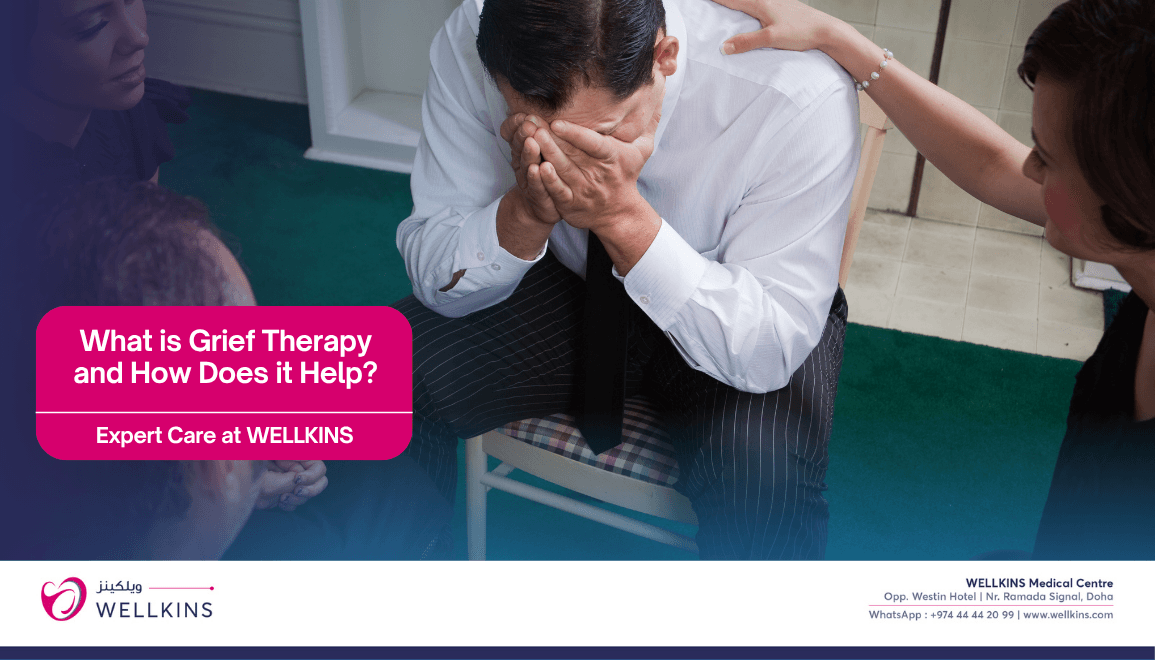
Every one of us will experience grief at some point in our lives. According to the World Health Organization, bereavement is one of life’s most significant stressors and can have a profound impact on both mental and physical health. Research also shows that while most people gradually adapt to loss with time and support, around seven to ten percent of bereaved adults experience prolonged grief in which intense grief continues for much longer than expected and significantly affects daily life.
In a multicultural country like Qatar, grief can feel even more complicated. Many expatriates experience the pain of losing loved ones while being thousands of kilometers away from family. Others struggle with missing important rituals, funerals or cultural traditions because they cannot travel home. Grief can feel lonelier when your support system is far away, when the people who knew the person you lost are in a different time zone and when the workplace keeps moving forward as though nothing significant has happened.
What Is Grief?
Grief is our natural emotional response to losing someone or something deeply meaningful. It is not a sign of weakness. It is a reflection of love. The deeper the connection, the deeper the grief may feel.
Everyone grieves differently. There is no right way. There is no timeline. There is no perfect way to heal. Two people who have lost the same person may grieve in completely different ways and both experiences are entirely valid. Comparing your grief to someone else’s or to a perceived norm of how you should be feeling at a particular point in time is one of the most consistent sources of additional suffering for grieving people.
Grief Is More Than Sadness
Many people expect grief to look like crying. But grief has many faces. It may feel like:
- Deep sadness
- Anger at the person who died, at yourself, at circumstances or at a world that kept moving
- Guilt about things said or unsaid, done or undone
- Numbness, a protective emotional flatness that keeps the full weight of the loss at a manageable distance
- Anxiety about the future or about your own mortality
- Loneliness even when surrounded by people who care
- Confusion about who you are now that this person or this chapter of your life is gone
- Relief, particularly after prolonged caregiving or after a relationship that caused significant pain, which can itself become a source of guilt
Sometimes people do not cry at all. Instead they feel emotionally disconnected or go through the motions of daily life in a state of suspended feeling. Others become constantly busy because slowing down means facing what is there. Every grief journey is unique and none of these experiences is wrong or abnormal.
Grief Can Affect Your Body Too
Loss does not only affect the heart. It affects the entire body. Many people experience:
- Difficulty sleeping or sleeping far more than usual
- Fatigue that does not resolve with rest
- Poor concentration and an inability to hold focus on tasks that previously required little effort
- Changes in appetite in either direction
- Chest tightness or a physical heaviness in the body
- Frequent headaches
- Muscle tension, particularly in the shoulders, neck and jaw
- Low energy that makes the smallest tasks feel disproportionately demanding
Some people worry they are becoming physically ill when in reality their body is responding to emotional pain. This is not imagination. Our minds and bodies are deeply connected and grief is a physiological experience as much as an emotional one. Understanding this can reduce the additional anxiety that comes from not knowing why the body feels so different.
Living With Grief in Qatar
Qatar is home to people from all over the world. Many individuals leave their families behind to build careers and better futures. When loss happens back home it can bring feelings of helplessness that are particular to the expatriate experience. Some people are unable to attend funerals. Others return to work soon after receiving devastating news because life responsibilities continue regardless of what has happened internally. Many quietly carry their grief while smiling at work each day.
In therapy I often hear people say: “I do not want to burden anyone.” “Everyone expects me to be okay now.” “I feel guilty for laughing again.” These feelings are incredibly common. Grief often comes with emotions we never expected including guilt about resuming normal life, anger at the unfairness of the circumstances and a profound sense of isolation even within busy and loving communities.
For expatriates in Qatar the absence of extended family and the cultural expectation in many professional environments that life continues normally can mean that grief goes largely unseen and largely unsupported for months. This is not a reflection of a lack of care from those around the grieving person. It is a feature of environments that have not yet built the language or the structures to hold grief openly.
What Does Healthy Grieving Look Like?
Healthy grieving does not mean getting over someone. It means gradually learning to live alongside the loss. That might include:
- Allowing yourself to cry without trying to stop it or apologies for it
- Talking about the person you miss rather than avoiding their name
- Looking through photographs when you feel ready
- Celebrating meaningful memories and anniversaries rather than only dreading them
- Accepting support from family and friends without feeling that doing so diminishes your love or your loyalty to the person lost
- Finding new routines while honoring old memories in ways that feel right to you
Healing does not happen because we stop loving someone. Healing happens because we slowly learn how to carry that love differently.
When Does Grief Become More Difficult?
Most people gradually find ways to adapt to loss over time. However sometimes grief becomes so overwhelming that it begins affecting everyday life in ways that need professional support to address.
You may benefit from professional support if:
- Intense sadness continues for many months without any improvement in your ability to function day to day.
- You feel unable to accept the reality of the loss even at a cognitive level.
- You withdraw from everyone around you and find yourself increasingly isolated.
- You struggle to return to the basic routines of daily life including work, sleep and self-care.
- You feel hopeless about the future or feel that there is no meaningful way forward.
- You actively avoid anything that reminds you of your loved one in a way that is increasingly limiting your life.
- Your grief is noticeably affecting your relationships, your work performance or your physical health over a sustained period.
Seeking help does not mean your love was weaker. It means your pain deserves care.
How Can Grief Counselling Help?
Many people worry that counselling will encourage them to “forget” the person they lost. It does not. Grief counselling creates a safe compassionate space where you can:
- Talk openly without fear of judgment
- Understand your emotional reactions and why grief feels the way it does for you specifically
- Process painful memories at a pace that is manageable
- Learn healthy ways to cope with the acute waves of grief when they arrive
- Reduce feelings of guilt or self-blame that are a consistent feature of many grief experiences
- Rebuild daily routines and a sense of forward movement without feeling disloyal
- Find hope while still honoring your loved one
Therapy is not about erasing grief. It is about helping grief become something you can carry without it carrying you.
Healing Doesn’t Mean Forgetting
One of the biggest misconceptions about grief is that healing means leaving someone behind. It does not. The goal is not to stop missing them. The goal is to remember them without every memory bringing unbearable pain.
Over time grief often changes. The sharp waves become gentler. The tears become memories. The pain slowly begins to sit beside gratitude for having had the person, the relationship or the chapter at all. This transformation does not happen on a schedule and it cannot be forced. But with time, support and compassion it does happen for most people.
A Message to Anyone Who Is Grieving
If you have recently experienced a loss, I want you to know this: there is nothing wrong with you because you are struggling. There is no deadline for healing. There is no correct way to grieve.
Some days you may feel okay. Some days you may feel like the loss happened yesterday. Both experiences are normal. Be patient with yourself. Allow yourself the kindness you would offer without hesitation to someone you love.
Final Thoughts
Grief is one of the most profound experiences we go through as human beings. It reminds us that love leaves a lasting imprint. Although the pain of loss may never disappear completely, it can become easier to carry with time, support and compassion.
You do not have to walk through grief alone. Sometimes the bravest step is simply allowing someone to walk beside you while you heal. Because healing does not mean forgetting. It means learning to live again while keeping love close to your heart.
If you are ready to take that step, the clinical psychology team at Wellkins Medical Centre is here for you.
To book an appointment at Wellkins Medical Centre: https://wellkins.com/nikitha
To know more about the clinical psychology at Wellkins Medical Centre, Doha: https://wellkins.com/mentalhealth