
Author: Dr. Reneesh (Consultant Orthopedic Surgeon – WELLKINS Medical Centre)
Introduction
Achilles tendinitis is one of the most common overuse injuries encountered in orthopedic and sports medicine practice, particularly among the active community at Wellkins Medical Centre. It affects the Achilles tendon the largest and strongest tendon in the human body which connects the gastrocnemius–soleus muscle complex to the calcaneus (heel bone). Despite its incredible strength, which can withstand several times a person’s body weight during a sprint, the Achilles tendon is particularly vulnerable to repetitive stress, degeneration and biomechanical overload. This condition is frequently seen in “weekend warriors,” athletes and middle-aged patients who engage in sudden, high-intensity physical activity without proper conditioning. Early recognition and appropriate management are essential to prevent chronic pain, tendon degeneration and the much-feared tendon rupture.
For individuals in Qatar experiencing heel pain due to Achilles tendinitis, timely orthopedic care is essential to reduce inflammation and restore tendon strength. With the right treatment approach including activity modification, targeted physiotherapy and structured rehabilitation the condition can be effectively managed. When addressed early, Achilles tendinitis treatment helps relieve pain, improve mobility, prevent complications and support a safe, confident return to daily activities as part of a complete orthopedic care plan.
Causes of Achilles Tendinitis
Achilles tendinitis is primarily caused by repetitive microtrauma and overloading of the tendon beyond its capacity for repair. At Wellkins, we often find that a combination of internal and external factors triggers the inflammatory or degenerative process.
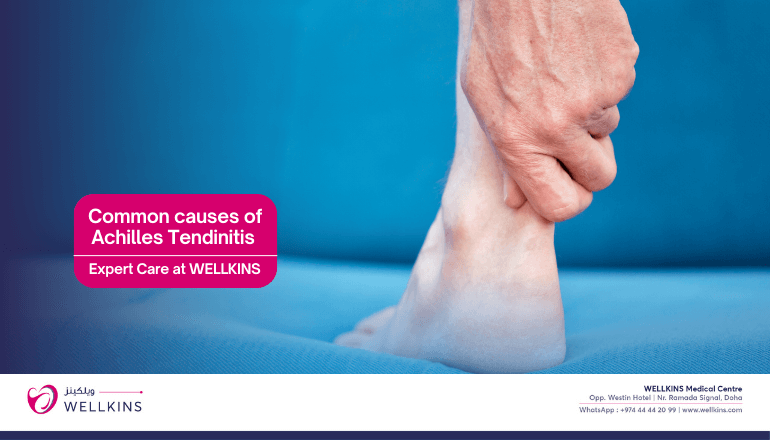
Common causes include:
- Overuse and repetitive strain: Frequent running, jumping, or a sudden increase in training intensity before the body can adapt.
- Sudden change in activity level: Transitioning from a sedentary lifestyle to a
rigorous fitness program or shifting from grass to hard pavement. - Poor footwear: Using shoes that lack adequate heel support, cushioning, or are worn out and unable to absorb impact.
- Tight calf muscles: Limited ankle dorsiflexion (upward movement) places excessive tension on the tendon fibers.
- Biomechanical abnormalities: Structural issues like flatfoot (pes planus), excessive pronation, or limb length discrepancy that force the tendon to “pull” at an awkward angle.
- Age-related tendon degeneration: As we age, reduced vascularity (blood supply) and collagen elasticity make the tendon more brittle.
- Obesity: Increased mechanical load on the tendon with every step.
- Systemic conditions: Factors such as diabetes mellitus, inflammatory arthritis, or hypercholesterolemia that affect tissue healing.
- Medication-related factors: Specifically, fluoroquinolone antibiotics or local corticosteroid injections into the tendon itself.
Clinically, Achilles tendinitis is classified into:
- Non-insertional Achilles tendinitis: Involving the mid portion of the tendon (2–6 cm proximal to insertion), often affecting younger, active individuals.
- Insertional Achilles tendinitis: Involving the tendon’s attachment to the calcaneus, often associated with calcific changes, bone spurs, or retrocalcaneal bursitis.
Symptoms
Patients typically present with a combination of pain, stiffness and functional limitation that can turn a simple morning walk into a chore.
Common symptoms include:
- Gradual onset pain: Usually felt along the Achilles tendon, especially during or immediately after physical activity.
- Morning stiffness: Intense pain at the start of walking in the morning that often “warms up” and improves with movement.
- Localized tenderness: A specific “sore spot” that hurts when squeezed.
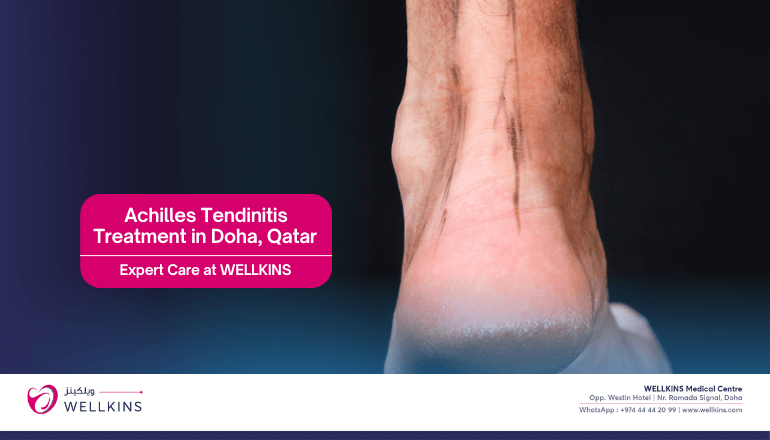
- Thickening or nodularity: The tendon may feel enlarged or develop a firm “lump” (nodule) in its mid-portion.
- Aggravated pain: Discomfort that spikes when running, climbing stairs, or standing on tiptoe.
- Chronic persistent pain: In advanced cases, the pain may be present even during rest or daily office activities.
Insertional tendinitis may additionally present with posterior heel pain, difficulty wearing shoes with firm backs and localized swelling at the very back of the heel.
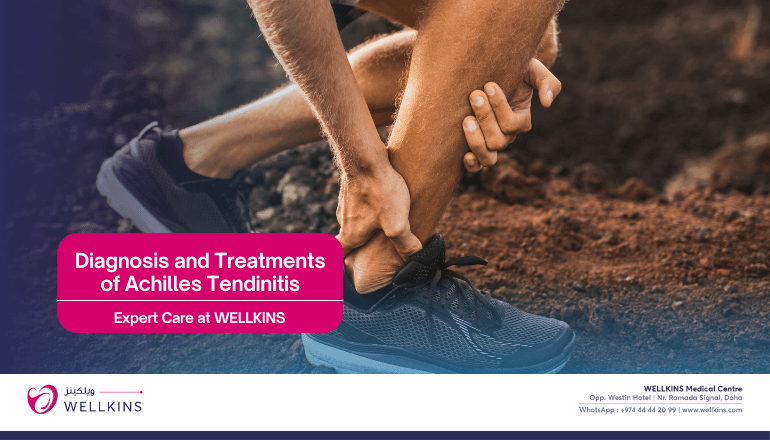
Diagnosis includes: Clinical Evaluation
Diagnosis at Wellkins Medical Centre is primarily clinical and based on a detailed history and physical examination performed by our orthopedic specialists:
- Inspection: Looking for visible swelling, redness, or a loss of the normal tendon “contour.”
- Palpation: Precisely identifying the location of tenderness to differentiate between mid substance and insertional issues.
- Functional testing: Evaluating pain elicited on resisted plantarflexion (pushing down) or passive dorsiflexion (stretching up).
- Biomechanical Screen: Assessment of calf tightness, ankle range of motion and overall foot alignment.
Imaging Studies
Imaging is vital for confirming the diagnosis, assessing the “grade” of degeneration and ruling out other pathologies:
- Ultrasound: A dynamic tool that demonstrates tendon thickening, hypoechoic areas (signs of degeneration), neovascularization (new blood vessel growth) and calcifications.
- MRI: The gold standard for evaluating the internal structure of the tendon, detecting partial tears, edema and soft tissue involvement.
- X-ray: Essential in insertional tendinitis to identify calcifications, bone spurs (enthesophytes), or a Haglund deformity (a bony bump on the heel).
Complications
If left untreated or managed with “just rest,” Achilles tendinitis can lead to significant, long term complications:
- Chronic tendinopathy: Permanent degenerative changes in the tendon fibers that make recovery much harder.
- Tendon calcification: The body may deposit calcium into the tendon, leading to hard, painful lumps.
- Reduced strength: A significant loss of explosive power in the ankle and calf.
- Altered gait mechanics: Compensating for heel pain often leads to secondary knee, hip, or lower back problems.
- Achilles tendon rupture: The most serious complication; a sudden “snap” that usually requires surgery and months of rehabilitation.
Prognosis
The prognosis of Achilles tendinitis is generally favorable with early diagnosis. At Wellkins, we emphasize that “patience is a clinical necessity” when it comes to tendons, as they heal slower than muscles due to limited blood supply.
Factors influencing prognosis include:
- Timeliness: How soon treatment was started after the first symptoms appeared.
- Compliance: Adherence to activity modification and the prescribed rehabilitation exercises.
- Underlying Health: Managing systemic diseases like diabetes to improve healing potential.
- Imaging Severity: The baseline level of tendon degeneration seen on MRI or Ultrasound.
Recovery and Rehabilitation: Conservative Management
Non-surgical treatment is the cornerstone of our approach at Wellkins Medical Centre:
- Activity modification: Focusing on “relative rest” (low impact activities like swimming instead of running).
- Cryotherapy: Targeted ice application during the acute phase to manage pain.
- Medication: Short-term use of NSAIDs to control pain and initial inflammation.
- Orthotic support: Heel lifts or custom orthotics to temporarily reduce the strain on the tendon.
Physiotherapy: The most crucial element, focusing on:
- Eccentric calf strengthening: Using the “Alfredson Protocol” to stimulate tendon repair.
- Stretching: Targeting the gastrocnemius–soleus complex to restore flexibility.
- Proprioceptive training: Improving balance and coordination.
Advanced Non-surgical Options
For persistent cases, we offer advanced interventions:
- Platelet-rich plasma (PRP) injections: Using your body’s own growth factors to stimulate healing in degenerate areas.
- Extracorporeal Shockwave Therapy (ESWT): Using acoustic waves to trigger a healing response and break down calcifications.
Surgical Management
Surgery is reserved for refractory cases failing at least 6 months of conservative treatment, focusing on removing degenerate tissue or repairing bone spurs.
Recovery Timeline
- Mild cases: Significant improvement often seen within 6–8 weeks.
- Moderate cases: Typically require 3–6 months of dedicated rehabilitation.
- Post-surgical recovery: May take 6–12 months for a full return to high-level functional activity.
Conclusion
Achilles tendinitis is a common yet potentially debilitating condition that requires a proactive, individualized management plan. From an orthopedic surgeon’s perspective, the goal is not just to relieve pain, but to rebuild a stronger, more resilient tendon capable of meeting your lifestyle demands.
At Wellkins Medical Centre, we combine clinical expertise with advanced technology to help you recover safely and effectively. Early diagnosis helps prevent progression to chronic tendinopathy or rupture. After a thorough clinical assessment and imaging when required, treatment may include activity modification, structured physiotherapy, eccentric strengthening exercises, shockwave therapy and regenerative options where appropriate. With proper guidance, footwear advice and a gradual return-to-activity plan, most patients regain strength, flexibility and confidence while reducing the risk of recurrence.
To book an appointment at Wellkins Medical Centre: https://wellkins.com/orthopedics/