
Author: Dr. Reneesh (Consultant Orthopedic Surgeon – Wellkins Medical Centre)
Introduction
Thigh muscle injuries are among the most frequent reasons for visits to our clinic at Wellkins Medical Centre. These injuries are particularly common in athletes and physically active individuals, but they can also occur during routine daily activities like a sudden dash to catch a bus or an awkward step off a curb. The thigh contains the body’s most powerful muscle groups the quadriceps (front thigh) and hamstrings (back thigh) which act as the primary “engines” for walking, running, jumping and maintaining knee stability. When these engines fail, your mobility and quality of life can come to a sudden, painful halt.
For athletes and active individuals receiving thigh muscle sports injury treatment in Qatar, appropriate post-treatment care is essential for safe recovery and lasting muscle performance. From a sports medicine standpoint, close monitoring of muscle healing, load management and inflammation control is vital throughout rehabilitation. Structured recovery plans including gradual return to activity, focused stretching, strengthening exercises and proper hydration help relieve pain, improve strength and flexibility and reduce the risk of re-injury, supporting long-term thigh muscle health rather than temporary relief.
Thigh muscle injuries usually occur when the muscle is stretched beyond its limit or forced to contract with extreme intensity while in a lengthened state (known as eccentric loading). In Qatar’s active community, we see these frequently during high intensity sports like padel or football.
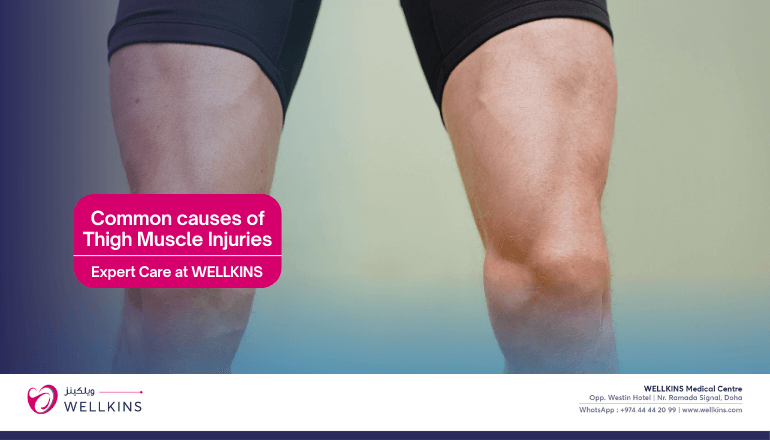
Common causes include:
- Sudden sprinting or acceleration: Forcing the muscle to transition from rest to 100% power in a split second.
- Jumping or abrupt stopping: The “deceleration” phase often puts more stress on the muscle than the takeoff.
- Overuse in sports: Such as football, cricket, basketball, athletics and cycling, where repetitive micro-trauma adds up.
- Inadequate warm-up or stretching: Cold muscles are less elastic and much more prone to snapping under pressure.
- Muscle fatigue or dehydration: In the Doha heat, loss of electrolytes leads to premature fatigue, causing the muscle to lose its protective “tone.”
- Direct trauma: Often seen as a “charley horse” or muscle contusion from a direct blow during contact sports.
- Muscle imbalance or poor conditioning: If your quads are significantly stronger than your hamstrings, the weaker group is at high risk.
- Previous muscle injury or scar tissue: Once a muscle has torn, the resulting scar tissue is less flexible than the original fiber, increasing the risk of a re tear.
Symptoms
The symptoms of a thigh injury can range from a nagging ache to an agonizing sensation that makes weight-bearing impossible. Recognizing the “Grade” of the injury early is key to a fast recovery.
Symptoms depend on the severity of the injury:
- Sudden sharp pain in the thigh: Often described as a “stabbing” sensation.
- Swelling and tenderness: The area may feel warm and look visibly larger than the other leg.
- Muscle tightness or stiffness: An inability to fully straighten or bend the knee without discomfort.
- Bruising or discoloration: This “ecchymosis” often travels down toward the knee due to gravity.
- Difficulty walking, running, or bending the knee: A noticeable limp is usually a sign of a Grade 2 or 3 injury.
- Weakness: Finding it difficult to lift the leg while lying down or failing to “push off” while walking.
- A “Popping” sensation: In severe injuries, a distinct audible pop and a visible deformity (a “gap” or “bunching” of the muscle) indicate a complete rupture.
Investigations
Clinical examination by a specialist is the first step in diagnosing the extent of the damage. At Wellkins, we use precise imaging to ensure we aren’t just treating the pain, but the actual structural tear.
- Ultrasound scan: An excellent first-line tool to detect hematomas (blood collections) and superficial muscle tears in real-time.
- MRI scan: The gold standard for orthopedic imaging. It allows us to see deep-seated tears and precisely grade the injury from I to III.
- X-ray: While it won’t show the muscle, it is vital to rule out “avulsion fractures,” where the muscle pulls a small piece of bone away at the attachment site.
- Blood tests: Rarely needed, but useful if we suspect underlying inflammatory conditions or severe muscle breakdown (rhabdomyolysis).
Treatment
The goal of treatment at Wellkins Medical Centre is to ensure the muscle heals with high quality, flexible tissue rather than weak, brittle scar tissue.
Conservative Treatment (Most Cases)
Most thigh muscle injuries respond beautifully to non-surgical care if managed correctly in the first 72 hours:
The R.I.C.E. Protocol: Rest, Ice (to constrict blood vessels), Compression (to limit swelling) and Elevation.
Medication: Use of targeted anti inflammatory like ice packs to manage the initial “inflammatory storm.”
Physiotherapy: This is the most critical phase. We focus on:
- Gentle stretching: To align healing fibers.
- Isometric and Eccentric Strengthening: Building strength while the muscle is lengthening.
- Manual Therapy: To break down early adhesions and improve blood flow.
Interventional / Surgical Treatment
- PRP (Platelet-Rich Plasma) Injections: We use your own growth factors to “supercharge” the healing of chronic or non healing tears.
- Surgical repair: Reserved for complete ruptures where the muscle has retracted, especially in high-level athletes who require maximum explosive power.
Complications If Not Treated
“Walking it off” is rarely a good strategy for significant thigh tears. Neglected injuries can lead to:
- Chronic pain and stiffness: A permanent “pulling” sensation during activity.
- Persistent muscle weakness: The leg may never return to its full pre-injury power.
- Recurrent muscle tears: A cycle of injury that can end an athletic career.
- Myositis ossificans: A rare but serious condition where the body mistakenly grows bone tissue inside the muscle after a severe bruise or tear.
- Altered gait: Compensating for a weak thigh can lead to chronic knee, hip, or lower back problems.
Prognosis and Recovery
Patience is a virtue in muscle healing. Returning to sport too early is the #1 cause of re injury.
- Mild strain (Grade 1): 1–3 weeks of rest and light rehab.
- Moderate tear (Grade 2): 4 8 weeks; this requires a dedicated physiotherapy plan.
- Severe tear (Grade 3): 3–6 months; a long road involving significant strengthening and possibly surgery.
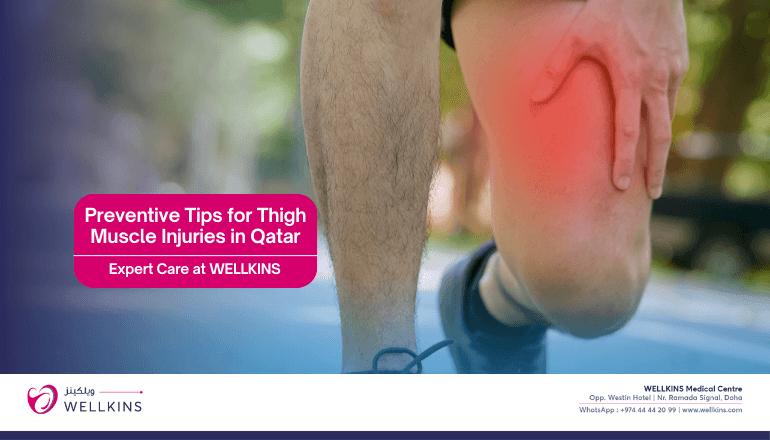
Prevention Tips
- Dynamic Warm-ups: Move your joints through their full range of motion before you start your main activity.
- Eccentric Strength Training: Exercises like “Nordic Hamstring Curls” are scientifically proven to prevent tears.
- The 10% Rule: Never increase your training intensity or duration by more than 10% per week.
- Hydration: Keep your muscles “plump” and reactive by drinking plenty of electrolytes.
- Listen to “Tightness”: A tight muscle is a muscle that is about to tear. Don’t ignore the warning signs.
Conclusion
Thigh muscle injuries can be frustrating, but they are highly treatable when caught early. At Wellkins Medical Centre, we specialize in getting you back to your peak performance through accurate diagnosis and structured rehabilitation. Don’t let a “pulled muscle” become a permanent problem. Whether you’re an elite athlete or a weekend warrior, our personalized recovery plans are tailored to your specific goals and pace. We don’t just treat the symptoms; we rebuild your strength to prevent future re-injury. Take the first step toward a pain-free stride today because your recovery deserves more than just rest.
To book an appointment at Wellkins Medical Centre: https://wellkins.com/orthopedics/