

Author: Dr. Reneesh (Consultant Orthopedic Surgeon – Wellkins Medical Centre)
Hyaluronic acid (HA) injections commonly referred to as viscosupplementation are widely used in orthopedic practice for managing degenerative, post-traumatic and mechanical joint disorders. In a bustling city like Doha, where staying active is key to quality of life, joint pain can be a major hurdle. While most commonly administered in the knee, HA is also effectively used in the hip, ankle, shoulder and other synovial joints to restore fluid movement and reduce friction. At Wellkins Medical Centre, we view these injections not just as a quick fix, but as a gateway to more effective physical therapy and long-term joint preservation. This blog provides a condition-independent, structured overview of post-injection care, onset of effect, number of sessions, rehabilitation phases, return to activity and key clinical recommendations to help you get the most out of your treatment.
For patients receiving hyaluronic acid injections in Qatar, proper post procedure care plays a vital role in treatment success and long-term joint relief. From an orthopedic perspective, monitoring joint response, activity levels and inflammation risk is essential after the injection. Guided aftercare, including temporary activity modification, joint support and hydration, helps reduce discomfort, enhance absorption and prolong benefits ensuring the treatment addresses joint health effectively rather than offering short term symptom relief.
Indications include:
- Osteoarthritis (mild to moderate): To supplement the thinning synovial fluid.
- Post-traumatic chondral injury: Helping the joint heal after a sports-related impact.
- Early degenerative joint disease: Acting as a preventative measure to slow down wear and tear.
- Mechanical joint pain with preserved joint space: Addressing pain that occurs during movement.
- Patients’ intolerant to NSAIDs: Providing a safer alternative for those who cannot take common painkillers due to stomach or kidney issues.
- Patients seeking to delay surgical intervention: Extending the “life” of the natural joint before considering a replacement.
They are not disease-curing, but aim to improve joint lubrication, shock absorption, pain modulation and function, allowing for a more active lifestyle.

Post-Injection Care: Do’s and Don’ts
The first few days after your procedure at Wellkins are vital for ensuring the substance settles correctly within the joint capsule.
DO’s
- Relative rest for 24–48 hours: Limit your walking and standing to essential movements only.
- Apply cold packs: If mild pain or swelling occurs, use ice for 10–15 minutes, 2–3 times daily to soothe the area.
- Continue prescribed analgesics: If your surgeon has recommended mild pain relief, keep a consistent schedule.
- Begin gentle exercises: Start pain-free range-of-motion movements after the initial 48 hour rest period.
- Maintain adequate hydration: Water is essential for the health of all connective tissues, especially in Qatar’s climate.
- Adhere to advised programs: Stick closely to the physiotherapy and weight management plans discussed during your consultation.
DON’ts
- Avoid high-impact activities: Refrain from running, jumping, or heavy squatting for at least 48–72 hours.
- Avoid prolonged standing: Steer clear of long shopping trips or stair climbing immediately post-procedure.
- Avoid strenuous exercise: Give your body at least 3–5 days before returning to the gym or sports.
- No heat application: Do not apply heat over the injected joint for the first 48 hours, as this can increase swelling.
- Avoid aggressive stretching: Gentle is better; do not push your joints into extreme ranges in the early phase.
Mild post-injection discomfort, often called an “injection flare,” can occur as the joint adjusts to the new volume of fluid, but it usually resolves within 24–72 hours.
Onset of Effect
Patience is key when undergoing viscosupplementation. Unlike a numbing agent, HA works by changing the environment inside the joint.
- Early improvement (1–3 weeks): You may begin to feel a slight “lightness” or reduction in morning stiffness.
- Noticeable symptom relief (4–6 weeks): The cushioning effect becomes more apparent during daily activities.
- Peak clinical benefit (6–8 weeks): This is when the maximum lubrication and anti inflammatory benefits are reached.
Unlike corticosteroid injections which offer immediate but shorter-term relief, hyaluronic acid works gradually and patients should be counseled to expect delayed but sustained improvement.
How Many Sessions Are Required?
The number of sessions depends on the specific formulation of the product used and the severity of the joint condition.
- Single-injection preparations: A highly concentrated formula administered in 1 session, ideal for busy professionals.
- Multi-dose regimens: A series of 3–5 weekly injections, which may be preferred for certain chronic conditions.
Both regimens are highly effective when appropriately indicated and accurately injected by a specialist using ultrasound guidance if necessary.
Duration of Symptom Relief
While HA is eventually absorbed by the body, the biological changes it triggers in the joint can last for many months.
- Typical duration: 4–6 months of significantly improved mobility.
- Extended benefit: 9–12 months in selected patients who follow a strict rehabilitation programs.
- Repeatability: Injections may be safely repeated every six months if symptoms recur and no contraindications exist.
Best outcomes are observed in early to moderate disease where the joint mechanics are still largely preserved.
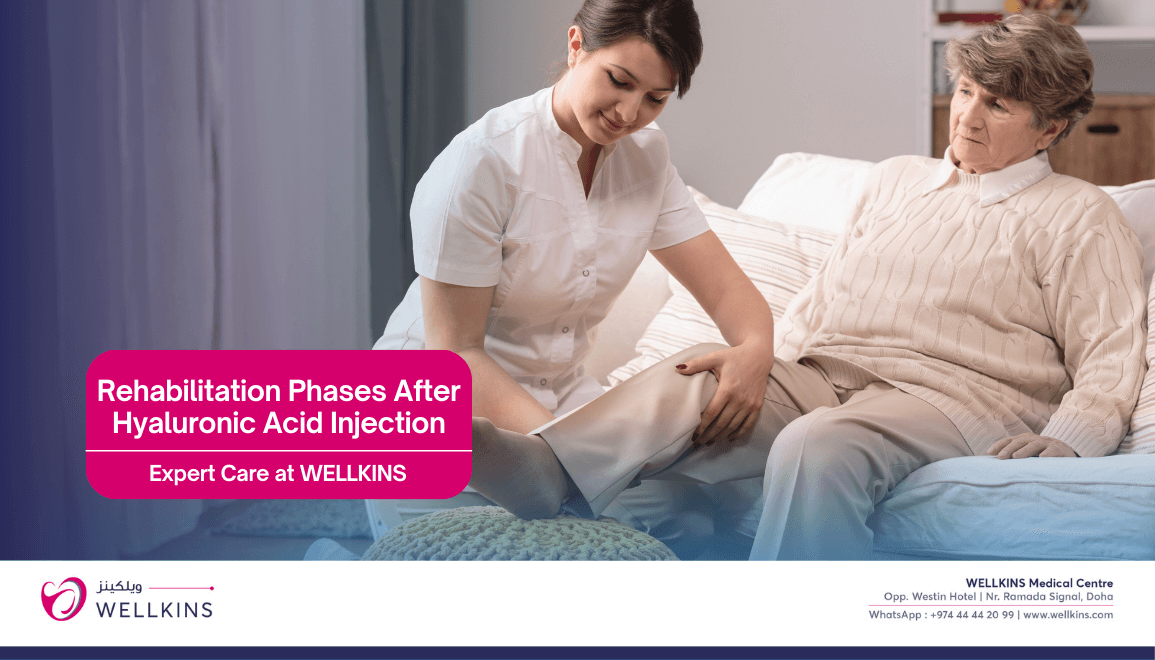
Rehabilitation Phases After Hyaluronic Acid Injection
Recovery is a journey, not a destination. Our physiotherapy department at Wellkins structures your recovery into four distinct phases:
Phase 1: Protection Phase (Day 0–2)
- Relative rest: Avoiding any unnecessary strain.
- Ice therapy: Using cold compresses to keep inflammation at bay.
- Gentle movements: Making small, non-weight-bearing circles or flexions.
Phase 2: Mobility Phase (Day 3–14)
- Range-of-motion: Moving the joint through its full available path.
- Stretching: Focusing on the muscles around the joint without causing pain.
- Low-load movements: Starting to incorporate light walking.
Phase 3: Strengthening Phase (Week 2–6)
Progressive muscle strengthening: Building the “support pillars” for your joints.
Focus on periarticular muscles: * Knee: Quadriceps, hamstrings and hip abductors.
- Hip: Gluteal and core stabilizers.
- Ankle: Calf and intrinsic foot muscles.
- Shoulder: Rotator cuff and scapular stabilizers.
Balance training: Improving proprioception to prevent future stumbles or injuries.
Phase 4: Functional & Activity Phase (6+ weeks)
- Gait retraining: Ensuring your walking pattern is efficient and balanced.
- Return to work: Gradually resuming all occupational and functional tasks.
- Sport-specific conditioning: Preparing the body for the specific demands of your chosen sport.
Return to Activity (General Guidelines)
- Activities of daily living: Usually safe within 24–72 hours.
- Low-impact activities (walking, cycling, swimming): Recommended after 1–2 weeks to keep the joint moving.
- Moderate recreational activity: Generally safe after 3 4 weeks of progressive strengthening.
- High-impact sports: Generally discouraged in advanced degenerative conditions; if considered, only after full symptom resolution and adequate conditioning.
Key Clinical Recommendations
To ensure you are the right candidate and achieve the best possible result, we follow strict clinical guidelines:
Ideal candidates include those with:
- Mild to moderate degenerative joint disease where cartilage is still present.
- Mechanical pain that correlates with specific movements.
- A desire to avoid or delay surgery due to age, health status, or personal preference.
Optimal outcomes require:
- Accurate technique: Ensuring the fluid is placed precisely within the joint capsule.
- Education: Managing expectations regarding the gradual onset of the drug.
- Structured rehab: Combining the injection with physical therapy for maximum benefit.
- Lifestyle modification: Addressing weight management and ergonomics to reduce joint load.
Conclusion
Hyaluronic acid injections are a safe, joint-preserving and evidence-based intervention across multiple orthopedic conditions when used in appropriately selected patients. The true benefit lies not only in the injection itself, but in the complete post-procedure care, rehabilitation and lifestyle modification that follows. At Wellkins Medical Centre, our role is to integrate viscosupplementation into a holistic, patient-centered treatment strategy aimed at improving function, reducing pain and delaying disease progression. By treating the whole person not just the joint we help you move with confidence and rediscover the activities you love.
To book an appointment at Wellkins Medical Centre: https://wellkins.com/orthopedics/