
Author: Dr. Rahmathunnisa AM, (Dentist – Wellkins Medical Centre)
A brighter smile is one of the most consistently requested aesthetic outcomes in dental practice and one of the most achievable. Teeth whitening is safe, effective and produces results that genuinely change how people feel about their smile when it is performed correctly using professional-grade treatments rather than the over-the-counter options that line pharmacy shelves with promises they cannot fully deliver.
In Qatar, interest in teeth whitening has grown significantly alongside the broader growth of aesthetic dental care across Doha’s diverse and image-conscious population. Whether driven by a wedding, a professional milestone, a desire to reverse the staining that years of tea, coffee and lifestyle habits accumulate or simply a wish to look and feel more confident, the motivation is different for every patient. What does not differ is the value of getting it done properly.
At Wellkins Medical Centre, teeth whitening is offered as a professional dental treatment rather than an over-the-counter purchase. That distinction matters clinically, practically and in terms of the results patients actually achieve. This guide covers everything you need to know about professional teeth whitening in Qatar: how it works, what options are available, what to expect and how to maintain your results in an environment that is particularly challenging for tooth color.
Teeth whitening is one of the treatments I recommend most frequently when patients ask what single aesthetic dental treatment will have the most visible and the most immediate impact on their smile. The results from professional whitening, particularly for patients with significant staining from tea, coffee or tobacco, are consistently impressive and consistently well received. What I emphasize to every patient before we begin is that whitening works most safely and most predictably when the teeth are clinically healthy beforehand. A thorough dental assessment before any whitening treatment is not optional. It is the foundation of a good outcome.
People Also Ask
Is professional teeth whitening safe?
Yes. Professional teeth whitening performed by a qualified dentist using clinically approved whitening agents is safe for the vast majority of patients. The whitening agents used in professional treatments, primarily hydrogen peroxide or carbamide peroxide at regulated concentrations, have extensive evidence supporting their safety and efficacy when applied correctly. Temporary tooth sensitivity and mild gum irritation are the most common side effects and both resolve within a few days of treatment. A pre-whitening dental assessment identifies any conditions including untreated decay, gum disease or significant enamel erosion that would need to be addressed before whitening can be safely performed.
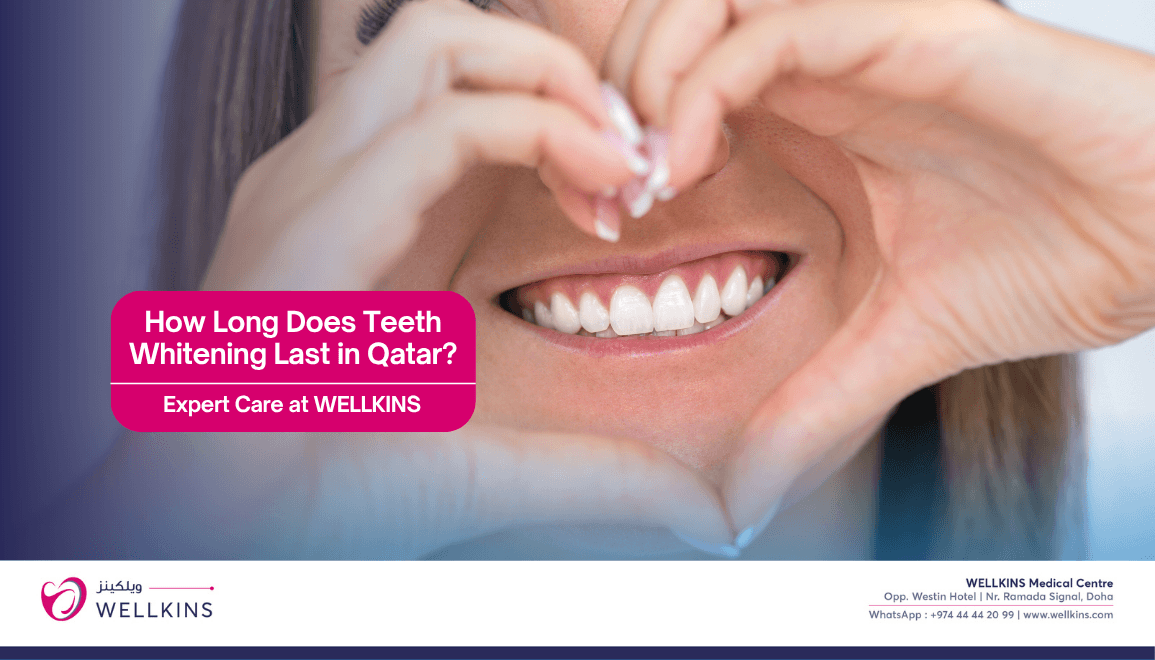
How long does teeth whitening last in Qatar?
Professional teeth whitening results typically last between one and three years depending on the individual’s dietary and lifestyle habits and their baseline tooth color. In Qatar’s tea and coffee culture where karak chai, Arabic coffee and regular black tea are consumed multiple times daily, color relapse tends to occur more quickly without active maintenance. Avoiding or limiting strongly pigmented foods and beverages immediately after whitening, using a whitening toothpaste for daily maintenance and attending periodic professional top-up sessions significantly extends the longevity of whitening results.
What is the difference between in-chair and take-home teeth whitening?
In-chair whitening is performed in the dental clinic in a single appointment of approximately 60 to 90 minutes using a high-concentration professional whitening agent applied by the dentist. Results are immediate and typically represent the maximum achievable whitening in a single session. Take-home whitening uses custom-fitted trays made from impressions of your teeth combined with a lower-concentration professional whitening gel that you apply at home over one to three weeks. Both approaches use clinically proven professional-grade agents. The choice depends on the degree of color change desired, the patient’s timeline and their preference for a single appointment versus a gradual at-home process.
Can teeth whitening damage enamel?
Professional teeth whitening performed at dentist-recommended concentrations and with appropriate application time does not damage tooth enamel when the teeth are assessed as clinically healthy before treatment. The whitening agent temporarily increases the porosity of the enamel surface to allow the peroxide molecules to penetrate and oxidize the pigmented compounds within the tooth structure, then the enamel returns to its normal state over 24 to 48 hours. Using remineralising toothpaste and avoiding acidic foods and beverages in the days immediately following whitening supports the enamel recovery process.

Why Teeth Become Discolored: Understanding the Two Types of Staining
Understanding what type of discoloration you have is the essential starting point for any teeth whitening conversation because it determines what is achievable and what approach will produce the best results.
Extrinsic Staining
Extrinsic staining affects the outer surface of the tooth enamel and is caused by the accumulation of pigmented compounds from food, beverages, tobacco and other external sources. This is the most common type of discoloration and the most directly responsive to teeth whitening treatment.
The most significant sources of extrinsic staining in Qatar’s population include:
- Tea: Both karak chai and regular black tea contain high concentrations of tannins, polyphenolic compounds that bind strongly to tooth enamel and produce the characteristic yellow-brown staining that is among the most prevalent dental discoloration in Qatar’s population. Regular tea drinking multiple times daily accumulates significant staining over months and years.
- Coffee: Similar to tea, coffee contains tannins and other chromogens that adhere to enamel. Espresso-based drinks are particularly staining and the addition of sugar in many of the sweetened coffee preparations popular in Qatar creates an additional acidic environment that makes enamel more porous and more susceptible to pigment penetration.
- Tobacco: Tobacco smoking and the use of shisha, which is widespread in Qatar’s social culture, produce intense yellow-brown to almost black staining from tar and nicotine deposits on the enamel surface. Tobacco staining tends to be the most resistant to whitening among the common extrinsic stain types.
- Red wine, tomato sauces and dark-coloured spices: Intensely coloured foods contribute to cumulative surface staining over time particularly in patients who brush infrequently after eating.
Intrinsic Discoloration
Intrinsic discoloration originates within the tooth structure itself rather than on the surface. Common causes include:
- Tetracycline staining: An antibiotic taken during childhood when teeth are still forming can incorporate into the developing enamel and dentine, producing grey-blue banding that is resistant to standard whitening and may require prolonged treatment or alternative restorative approaches.
- Fluorosis: Excessive fluoride intake during tooth development produces white spots or brown mottling in the enamel. Mild fluorosis may respond partially to whitening. Moderate to severe fluorosis typically requires restorative treatment.
- Age-related darkening: As people age the enamel thins and the underlying dentine, which is naturally more yellow, becomes more visible. The dentine also becomes progressively darker with accumulated secondary dentine deposition. Professional whitening can significantly improve age-related darkening though the degree of improvement is influenced by how much of the color change is from enamel thinning.
- Trauma or root canal treatment: A tooth that has been traumatized or has undergone root canal treatment may darken as the internal tissue breaks down. Internal or walking bleach techniques are available for these cases.
Professional Teeth Whitening Options at Wellkins Medical Centre
In-Chair Professional Whitening
In-chair whitening is performed in the dental clinic at Wellkins in a single appointment. The treatment uses a high-concentration professional whitening agent applied directly to the tooth surfaces by the dentist with the gums carefully protected using a light-cured barrier gel.
The process at Wellkins follows these steps:
- A pre-whitening dental assessment confirms that the teeth and gums are clinically healthy and that there are no contraindications to whitening. Any existing decay or gum disease is identified and must be treated before whitening proceeds.
- A professional clean is performed to remove surface deposits and calculus that would otherwise reduce the uniform contact of the whitening agent with the tooth surface.
- A shade assessment is taken with photographs to document the starting color and allow accurate comparison after treatment.
- Gum protection is applied to ensure the whitening agent contacts only the tooth surfaces.
- The professional whitening gel is applied and left for the appropriate contact time as specified by the product protocol. Multiple application cycles may be performed within the same appointment to achieve the maximum color change.
- The gel is thoroughly removed and the final shade is assessed and photographed.
The appointment typically takes 60 to 90 minutes and results are visible immediately following treatment. The teeth continue to brighten slightly over the 24 to 48 hours following treatment as the enamel rehydrates.
Take-Home Professional Whitening
Take-home whitening at Wellkins uses custom-fabricated trays made from impressions of your own teeth combined with a professional-grade whitening gel for use at home over a period of one to three weeks.
- Custom trays are fabricated from dental impressions ensuring a precise fit that holds the gel against the tooth surface evenly and prevents it from spreading onto the gum tissue.
- A professional whitening gel at the appropriate concentration for home use is dispensed with clear instructions for application time and frequency.
- Results develop gradually over the treatment period, typically one to three weeks, and can ultimately achieve a comparable or superior degree of whitening to in-chair treatment when the full course is completed consistently.
- Custom trays are retained for future top-up treatments, making take-home whitening a cost-effective long-term whitening maintenance strategy when additional gel is purchased for periodic retreatment.
Who Is Suitable for Teeth Whitening?
The majority of adults with extrinsic or mild to moderate intrinsic discoloration are good candidates for professional teeth whitening. The pre-treatment dental assessment at Wellkins confirms suitability on an individual basis.
Good candidates for whitening include:
- Adults with healthy teeth and gums who have not had active gum disease or untreated decay.
- Patients with predominantly extrinsic staining from tea, coffee, tobacco or food pigments.
- Patients with mild to moderate age-related yellowing of the natural teeth.
- Patients whose teeth have darkened gradually and who want to restore a brighter natural appearance without restorative work.
Patients for whom whitening requires additional consideration:
- Patients with crowns, veneers or large composite fillings on visible front teeth: Whitening agents do not change the color of existing restorations. If these are present on front teeth the natural teeth may whiten while the restorations remain their original shade, creating a color mismatch that requires the restorations to be replaced to match the new tooth color. This is discussed and planned carefully before whitening begins.
- Patients with significant tooth sensitivity: Pre-existing dentine hypersensitivity does not exclude whitening but the treatment protocol may be modified, including the use of lower-concentration gel, shorter contact times and desensitizing agents before and after treatment.
- Pregnant or breastfeeding patients: Whitening is not recommended during pregnancy or breastfeeding as a precautionary measure given the limited evidence in this group.
- Patients under 18: Professional whitening is generally not recommended for patients whose teeth are still developing.
Maintaining Your Results in Qatar’s Environment
Qatar presents specific challenges for whitening maintenance that are worth understanding before beginning treatment so that realistic expectations are set and the right maintenance habits are established from the start.
- Manage Tea and Coffee Consumption: Immediately after whitening the enamel is temporarily more porous and more susceptible to restaining for 24 to 48 hours. Avoiding intensely coloured beverages including tea, coffee and coloured juices during this window reduces early restaining significantly. Longer term, drinking tea and coffee through a straw where culturally appropriate and rinsing with water immediately after reduces cumulative staining.
- Use a Whitening Toothpaste for Maintenance: A daily whitening toothpaste with mild abrasive or peroxide-containing formulation helps remove surface deposits before they accumulate into visible staining. This maintenance step significantly extends the interval between professional whitening sessions.
- Schedule Regular Professional Cleans at Wellkins: Professional scaling and polishing removes the calculus and surface stain deposits that accumulate between brushing and contributes meaningfully to the longevity of whitening results. Every six months is the appropriate frequency for most patients.
- Consider Periodic Top-Up Treatments: Patients who retain their custom take-home trays can perform a short one to two-week top-up whitening course annually or when color relapse becomes noticeable, maintaining their results at a fraction of the cost and time of starting treatment from scratch.
- Quit Tobacco: Tobacco staining is the most aggressive and most persistent source of tooth discoloration. Whitening results in tobacco users deteriorate faster than in non-smokers regardless of the initial treatment quality. Quitting is the most impactful single step a tobacco user can take for the longevity of their whitening results alongside its far broader health benefits.
When to See a Dentist at Wellkins Before Whitening
A dental assessment at Wellkins Medical Centre before any whitening treatment is not a formality. It is the clinical step that makes whitening safe and successful. You should book a dental consultation before considering teeth whitening if any of the following apply.
- You have not had a dental check-up in more than twelve months and are unsure whether there are any conditions including decay or gum disease that need to be addressed first.
- You have crowns, veneers or composite fillings on your front teeth and want to understand how whitening will interact with these restorations.
- You experience significant tooth sensitivity with cold drinks or air and want to discuss whether whitening is appropriate and how it can be safely managed for your sensitivity level.
- You have noticed specific isolated dark or discolored teeth rather than generalized color change, which may indicate an internal cause requiring a different treatment approach.
- You have used over-the-counter whitening products without significant improvement and want to understand what professional options can offer.
- You are planning a whitening treatment before a significant upcoming event including a wedding or graduation and want to plan the timing and the realistic outcome correctly.
A brighter smile is one of the most accessible and most impactful aesthetic improvements available in dentistry. When it is based on a proper clinical assessment, using professional-grade agents and supported by the right maintenance habits in Qatar’s specific environment, the results are consistently impressive and consistently long-lasting.
Your smile is worth doing properly.
To book an appointment at Wellkins Medical Centre: https://wellkins.com/drrahmath
To know more about the Dental services at Wellkins Medical Centre: https://wellkins.com/dental-care