
Author: Dr. Steffy Mariyam Reji, (Specialist Dermatologist – Wellkins Medical Centre)
Qatar has some of the highest ultraviolet radiation levels recorded anywhere on Earth. The UV index regularly reaches 11 or above during the summer months, a level classified as extreme, and remains in the high to very high range throughout much of the year. For a country where outdoor exposure is part of daily life at school runs, sporting activities, commutes and weekend gatherings, the skin is under consistent and significant UV stress across almost every month of the year.
And yet sun protection remains one of the most inconsistently practiced habits among Qatar’s diverse adult and child population. Some families apply sunscreen religiously. Many apply it occasionally. A significant proportion do not apply it at all, either because they believe their skin tone provides adequate protection, because they are unsure which product to choose or because they find that most sunscreens feel uncomfortable in Qatar’s heat and humidity.
This guide is designed to change that. Choosing the right sunscreen for Qatar’s specific UV environment is not complicated once you understand what the numbers mean, which ingredients matter and how to apply it in a way that actually works.
The single most evidence-supported anti-ageing intervention available to every person in Qatar is daily broad-spectrum sunscreen. Not a serum, not a treatment, not a clinic procedure. Sunscreen, applied correctly and consistently from early life. I say this to every patient who comes to me asking about skin ageing, pigmentation, uneven skin tone or skin cancer risk. The foundation of everything we do in dermatology to protect and maintain healthy skin starts with the sunscreen that should already be on before the day begins. In Qatar’s UV environment this is not optional. It is essential.
People Also Ask
What SPF should I use in Qatar?
A minimum of SPF 30 is the clinical recommendation for daily use. In Qatar’s extreme UV environment, particularly during outdoor activity, SPF 50 or SPF 50+ is the more appropriate choice for most people. SPF 30 blocks approximately 97 percent of UVB radiation when applied correctly. SPF 50 blocks approximately 98 percent. The difference sounds small but at Qatar’s UV index levels the additional protection is clinically meaningful, particularly for people with lighter skin tones, a history of pigmentation or a family history of skin cancer.
What is the difference between UVA and UVB protection?
UVB rays are the primary cause of sunburn and a significant driver of skin cancer. SPF measures protection specifically against UVB. UVA rays penetrate deeper into the skin and are the primary cause of photoaging including wrinkles, loss of skin firmness and pigmentation changes. UVA also contributes to skin cancer risk. A broad-spectrum sunscreen protects against both UVA and UVB. In Qatar where year-round UV exposure is high across both spectrums, broad-spectrum protection is non-negotiable. Always look for “broad spectrum” on the label regardless of the SPF number.
Should people with dark skin use sunscreen in Qatar?
Yes, absolutely. Darker skin tones contain more melanin which provides some natural protection against sunburn and reduces the risk of certain forms of skin cancer compared to lighter skin. However melanin does not provide meaningful protection against UVA-driven photoaging or hyperpigmentation, which are actually more visually prominent concerns in darker skin tones. Post-inflammatory hyperpigmentation and melasma, conditions that produce dark patches on the skin, are significantly worsened by UV exposure in all skin tones. Daily broad-spectrum sunscreen is as relevant for South Asian, Arab, African and Southeast Asian skin as it is for fairer skin, simply for different primary reasons.
How much sunscreen should I apply and how often should I reapply?
The correct amount of sunscreen for the face is approximately a teaspoon, which is considerably more than most people apply. For the body, the general guidance is two milligrams per square centimeter of skin, which for a full-body application equates to approximately one shot glass volume of product. Most people apply 25 to 50 percent of the recommended amount, which substantially reduces the actual protection level achieved. Reapplication every two hours during outdoor exposure is essential regardless of the SPF number on the label as sunscreen degrades with UV exposure, sweat and physical contact. Water-resistant formulas require reapplication after 40 to 80 minutes of water exposure.

Understanding SPF: What the Numbers Actually Mean
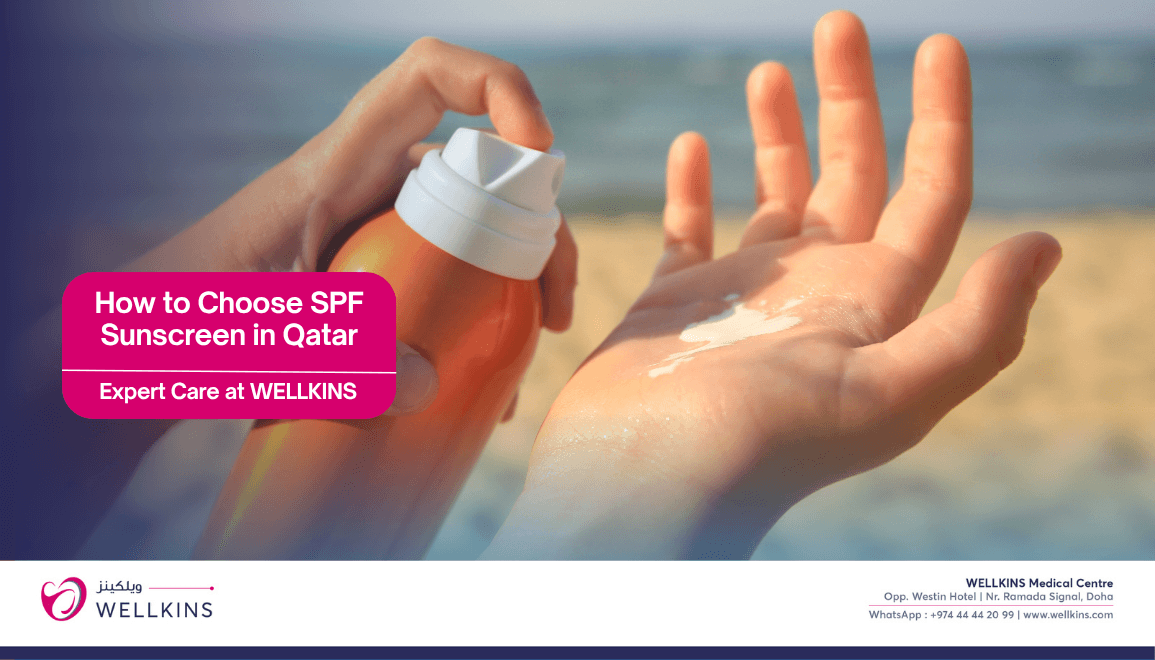
SPF stands for Sun Protection Factor and it measures how much longer it takes for UVB rays to produce sunburn on sunscreen-protected skin compared to unprotected skin. The number does not represent a percentage of rays blocked in a simple linear way.
- SPF 15 blocks approximately 93 percent of UVB rays.
- SPF 30 blocks approximately 97 percent of UVB rays.
- SPF 50 blocks approximately 98 percent of UVB rays.
- SPF 100 blocks approximately 99 percent of UVB rays.
The difference between SPF 30 and SPF 50 may appear small but in practical terms at Qatar’s UV index levels the gap between allowing 3 percent versus 2 percent of UVB through is meaningful over years of daily exposure. Dermatologists in high UV environments including Qatar consistently recommend SPF 50 as the practical standard for daily use.
Three important clarifications that matter in Qatar’s context:
- SPF only measures UVB protection. It tells you nothing about UVA protection. A product with a high SPF that is not labelled broad-spectrum may provide excellent UVB protection while providing minimal UVA protection. Always choose broad-spectrum.
- The SPF number assumes correct application quantity. SPF ratings are tested at 2mg per cm² of skin. Most people apply significantly less than this, meaning the real-world SPF achieved is considerably lower than the label states. SPF 50 applied at half the recommended amount delivers SPF 50 protection to none of the skin that remains uncovered.
- SPF does not extend proportionally with reapplication time. SPF 50 does not mean you can stay in Qatar’s midday sun for 50 times longer than without protection. The protection degrades with UV exposure, sweat and contact and must be reapplied every two hours regardless of the SPF value.
UVA vs UVB: Why Both Matter in Qatar
The sun emits two types of ultraviolet radiation that reach the Earth’s surface and both require protection, particularly in Qatar’s extreme UV environment.
- UVB rays have shorter wavelengths and are the primary cause of sunburn. They are most intense between 10 AM and 4 PM and are partially blocked by glass and cloud cover. UVB is the primary driver of squamous cell carcinoma and a significant contributor to melanoma risk. SPF directly measures UVB protection.
- UVA rays have longer wavelengths that penetrate deeper into the dermis, the skin’s second layer where collagen and elastin fibers live. UVA is present at relatively consistent levels throughout daylight hours including on cloudy days and penetrates glass, meaning car windows and office windows do not provide protection. UVA is the primary driver of photoaging including wrinkles, skin laxity, pigmentation irregularities and the leathery skin texture that accumulates with years of unprotected UV exposure. UVA also contributes to skin cancer risk. In Qatar where driving time is significant and where office environments with large glass windows are common, UVA protection is particularly important throughout the day even when direct outdoor sun exposure is limited.
A broad-spectrum sunscreen is one that has been tested and confirmed to provide meaningful protection across both the UVA and UVB wavelength ranges. The term “broad-spectrum” on a sunscreen label is the simplest and most reliable indicator that UVA protection is included alongside the UVB protection that SPF measures.
Chemical vs Mineral Sunscreen: Which Is Right for You in Qatar?
Sunscreen active ingredients fall into two categories: chemical filters that absorb UV energy and convert it to heat and mineral filters that physically reflect UV rays. Both are effective when formulated and applied correctly but they have different properties that make each better suited to specific situations in Qatar’s climate.
Chemical Sunscreens
- How they work: Chemical filters including avobenzone, octinoxate, octisalate, oxybenzone and the newer stabilised filters homosalate and tinosorb absorb UV radiation and convert it into harmless heat energy that dissipates from the skin.
- Texture and feel: Chemical sunscreens are typically lighter, more fluid and easier to blend invisibly into the skin. They sit well under makeup and in tinted formulations and are generally more cosmetically elegant than mineral alternatives, which matters in Qatar’s heat where heavy products feel uncomfortable.
- Considerations: Chemical sunscreens require approximately 20 minutes after application before they are fully active. Some chemical filters including oxybenzone can cause irritation in sensitive skin. They may not be the first choice for people with reactive or rosacea-prone skin.
- Best suited to: Adults with normal to oily skin in Qatar’s heat who want a lightweight daily sunscreen that sits invisibly under makeup or that does not feel heavy during outdoor activity.
Mineral Sunscreens
- How they work: Mineral filters, specifically zinc oxide and titanium dioxide, sit on the skin surface and physically scatter and reflect UV radiation before it penetrates the skin.
- Texture and feel: Traditional mineral sunscreens can be thick, white-casting and difficult to blend, particularly on darker skin tones where the white cast is more visible. Modern micronized or nano-particle formulations significantly reduce this white cast while maintaining the physical filtering action.
- Considerations: Mineral sunscreens are active immediately on application with no waiting period. They are the preferred choice for sensitive and reactive skin, for children and for people with conditions including rosacea, melasma and post-procedure skin because they sit on the surface rather than being absorbed.
- Best suited to: Children, people with sensitive or reactive skin and those using sunscreen post-laser or post-chemical peel where skin is particularly vulnerable. Also an excellent choice for patients managing melasma in Qatar’s high UV environment where the iron oxides in tinted mineral sunscreens provide additional protection against visible light which is a significant driver of melasma.
Choosing the Right Sunscreen for Your Skin Type in Qatar
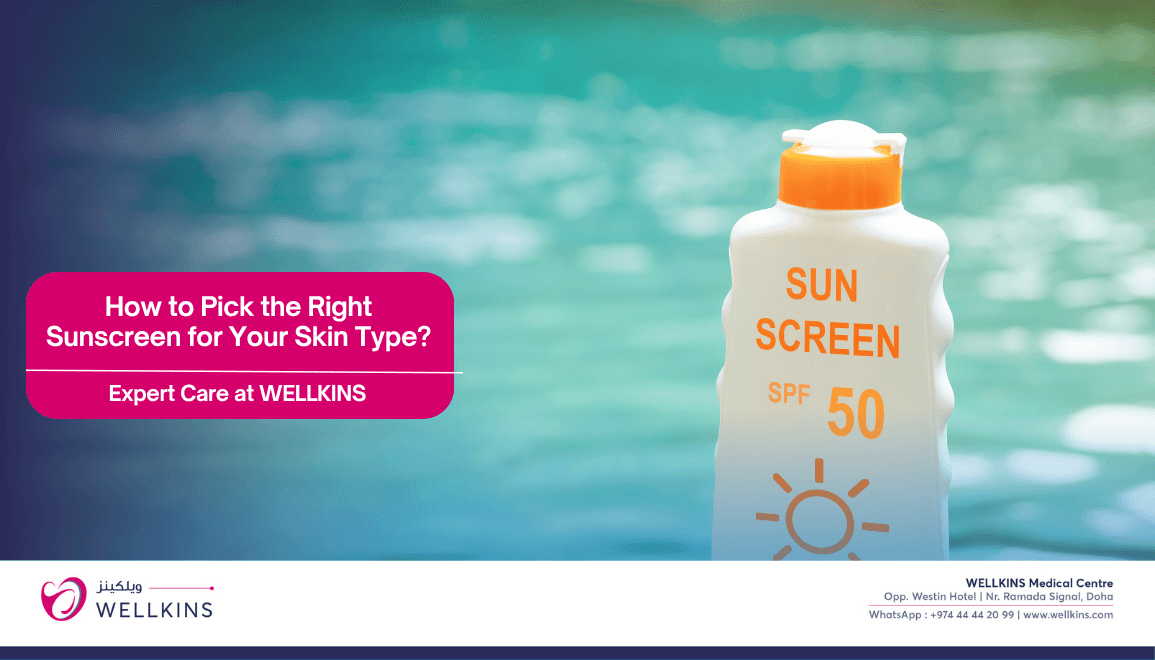
Qatar’s combination of intense heat, high humidity during the coastal summer months and year-round UV exposure creates specific demands on sunscreen formulation choice beyond simply selecting the right SPF number.
- Oily and acne-prone skin: Choose an oil-free or mattifying formula labelled non-comedogenic. Fluid or gel sunscreen textures with a matte finish sit well on oily skin without blocking pores or worsening breakouts. Avoid heavy cream formulations that can feel occlusive and greasy in Qatar’s heat and humidity. Chemical filters in a lightweight fluid base are typically the most comfortable option for this skin type in Qatar’s climate.
- Dry and sensitive skin: Choose a mineral sunscreen with hydrating ingredients including hyaluronic acid, glycerin or niacinamide. Cream or lotion formulations provide additional moisturization alongside protection. Mineral zinc oxide is the most gentle filter for reactive skin and is appropriate for both daily use and for use after dermatological procedures or treatments.
- Skin with pigmentation or melasma: Broad-spectrum SPF 50 or higher is non-negotiable for anyone managing hyperpigmentation or melasma in Qatar’s UV environment as UV exposure is the single most powerful driver of pigmentation worsening. A tinted mineral sunscreen with iron oxides provides additional protection against visible light and high-energy visible blue light that also drives melasma beyond the UV spectrum. This is the most clinically effective sunscreen choice for pigmentation management in Qatar.
- Dark skin tones: Modern mineral sunscreens in tinted formulations or hybrid chemical-mineral products avoid the white cast that older mineral formulations produce on darker skin. Alternatively a lightweight chemical broad-spectrum product is equally protective and blends without residue. The key message for any skin tone is that broad-spectrum protection is essential regardless of natural melanin content.
- Children’s skin: Mineral sunscreen with zinc oxide or titanium dioxide is the first choice for children due to its immediate action, its gentleness on sensitive developing skin and its well-established safety profile. SPF 50 applied generously and reapplied after swimming or sweating is the appropriate standard for children in Qatar’s outdoor environment.
How to Apply Sunscreen Correctly: The Steps That Make the Difference
The gap between how most people apply sunscreen and how it must be applied to deliver the labelled protection level is one of the most significant and most correctable factors in real-world sun protection. Correct application technique is as important as product choice.
- Apply to dry skin as the last skincare step before makeup: Sunscreen should be the final step in your morning skincare routine, applied to clean dry skin and allowed to absorb or sit before foundation or other products are applied over it. Mixing sunscreen into moisturizer or applying it over wet skin dilutes the active ingredients and reduces the uniform coverage needed for consistent protection.
- Use the right amount for the face: The standard recommendation for the face is approximately a teaspoon of product. This is more than most people apply. Insufficient quantity is the most common reason real-world sun protection falls short of the labelled SPF.
- Cover all exposed areas: Ears, the back of the neck, the back of the hands, the top of the feet and any areas of skin exposed by clothing or hairstyle are commonly missed. In Qatar’s outdoor environment these areas accumulate significant UV exposure that contributes meaningfully to skin damage and ageing over years.
- Apply 20 minutes before sun exposure for chemical sunscreens: Chemical filters require absorption time to be fully active. Mineral sunscreens are active immediately on application.
- Reapply every two hours during outdoor exposure: Sunscreen degrades with UV exposure, sweat and physical contact. No sunscreen maintains full protection for longer than two hours of continuous outdoor exposure in Qatar’s sun. Water-resistant formulations maintain protection for 40 to 80 minutes of water or sweat exposure and should then be reapplied.
- Do not rely on makeup SPF as your primary sun protection: Foundation and tinted moisturizers with SPF are applied in quantities far below what is needed to achieve the labelled SPF. They are a supplement to a dedicated sunscreen layer, not a replacement for it.
What Happens to Skin Without Adequate Sun Protection in Qatar
The consequences of inadequate sun protection accumulate gradually and often invisibly until they become difficult to ignore or difficult to treat. In Qatar’s extreme UV environment these consequences arrive earlier and are more pronounced than in lower UV climates.
- Photoaging: Chronic UVA exposure is the primary driver of premature skin ageing including fine lines, deeper wrinkles, loss of skin firmness and the uneven skin tone that accumulates with years of unprotected UV exposure. This is distinct from intrinsic ageing and is largely preventable with consistent broad-spectrum sun protection from early adulthood.
- Hyperpigmentation and melasma: UV exposure is the most powerful trigger for melanin overproduction, producing sunspots, post-inflammatory hyperpigmentation and melasma. In Qatar’s high UV environment, pigmentation conditions are among the most common presentations in the dermatology clinic and consistent daily sunscreen is the most essential component of any pigmentation management plan.
- Actinic keratoses: Rough precancerous patches that develop on chronically sun-damaged skin, particularly on the face, scalp, ears and the backs of the hands. These require treatment to prevent progression and are a direct consequence of cumulative unprotected UV exposure.
- Skin cancer: Basal cell carcinoma, squamous cell carcinoma and melanoma are all associated with cumulative UV exposure over a lifetime. Qatar’s extreme UV environment creates significant lifetime UV exposure for long-term residents and consistent broad-spectrum sun protection from early life is the most important preventive measure available.
When to See a Dermatologist at Wellkins Medical Centre
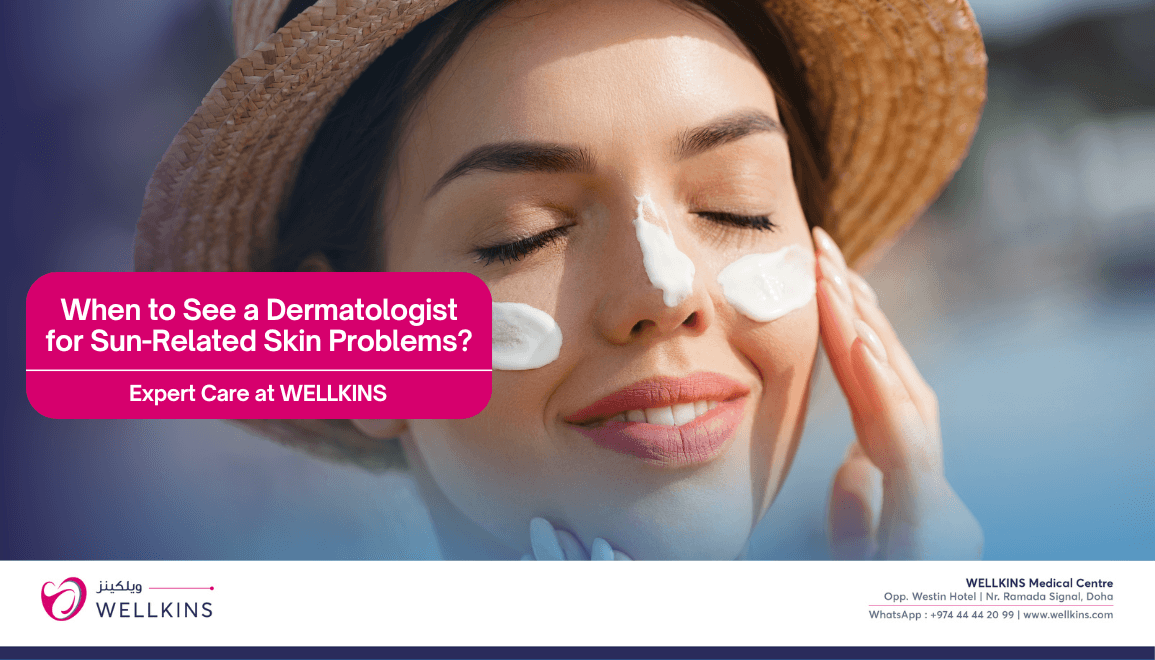
A dermatology consultation at Wellkins Medical Centre is worthwhile for any of the following situations related to sun exposure and skin health.
- You have new or changing pigmented lesions or spots that were not present previously or that have changed in size, shape or color.
- You are managing melasma or hyperpigmentation and want a clinically guided sun protection and treatment plan tailored to your skin tone and Qatar’s UV environment.
- You are using active skincare ingredients including retinoids, vitamin C or AHAs and want guidance on the right sunscreen to complement and protect your routine.
- You have recently had a laser treatment, chemical peel or other in-clinic procedure and need guidance on post-procedure sun protection in Qatar’s high UV environment.
- You are unsure which sunscreen formulation is right for your skin type or you have been using sunscreen inconsistently and want a personalized recommendation.
- You have a personal or family history of skin cancer and want a comprehensive skin check alongside guidance on the most appropriate sun protection strategy for Qatar.
Sun protection in Qatar is not a seasonal habit. It is a year-round daily practice that is the foundation of skin health across every skin tone, every age group and every lifestyle. The right sunscreen chosen for your skin type, applied in the right quantity and reapplied consistently, is one of the most powerful health decisions available to you in a country where the sun never truly takes a day off.
To book an appointment with Dr. Steffy Mariyam Reji at Wellkins Medical Centre: https://wellkins.com/drsteffy
To know more about the Orthopedic services at Wellkins Medical Centre: https://wellkins.com/dermatology