
Author: Dr. Reneesh, ( Consultant Orthopedic Surgeon – WELLKINS Medical Centre )
Choosing the right footwear is not merely a matter of style. It plays a crucial role in maintaining musculoskeletal health, preventing injuries and enhancing overall performance. As an orthopedic surgeon, I frequently encounter patients whose foot, knee, hip or even back problems are directly linked to inappropriate footwear. This guide will help you understand how to select the right shoes for different activities while protecting your joints and soft tissues.
In Qatar’s unique environment, this conversation carries even greater weight. Hard tiled indoor surfaces in offices, malls and homes offer zero shock absorption. Intense summer heat softens shoe soles and changes how they perform underfoot. Long working hours spent standing and walking on unforgiving surfaces create a cumulative mechanical load that the wrong shoe simply cannot handle. The result is that patients in Doha face orthopedic consequences from poor footwear choices at a rate that is entirely preventable with the right knowledge.
The foot is one of the most mechanically complex structures in the human body. Twenty-six bones, thirty-three joints and over a hundred muscles, tendons and ligaments work together with every single step you take. When footwear fails to support this system appropriately for the demands being placed on it, the consequences accumulate quietly over weeks and months before they become painful enough to bring a patient to the clinic. By the time most people come to see me about foot, knee or back pain linked to poor footwear, the problem is already well established. Selecting the right shoe for the right activity is one of the simplest and most powerful things you can do for your long-term orthopedic health.
Why Footwear Matters
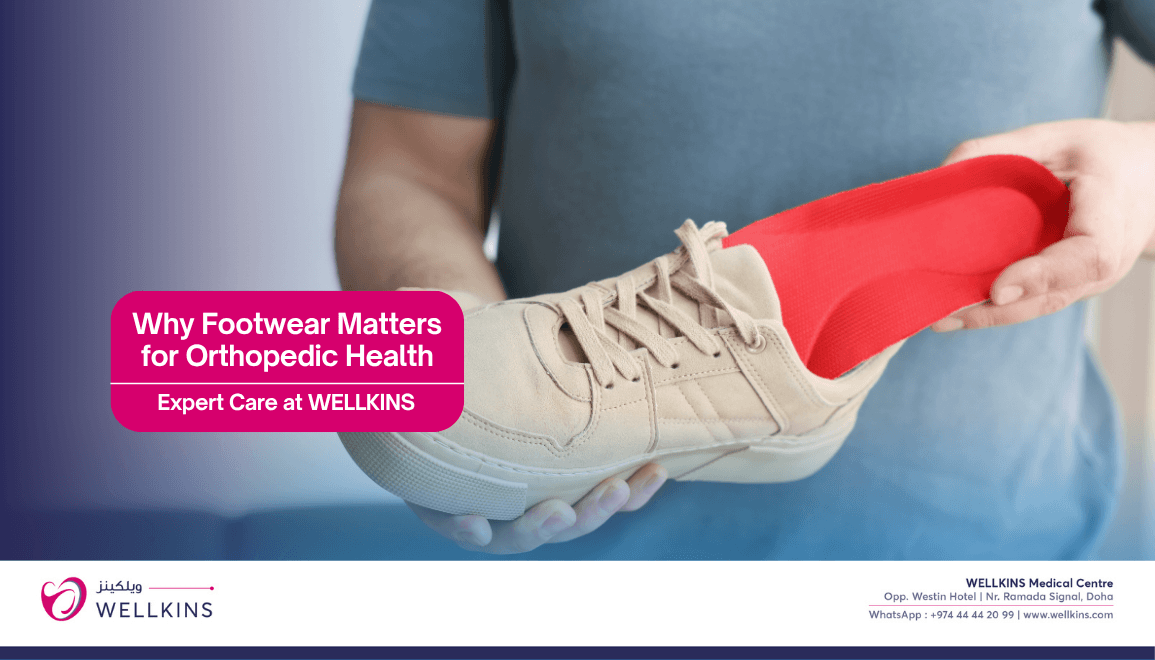
Your feet serve as the foundation of your body. Improper footwear can alter biomechanics, leading to abnormal stress distribution across joints. Over time, this may result in conditions such as plantar fasciitis, Achilles tendinitis, hallux valgus (bunions), metatarsalgia and even knee or lower back pain.
With every step, the foot absorbs a force equal to approximately one and a half times your body weight. Running increases this to three times body weight or more. Over the course of a typical day, this adds up to thousands of impact cycles. When the shoe is not equipped to manage this load, the joints themselves absorb what the footwear cannot. This is the mechanical reality behind conditions that most patients associate simply with age or overuse, when footwear is often the primary and correctable driver.
Well-designed footwear provides:
- Adequate arch support: The arch functions as a natural spring, distributing load across the foot and reducing direct impact on any single structure. Without proper arch support, the plantar fascia, tibialis posterior tendon and medial knee structures bear disproportionate stress with every step.
- Shock absorption: A well-cushioned midsole dissipates impact energy before it transmits upward through the ankle, knee, hip and lumbar spine. This is particularly important on Qatar’s hard indoor surfaces where the floor itself provides no natural give.
- Proper alignment: Footwear that maintains neutral alignment of the subtalar joint reduces the torsional and compressive forces transmitted to the knee and hip during walking and running. Misalignment at the foot is one of the most common upstream contributors to patellofemoral pain and hip bursitis.
- Stability during movement: A stable shoe base prevents the ankle from rolling on uneven surfaces, reduces excessive pronation or supination and gives the muscles and tendons of the lower leg a consistent mechanical platform to work from. This is especially relevant for patients with previous ankle sprains whose lateral ligaments provide less passive stability than before the injury.
Everyday Walking and Daily Use
For routine activities, comfort and support should be your priority. The shoes worn during the seven to ten hours of daily activity outside of specific exercise sessions have a cumulative impact on musculoskeletal health that rivals or exceeds that of sport-specific footwear. This is where the most common and most consequential footwear mistakes are made, because people apply far less thought to their everyday shoes than to their sports shoes.
Choose shoes with:
- A cushioned sole for shock absorption: Adequate midsole cushioning protects the metatarsal heads, heel pad and plantar fascia during prolonged walking and standing on hard surfaces. In Qatar’s offices, malls and tiled homes, this single feature makes the most noticeable difference to end-of-day foot and lower limb comfort.
- A wide toe box to prevent crowding of toes: A toe box that allows the toes to spread naturally during the push-off phase of each step prevents progressive compression of the metatarsals and reduces the risk of Morton’s neuroma, hammer toe deformity and bunion development over time.
- Moderate arch support: Structured arch support keeps the foot in a neutral position during walking, reducing strain on the plantar fascia and preventing the excessive inward rolling that loads the medial knee and hip over thousands of daily steps.
- Breathable material: In Qatar’s heat, moisture accumulation inside footwear softens the skin, increases friction and raises the risk of blisters, skin breakdown and fungal infections. Mesh uppers, moisture-wicking insoles and natural materials that allow heat to escape are preferable to sealed synthetic constructions.
- A firm heel counter: The heel counter is the structural element at the back of the shoe that cups and controls heel movement. A firm heel counter keeps the subtalar joint in a neutral position during walking and prevents the heel from rolling excessively with each step, which is a common aggravating factor in both plantar fasciitis and posterior tibial tendon dysfunction.
- Appropriate weight: Unnecessarily heavy everyday shoes increase leg fatigue over a long day, particularly for patients who stand for extended periods at work. A lightweight construction that does not sacrifice structure or support is the ideal combination for daily use.
Avoid completely flat footwear such as unsupportive sandals or worn-out slippers, as they can strain the plantar fascia and lead to chronic heel pain. Thin-soled flat shoes also provide no shock absorption on hard surfaces and transfer ground reaction forces directly to the heel and metatarsal heads with every step. If sandals are preferred for comfort or cultural reasons, choosing a supportive sandal with a contoured footbed and a structured heel cup delivers significantly better orthopedic outcomes than a flat open design.
Running and High-Impact Sports
Running places repetitive stress on the feet and lower limbs that accumulates over hundreds of foot strikes per kilometer. Proper running shoes should include:
- Excellent shock absorption: Running generates ground reaction forces two to three times greater than walking. A well-constructed midsole using EVA foam, gel inserts or modern responsive foam compounds absorbs these forces before they reach the knee and hip joint surfaces.
- Heel cushioning: The heel strikes the ground first in most recreational runners. Adequate heel cushioning protects the calcaneus and the heel fat pad, both of which can develop pain syndromes when subjected to repetitive unabsorbed impact over time.
- Arch-specific support (neutral, flat feet or high arches): A neutral runner requires a balanced shoe with moderate support. An overpronator with flat feet benefits from a stability or motion control shoe with medial post reinforcement. A supinator with high arches needs a well-cushioned, flexible shoe that encourages the foot to absorb shock rather than transmitting it through a rigid lateral column.
- Lightweight yet stable design: Modern running shoes achieve a balance between cushioning, structural support and weight that older designs could not. A lighter shoe reduces leg fatigue over longer distances while retaining the stability features that protect the foot and ankle from injury.
- Appropriate heel-to-toe drop: The difference in height between the heel and forefoot of a running shoe influences foot strike pattern and load distribution along the lower limb. Higher drop shoes suit heel strikers. Lower drop shoes encourage a midfoot strike. Transitioning too abruptly between these designs is a well-documented cause of Achilles tendinopathy in recreational runners.
- Surface-appropriate outsole: Road running outsoles are designed for hard, predictable surfaces. Trail outsoles feature more aggressive grip patterns for variable terrain. Using road shoes on trails or trail shoes exclusively on roads compromises both durability and mechanical performance.
Replacing running shoes every 500 to 700 kilometers is recommended, as worn-out soles lose their protective function. In Qatar’s summer, running on hot asphalt also softens outsole compounds faster than in cooler climates, accelerating the effective wear of the shoe beyond what mileage alone would predict.
Gym Training and Cross-Training
For gym workouts, the type of shoe depends on the activity. Using the wrong shoe for a specific training modality is one of the most common and most overlooked injury risk factors among gym-goers in Qatar.
- Weightlifting: Flat, stable shoes for better ground contact. The cushioned, compressible midsole that protects a runner’s joints is actively counterproductive under a heavy barbell. It creates an unstable, shifting base that reduces force transfer to the floor and increases the risk of ankle roll under load. Weightlifting, deadlifting and squat-focused sessions require flat, firm-soled shoes with minimal compression. Olympic weightlifting shoes with a raised heel of approximately two centimeters are the gold standard for deep squatting as they improve ankle dorsiflexion range and allow a more upright torso position.
- Cardio and HIIT: Cushioned shoes with lateral support. High-intensity interval training and cardio sessions involve jumping, rapid direction changes and lateral movement patterns that place significant demand on the ankle and knee. A shoe with adequate cushioning for impact absorption and sufficient lateral rigidity to prevent ankle rolling is the appropriate choice for these sessions.
- Cross-training: Versatile shoes with a balance of cushioning and stability. For sessions that combine cardio, bodyweight exercise and moderate lifting, a cross-training shoe designed for versatility offers a reasonable middle ground. These provide more lateral support than running shoes and more cushioning than dedicated lifting shoes, making them a practical choice for varied training formats.
- Cycling: Stiff-soled shoes for efficient power transfer. Cycling-specific shoes with a stiff carbon or nylon outsole transfer pedal force efficiently and prevent the foot from flexing wastefully with each pedal stroke. Flexible-soled shoes on a bike diffuse pedaling force and can contribute to metatarsal pressure discomfort during longer sessions.
- Group fitness classes: Classes involving step, dance or aerobics require a shoe with cushioning, flexibility in the forefoot for pivoting and lateral support to accommodate the multidirectional movement patterns of these formats.
Avoid using running shoes for weightlifting, as excessive cushioning may reduce stability and increase injury risk. This is one of the most frequently made and least acknowledged footwear mistakes across gyms in Qatar and worldwide.
Office and Formal Wear
Formal footwear often prioritizes aesthetics over function, but certain features can reduce harm. Understanding the orthopedic consequences of prolonged formal footwear use allows better choices within realistic professional constraints.
- Opt for low heels, ideally less than two to three centimeters: Every centimeter of heel elevation shifts body weight forward onto the forefoot, increases pressure on the metatarsal heads, shortens the Achilles tendon and calf complex over time and alters lumbar spine curvature. A heel within the two to three centimeter range is the upper limit that most orthopedic specialists consider compatible with all-day professional wear without significant mechanical consequence.
- Ensure a wide toe box to prevent compression: Narrow, pointed formal shoes are a consistent driver of bunion development, Morton’s neuroma and hammer toe deformity over years of regular use. A rounded or square toe box that allows natural toe splay is orthopedically preferable and increasingly available in contemporary formal designs for both men and women.
- Use cushioned insoles if necessary: Adding a thin, cushioned forefoot insole to formal shoes significantly reduces metatarsal head pressure during prolonged standing on hard surfaces. These are widely available in pharmacies across Qatar and represent one of the simplest and most cost-effective interventions for formal footwear discomfort.
- Choose block heels over stilettos where possible: A wider heel base distributes weight more evenly and provides significantly greater ankle stability than a stiletto heel of equivalent height. For patients with a history of ankle sprains or balance concerns, a block heel or wedge design is the safer formal option.
- Rotate heel heights across the working week: Wearing the same heel height every day leads to adaptive shortening of the calf and Achilles complex. Rotating between flats, low heels and moderate heels prevents this adaptive change and maintains a more functional range of ankle motion over time.
- Invest in quality leather construction: Well-constructed leather formal shoes with a structured insole and firm heel counter provide significantly better support during long professional days than fashion-focused designs built without internal structure. The investment in a well-made shoe pays dividends in reduced foot fatigue over years of use.
Prolonged use of high heels can lead to forefoot pain, tendon shortening and postural imbalance. Patients who wear high heels daily for years frequently present with chronic Achilles tightness, metatarsalgia and a posturally driven pattern of lower back pain that responds poorly to treatment until the footwear factor is addressed.
Footwear for Special Foot Conditions
Patients with specific orthopedic conditions should take additional care when selecting footwear, as the standard guidance for healthy feet is often insufficient and in some cases actively inappropriate for their specific clinical situation.
- Flat feet: Require structured arch support or custom orthotics to prevent excessive inward rolling of the foot during walking. Without medial arch control, flat-footed patients develop progressive strain on the plantar fascia, the posterior tibial tendon and the medial structures of the knee over time. Motion control or stability shoes with reinforced medial posts are the appropriate off-the-shelf category.
- High arches: Benefit from cushioned soles to absorb shock. A rigid high arch transmits ground reaction forces along the lateral column of the foot with little natural attenuation. Well-cushioned, flexible shoes with a neutral construction allow the high-arched foot to absorb impact more effectively and reduce the risk of stress fractures and lateral ankle sprains.
- Diabetes: Need soft, seamless footwear to prevent ulcers. Peripheral neuropathy impairs sensation in the feet of many diabetic patients, meaning that pressure points, friction and small injuries go unnoticed until significant tissue damage has occurred. Specialist diabetic footwear with extra depth, seamless interiors, soft uppers and custom orthotic insoles is the standard of care and should be considered mandatory rather than optional for this patient group.
- Bunions or callosities: Prefer wide, soft upper material to reduce pressure on the medial first metatarsophalangeal joint and other pressure points. Rigid or narrow shoes mechanically accelerate bunion progression and cause pain at the site of the deformity. A shoe with a stretched or accommodating upper and a wide toe box is the most important single footwear feature for this patient group.
- Plantar fasciitis: Requires footwear with firm arch support, a cushioned heel and a slight heel elevation that reduces tension on the plantar fascia during walking. Completely flat shoes and barefoot walking on hard surfaces significantly aggravate this condition and should be strictly avoided during active flares.
- Achilles tendinopathy: Benefits from a small heel lift of five to ten millimeters that reduces the mechanical load on the tendon during everyday walking. This simple addition to a well-structured shoe can meaningfully reduce pain and allow rehabilitation to progress more comfortably.
Custom orthotics may be necessary in persistent or severe cases. Following a formal gait analysis and biomechanical assessment at Wellkins, custom-fabricated orthotic insoles provide a level of correction and offloading that standard footwear alone cannot achieve for patients with established orthopedic conditions.
Footwear for Children and Adolescents
Growing feet require special attention that adult footwear principles alone do not address. The choices made during childhood and adolescence influence foot structure, gait mechanics and the risk of orthopedic conditions that may not manifest until adulthood.
Choose shoes that:
- Allow natural foot development: The bones and soft tissues of a child’s foot are malleable and respond to the mechanical environment created by footwear. Overly rigid or restrictive shoes can interfere with the natural strengthening of the intrinsic foot muscles and the development of the medial arch, which typically matures by around age six to eight.
- Are flexible yet supportive: A children’s shoe should flex at the forefoot to accommodate the natural rolling movement of a growing foot during walking and running, while providing enough structure at the heel and midfoot to guide healthy alignment during this period of rapid skeletal development.
- Have adequate room for toe movement: Children’s feet grow quickly and shoes that fit today may be too tight within weeks. A thumb-width of space beyond the longest toe ensures that the growing foot is not compressed into an abnormal position during this critical developmental window.
- Are replaced regularly: Children often do not report foot pain or discomfort from tight shoes, either because they have not yet developed the awareness to notice or because they do not want to trouble their parents. Regular checking of shoe fit, every two to three months in rapid growth phases, is essential to ensure that the shoe is still appropriate for the current foot size.
- Are appropriate for the specific activity: Sports-playing children and adolescents benefit from the same activity-specific footwear principles that apply to adults. A child playing football regularly on artificial turf requires appropriate cleats just as an adult does, and a child with flat feet or a toe-walking pattern may benefit from an orthopedic assessment and guided footwear selection sooner rather than later.
Avoid tight or rigid footwear, as it may interfere with normal growth and alignment. It is also worth noting that allowing children and young adolescents to spend time barefoot on natural surfaces such as grass and sand supports the natural development of the intrinsic foot muscles in ways that constant shoe-wearing does not.
Common Mistakes to Avoid
Even well-intentioned footwear choices frequently fall into patterns that create avoidable orthopedic problems. The following mistakes are among the most consistently encountered in clinical practice.
- Wearing shoes that are too tight or too loose: A shoe that is too tight compresses the forefoot and toes, accelerating bunion formation and nerve entrapment. A shoe that is too loose allows the foot to slide within the shoe, creating friction, blisters and instability that increases the risk of ankle sprains. Feet should be measured standing, preferably in the afternoon when feet are at their largest after a day of activity, and both feet should be measured as they are often different sizes.
- Ignoring signs of wear and tear: Worn outsoles alter ground contact patterns and change the mechanical loads transmitted to the foot and lower limb in ways that can be highly asymmetric. A shoe that looks acceptable from the outside may have a completely collapsed midsole that provides no meaningful cushioning. Pressing the midsole firmly with a thumb and comparing the resistance to a new shoe of the same model is a simple way to assess whether cushioning has been lost.
- Choosing style over comfort: Fashion footwear is designed around aesthetic principles that frequently conflict with orthopedic ones. Pointed toes, minimal heel counters, unsupported flat soles and high heels all priorities appearance at the expense of foot mechanics. Wearing such footwear for prolonged daily use across years has cumulative consequences that are difficult and sometimes impossible to fully reverse.
- Using one type of shoe for all activities: A running shoe used for weightlifting creates instability under load. A formal shoe used for long walks on hard surfaces bruises the metatarsals. A gym shoe used for trail walking provides insufficient ankle protection. Each major activity category has specific mechanical demands that only an appropriate shoe can meet. Maintaining a small selection of activity-specific footwear rather than relying on a single pair for everything is both orthopedically sound and practically reasonable.
- Buying shoes based on size alone without trying them on: Shoe sizing varies considerably between brands and even between models within the same brand. Foot shape, width, arch height and toe length proportions all influence fit in ways that a size number cannot capture. Shoes should always be tried on and worn for a few minutes in the store to assess comfort, fit and any pressure points before purchasing.
- Neglecting insole replacement: The insole of a shoe wears faster than the outsole and midsole in most cases. A worn insole removes a layer of cushioning and contour support from the foot’s interface with the shoe. Replacing insoles regularly, or upgrading to a higher-quality aftermarket insole, extends the functional life of a shoe and improves comfort significantly.
When to See an Orthopedic Specialist
If you experience persistent foot pain, swelling, deformity or difficulty walking, it is important to seek medical evaluation. Early intervention can prevent progression and long-term complications.
You should book a consultation at Wellkins Medical Centre if:
- Heel or foot pain has been present for more than two to three weeks despite rest and a change of footwear.
- You notice a progressive change in the shape of your foot, toe alignment or the distribution of pressure across the sole.
- Knee, hip or lower back pain consistently improves on days when you wear different footwear, suggesting a biomechanical contribution from your current shoes.
- You have diabetes, rheumatoid arthritis or peripheral vascular disease and have not had a recent foot health assessment.
- You are returning to sport following an injury and want guidance on appropriate footwear to support a safe and well-structured return to activity.
- You want a formal gait analysis and biomechanical assessment to identify whether your foot type and movement pattern would benefit from orthotic support or a change in footwear category.
Selecting the right footwear is a simple yet powerful step in maintaining orthopedic health. By choosing activity-specific shoes with proper support and fit, you can significantly reduce the risk of injury and improve your overall quality of life. Remember, investing in the right footwear is an investment in your long-term health. The cost of a well-chosen pair of shoes is a fraction of the time, expense and discomfort involved in managing the injuries that the wrong footwear causes over months and years.
At Wellkins Medical Centre, Dr. Reneesh and the orthopedic team provide comprehensive assessment of foot and lower limb conditions, gait analysis and personalized guidance on footwear and orthotic solutions appropriate for your specific anatomy, activity level and clinical needs.
To book an appointment at Wellkins Medical Centre: https://wellkins.com/orthopedics/