

Author: Dr. Joanne Mae J Villanueva, (Specialist Pediatrics – Wellkins Medical Centre)
It is completely natural as a parent to wonder whether your child is hitting their milestones on time. Is she walking when she should be? Is he saying enough words for his age? Is this behavior normal or is it something we should be looking at more carefully? These questions come up at every stage of childhood and they are exactly the right questions to be asking.
In a dynamic multicultural city like Doha, parents have access to world-class pediatric healthcare across a range of settings. When you bring your child in for a routine developmental checkup at Wellkins Medical Centre, your pediatrician is evaluating considerably more than simply height and weight. We are looking at complex developmental pathways that are specific to your child’s age and stage, assessing physical growth alongside neurological, cognitive, social and emotional development simultaneously.
Understanding what we look for at each age group helps parents know what to observe between visits, what to bring up at appointments and when something warrants earlier assessment rather than a watch-and-wait approach.
One of the most important things I try to communicate to parents is that child development is not a single track. It is multiple parallel pathways that all progress at slightly different rates even in the same child. A child can be advanced in language and still developing in fine motor skills. What we are looking for is not whether every milestone has been hit on a specific date but whether the overall pattern of development is progressing in the right direction. When one area is consistently lagging or when several areas raise concern together, that is when early intervention makes the greatest difference. Coming to every scheduled check, even when your child seems perfectly well, is how we catch what a single visit might miss.
People Also Ask
How do I know if my child is developing normally?
Normal development follows broad age-based patterns across physical growth, language acquisition, social skills and cognitive ability but varies considerably between individual children. Your pediatrician assesses your child against established developmental milestones at each routine visit and looks for consistent progress across all domains rather than hitting every milestone on a precise date. If you have a concern about any aspect of your child’s development, the most reliable step is a clinical assessment with your pediatrician rather than relying solely on online milestone checklists, which do not account for individual variation.
What do pediatricians check at a routine child health visit in Qatar?
A routine pediatric visit at Wellkins Medical Centre in Doha covers physical measurements including height, weight and in infants head circumference, plotted against growth charts to confirm the child is following their expected growth curve. Beyond physical growth the visit assesses gross and fine motor development, language and communication milestones, social and emotional behavior, vision and hearing where age-appropriate and for adolescents mental health and pubertal development. Vaccination status is also reviewed and updated at each visit in line with Qatar’s National Immunization Program.
At what age should children be screened for developmental delays?
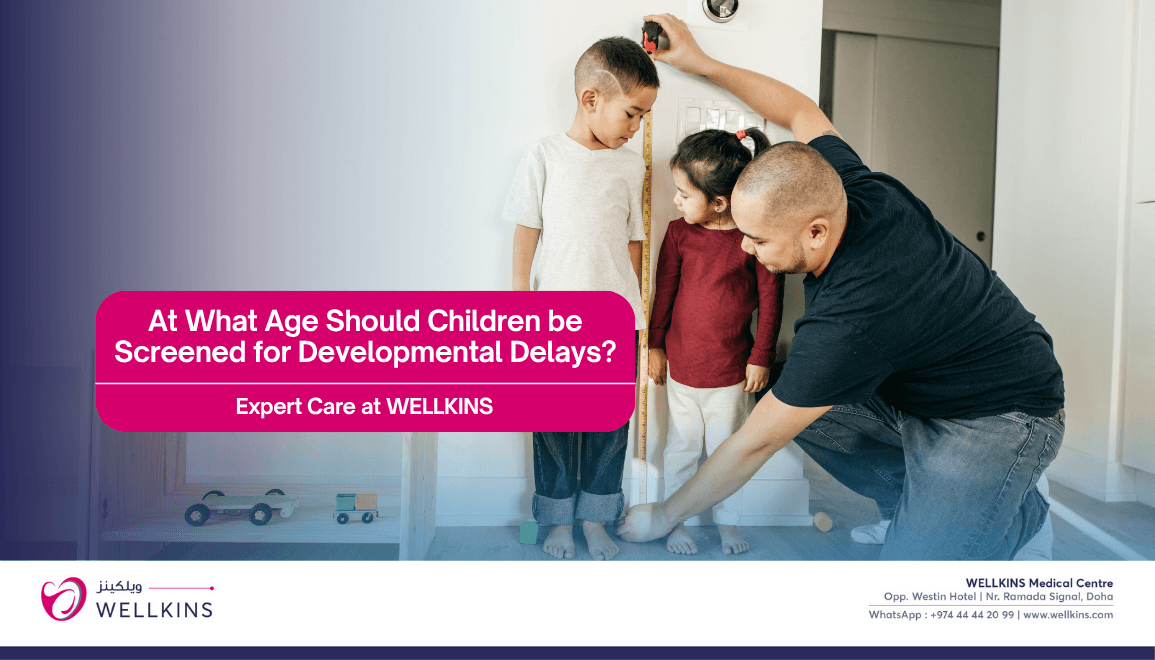
Developmental screening begins at birth and continues at every routine health visit throughout childhood. In Qatar, specific screening windows include the early infant visits at one, two and four months where neurological development is closely assessed, the toddler visits between eighteen months and two years where early language and social development indicators for conditions including autism spectrum disorder are evaluated and again at school entry age between four and six years when readiness for the structured learning environment of Doha’s international and local schools is assessed.
What is the HEADSSS assessment used for in adolescent care?
HEADSSS is a structured clinical framework used by pediatricians during adolescent checkups to evaluate the broader environment in which a teenager is growing up. It covers Home, Education, Activities, Drugs and Drinking, Sexuality, Suicidality and Safety. In Doha’s diverse adolescent population, this framework provides a confidential structured way to identify pressures around academic performance, screen time and social media, peer relationships and mental health that teenagers may not raise spontaneously but that can significantly affect their health and development.

1. Infancy (0 to 12 Months): The Foundation
During the first year of life, pediatric checkups are the most frequent of any developmental stage. This reflects the extraordinary pace of development happening during infancy and the importance of catching any deviation from expected patterns early when intervention is most effective. Your pediatrician focuses heavily on rapid physical growth and foundational neurological development across every visit.
- Growth Metrics: Height, weight and head circumference are measured and plotted on standard growth charts at every infant visit. Consistency along your child’s specific percentile curve matters considerably more than being in the highest percentile. A child consistently following the 25th percentile curve is developing normally. A child dropping across multiple percentile lines over successive visits warrants investigation regardless of their absolute size.
- Gross Motor Skills: The developmental sequence of physical milestones follows a predictable pattern that your pediatrician tracks at each visit. Lifting the head during tummy time is expected by two months. Rolling over develops between four and six months. Sitting without support typically arrives around six months. Pulling up to stand and early cruising along furniture develop between nine and twelve months.
- Communication and Social Development: Early social development begins far earlier than most parents expect. We look for the first social smiles at around two months, cooing and early vocalization in the first few months and responding to the sound of a familiar voice. By six months infants should be responding to their own name and by nine months babbling with consonant-vowel combinations including “mama” or “dada” used non-specifically is expected.
- Qatar National Immunization Program (QNIP) Review: At each infant visit in Qatar, your pediatrician reviews and updates vaccination status in line with the QNIP schedule. Key vaccines in the first year include BCG at birth, Hepatitis B at birth and one month, the Hexavalent combination vaccine at two, four and six months and the pneumococcal vaccine. Keeping to the schedule protects your infant at the point when their immune system is most vulnerable to serious infection.
2. Toddlerhood (1 to 3 Years): Independence and Language
The toddler years are defined by two of the most dramatic developmental shifts in childhood: the achievement of independent mobility and the explosion of language. Your pediatrician transitions from tracking foundational survival milestones to evaluating the social behavior and emerging autonomy that will shape your child’s readiness for the nursery and preschool environments of Doha.
- Advanced Motor Skills: Walking steadily and independently is expected by fifteen months. By age two most children are running, kicking a ball with some intent and beginning to climb stairs with support. By three years stair climbing without support and basic jumping are within the expected range for most children.
- Language and Cognitive Milestones: Language development is one of the most carefully watched areas during toddlerhood. By age two a child should have a vocabulary of at least fifty words and be combining two words together into simple phrases such as “more milk” or “daddy go.” By age three speech should be in short sentences that familiar adults can mostly understand, even if strangers occasionally misunderstand some sounds. Significant delays in this pattern always warrant assessment.
- Social and Behavioral Screening: The toddler window, particularly between eighteen months and two and a half years, is a critical period for early neurodevelopmental screening. Your pediatrician looks carefully at interactive behaviors including eye contact quality, response to joint attention cues such as following a pointed finger, pretend play including feeding a doll or talking on a toy phone and the development of interest in other children. These are the early indicators your doctor monitors for signs of autism spectrum disorder and other developmental conditions where early intervention produces the best outcomes.
3. Preschool and Early School Age (4 to 6 Years): Readiness for the World
At this stage your pediatrician is evaluating how well your child will integrate into the structured environment of a nursery or primary school, including the diverse range of international and local schools across Doha. The assessments at this age are increasingly oriented toward school readiness across physical, cognitive and social-emotional dimensions simultaneously.
- Fine Motor Precision: The ability to hold a pencil correctly, draw a recognizable person with two to four body parts, use safety scissors with some control and manage basic self-care tasks including dressing and fastening buttons are all assessed as indicators of the fine motor development needed for classroom learning.
- Social and Emotional Maturity: Beyond academic readiness, school success depends heavily on emotional regulation and social skills. Your pediatrician looks at how your child manages big emotions including frustration and disappointment, whether they can express basic empathy for others, how they cooperate with peers in group settings and whether they can follow multi-step instructions reliably. These skills predict classroom engagement as reliably as cognitive ability does.
- Physical Health Screening and Prevention: Vision and hearing screenings become a formal part of the health assessment at this age. Undetected vision problems and hearing impairment are among the most common and most correctable causes of learning difficulties in early primary school. Identifying them before school entry is one of the most impactful preventive healthcare steps available for this age group in Qatar.
4. School Age (6 to 11 Years): Academic and Social Integration
The primary school years are physically the most stable period of childhood development but represent a period of extraordinary cognitive and social rewiring. During annual well-child visits at this stage your pediatrician transitions from counting words and tracking motor milestones to analyzing how your child functions within the structured demands of school, friendships and an increasingly complex social world.
- Academic Progression and Focus: Your pediatrician will ask specifically about how your child is progressing at school, not just in terms of grades but in terms of how they engage with learning. This is the window when learning difficulties including dyslexia and attention deficit hyperactivity disorder most commonly become visible, because the demands of the school environment expose processing and attention challenges that may not have been apparent in less structured settings. Early identification and appropriate support at this stage produces significantly better long-term academic outcomes.
- Physical Tracking and BMI: Height and weight continue to be measured and plotted at every visit but your pediatrician places increased focus on body mass index as a health indicator during these years. In Qatar where childhood overweight rates are among the highest in the region, monitoring BMI trends provides an early opportunity to discuss nutritional habits, physical activity levels and the prevention of early-onset metabolic conditions before they become established.
- Socialization and Peer Relationships: The quality of peer relationships becomes a significant focus of the school-age pediatric visit. Your pediatrician evaluates how your child makes and sustains friendships, how they handle conflict and social disagreement and how they navigate peer pressure. Bullying, social withdrawal, low self-esteem and school-related anxiety are all topics that are actively explored during this stage rather than waiting for parents to raise them.
- Anxiety Screening: As academic and social expectations increase around age eight and beyond, modern pediatric guidelines recommend proactive screening for anxiety during routine physical visits. Many children with clinically significant anxiety are not identified because they present as generally well-behaved and academically engaged. Asking specific questions about a child’s internal experience of stress is a routine and important part of the school-age pediatric assessment at Wellkins.
5. Adolescence (12 to 18 Years): The Transition to Autonomy
As children enter their teenage years the nature of the pediatric visit changes significantly. Growth charts are still monitored and physical health remains central but the primary focus of the assessment expands to encompass pubertal development, mental health, lifestyle assessment and the gradual transfer of health ownership from parent to young person.
- Pubertal Growth and Physical Development: Your pediatrician tracks the onset and progression of puberty using the Tanner Scale, a clinical framework that defines the expected sequence of pubertal changes and allows early or delayed development to be identified and investigated. Scoliosis screening, which involves checking for abnormal spinal curvature that is most likely to develop during rapid adolescent growth spurts, is incorporated into the physical examination. Acne management and menstrual health are also addressed as part of the adolescent physical assessment.
- Mental Health and Mood Screenings: Adolescence brings significant academic pressure, social complexity and identity development challenges. Your pediatrician actively screens for changes in sleep patterns, mood shifts and drops in school performance that may indicate anxiety or depression. Formal validated screening tools are used rather than relying on open-ended questioning alone, ensuring that adolescents who are struggling are identified even when they have not spontaneously disclosed their difficulties.
- The HEADSSS Lifestyle Assessment: The HEADSSS framework, covering Home, Education, Activities, Drugs and Drinking, Sexuality, Suicidality and Safety, provides a structured way to evaluate the full environment in which your teenager is living and growing. This assessment covers screen time habits, social media use, peer relationships and exposure to risk in a way that is normalized and non-judgmental within the clinical visit. In Doha’s diverse adolescent population, where academic pressure can be intense and where teenagers navigate both local and global cultural influences, this assessment is particularly valuable.
- The Private Conversation: A defining feature of the adolescent pediatric visit at Wellkins is the confidential segment of the appointment. Parents are asked to step out of the room for a portion of the visit so that the teenager can speak candidly with their pediatrician about body changes, emotional health, peer relationships or any concerns they may not feel comfortable raising in front of a parent. This is not a reflection of any concern about the parent-child relationship. It is a clinical best practice that builds trust between the young person and their doctor and fosters a sense of ownership over their own health that serves them throughout adulthood.
Every stage of childhood development tells a story and your pediatrician is trained to read that story across multiple visits over time. The routine checkup, even when your child seems perfectly well, is where that story gets told clearly and where early chapters of difficulty can be identified and rewritten before they become longer-term challenges.
Your child only gets one childhood. The developmental assessments we do together at Wellkins are among the most important investments you can make in the person they are becoming.
To book an appointment with Dr. Joanne Mae J Villanueva at Wellkins Medical Centre: https://wellkins.com/drjoanne
To know more about the Pediatric services at Wellkins Medical Centre: https://wellkins.com/pediatrics