

Author: Dr. Joanne Mae J Villanueva, (Specialist Pediatrics – Wellkins Medical Centre)
Every parent watches their child grow with a mixture of wonder and quiet anxiety. The first smile, the first step, the first word. These moments are celebrated because they represent something profound: a small human being steadily becoming more capable, more connected and more themselves with every passing week.
Child growth and development is a continuous process that begins at birth and progresses through distinct stages. Growth refers to the measurable physical changes in height, weight and head circumference. Development involves the progressive acquisition of motor, cognitive, language and social skills. Both are influenced by a combination of genetic, nutritional, environmental and parental factors that make them dynamic and deeply individual.
Understanding these processes allows healthcare providers and caregivers to identify normal patterns, recognize early signs of delay and provide timely interventions when they are needed. At Wellkins Medical Centre, pediatric developmental assessment is not simply a checklist exercise. It is a meaningful clinical conversation about where a child is, where they are headed and what support they and their family may need along the way.
Parents often come to clinic with a feeling rather than a specific complaint. Something about their child’s development does not feel quite right but they cannot articulate it precisely. That feeling deserves clinical attention. Developmental milestones exist not as rigid standards every child must meet at an exact age but as windows of expected progress that help us identify when a child may benefit from early support. The earlier we identify a concern the more we can do about it and the better the long-term outcome for the child.
People Also Ask
What are the key stages of child development?
Child development is broadly divided into five stages: infancy from birth to twelve months, toddlerhood from one to three years, the preschool years from three to five, school age from six to twelve and adolescence from twelve to eighteen years. Each stage is characterized by specific physical, cognitive, language and social milestones that form the framework pediatricians use to assess whether a child is progressing as expected.
How do I know if my child is meeting developmental milestones?
Regular pediatric check-ups are the most reliable way to monitor developmental progress across all domains. Between appointments, parents can refer to age-appropriate milestone guides to observe whether their child is reaching expected skills within the expected time windows. Missing several milestones across more than one developmental domain warrants a clinical assessment rather than a wait-and-see approach.
What can delay a child’s growth and development?
Developmental delays can result from a wide range of factors including nutritional deficiencies, genetic conditions, premature birth, chronic illness, hearing or vision impairment, limited stimulation in the early years and adverse early childhood experiences. In many cases more than one contributing factor is present and a thorough pediatric assessment identifies which are most relevant for an individual child.
When should I be concerned about my child’s development?
If a child is not meeting several expected milestones within a developmental stage or if there is regression in skills they had previously acquired, a pediatric consultation is warranted without delay. Loss of language skills is a particularly important red flag that requires urgent clinical assessment. Early identification and intervention consistently produces better outcomes than monitoring and waiting.

The Five Stages of Child Growth and Development
Children grow and develop within broadly predictable stages, each building on the last. Understanding what is expected at each stage helps parents and caregivers engage with their child’s development as informed and active participants rather than passive observers.
Stage 1: Infancy (0 to 12 Months)
Infancy is the most rapid period of growth and neurological development in the entire human lifespan. The brain doubles in size during the first year of life and the foundations for all future learning, attachment and sensory processing are established during this window.
- Physical Growth: Birth weight typically doubles by four to five months and triples by the first birthday. Length increases by approximately twenty-five centimeters during the first year.
- Motor Development: Progresses from reflexive movements at birth through rolling, sitting with support then independently and beginning to crawl or pull to stand by the end of the first year.
- Cognitive and Social Development: Infants begin recognizing faces and responding to voices from the earliest weeks. Babbling develops by four to six months. Social smiling and responding to familiar voices are important early milestones that signal healthy neurological development.
Stage 2: Toddlerhood (1 to 3 Years)
Toddlerhood is marked by rapidly increasing independence and mobility. This stage is as demanding for caregivers as it is exciting because the toddler’s emerging autonomy outpaces their judgment and emotional regulation significantly.
- Physical and Motor Development: Walking typically begins between nine and fifteen months. Running, climbing and kicking a ball develop progressively through the second and third years of life.
- Language Development: First meaningful words emerge around twelve months. By eighteen months most children are using at least ten to twenty words and by two years they are beginning to combine two words in short phrases such as “more milk” or “daddy go.”
- Independence and Emotional Development: The toddler’s characteristic insistence on doing things independently is a healthy and important expression of developing autonomy. Tantrums reflect the gap between what the child wants to do and their capacity to manage the frustration of limitation, not a behavioral problem.
Stage 3: Preschool Years (3 to 5 Years)
The preschool years bring significant advances in coordination, language complexity and the capacity for imaginative and cooperative play. This is also the stage during which many developmental concerns become more clearly apparent as expectations for communication and socialization increase.
- Physical Development: Improved gross motor coordination allows running, jumping with both feet and beginning to hop. Fine motor skills develop to allow drawing recognizable shapes and using utensils with increasing competence.
- Language and Cognitive Development: Speech becomes fully intelligible to strangers by age three to four. Children speak in full sentences, ask relentless questions and begin to understand basic concepts including color, number and time.
- Social and Imaginative Play: Cooperative play with peers becomes possible during this stage alongside the rich imaginative play that characterizes healthy preschool development. Difficulty joining peer play or significantly preferring solitary activity warrants attention.
Stage 4: School Age (6 to 12 Years)
The school-age years are characterized by steadier physical growth and a significant expansion of cognitive capacity, social complexity and the development of sustained learning skills.
- Physical Development: Growth continues at a steady and predictable rate until the adolescent growth spurt begins. Motor skills become increasingly refined and sport and physical activity play an important role in both physical health and social integration.
- Cognitive Development: Logical reasoning, memory organization and the capacity for sustained focused learning all develop substantially during this period. Difficulties with reading, writing or mathematical concepts that emerge during the school years warrant learning assessment rather than simple reassurance.
- Social Development: Peer relationships become increasingly central to a child’s sense of identity and wellbeing during the school years. Building friendships, navigating social dynamics and developing empathy and communication skills are as important to this stage as academic learning.
Stage 5: Adolescence (12 to 18 Years)
Adolescence is the transition from childhood to adulthood, characterized by rapid physical growth driven by hormonal changes, significant emotional development and the critical psychological work of establishing identity and independence.
- Physical Development: The adolescent growth spurt produces the final major increase in height and the development of secondary sexual characteristics. Nutritional requirements during this period are among the highest across the entire lifespan.
- Emotional and Identity Development: Adolescents are engaged in the challenging work of separating from parental identity and constructing their own. This process is accompanied by emotional intensity, heightened peer sensitivity and periods of conflict with authority that are developmentally normal even when they are practically demanding.
- Lifelong Health Behaviors: The habits established during adolescence including physical activity patterns, dietary choices, sleep practices and approaches to stress and mental health have lasting implications for adult health. Supporting positive behavior formation during this window is one of the most impactful things caregivers and clinicians can offer.
Your Child’s Early Milestones at a Glance
The following developmental guide summarizes key milestones from two months through to five years across the major developmental domains. These milestones represent the broad range of typical development and are used by pediatricians to identify children who may benefit from further assessment.
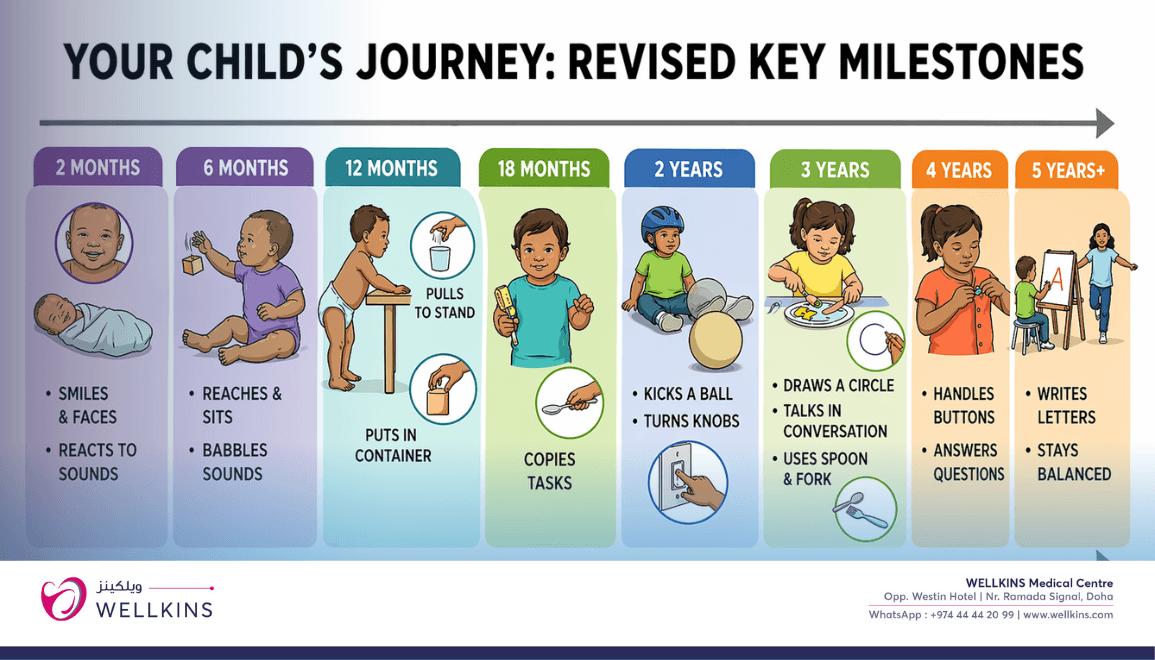
2 Months
- Looks at your face and reacts to loud sounds
- Smiles when you talk to or smile at them
- Holds head up when lying on tummy
6 Months
- Knows familiar people and takes turns making sounds with you
- Reaches to grab a toy they want
- Rolls from tummy to back
12 Months
- Plays games with you such as pat-a-cake
- Calls a parent “mama” or “dada”
- Puts something in a container and pulls up to stand
18 Months
- Points to show you something interesting
- Tries to say three or more words besides “mama” and “dada”
- Copies doing simple chores and tries to use a spoon
2 Years
- Looks at your face to see how to react in a new situation
- Says at least two words together such as “More milk”
- Tries to use switches, knobs or buttons on a toy and kicks a ball
30 Months
- Says about 50 words and uses things to pretend
- Shows you what they can do by saying “Look at me”
- Jumps off the ground with both feet
3 Years
- Talks with you in conversation
- Draws a circle when shown how and uses a fork
- Notices other children and joins them to play
4 Years
- Answers simple questions such as “What is a coat for?”
- Names a few colors of items
- Unbuttons some buttons and likes to be a helper
5 Years
- Follows rules or takes turns when playing games with other children
- Uses or recognizes simple rhymes
- Writes some letters in their name and hops on one foot
Practical Tips to Support Your Child’s Healthy Development
Supporting healthy growth and development does not require expensive resources or elaborate programmes. The most evidence-supported inputs are available to every family through consistent daily practices.

- Ensure Proper Nutrition: Provide a balanced diet with protein, fruits and vegetables, whole grains and dairy at every stage. Avoid excessive junk food and sugary drinks which displace the nutrient-dense foods that growing bodies genuinely need. In Qatar where processed and fast foods are widely accessible and culturally embedded in many family routines, intentional dietary choices require specific and ongoing effort.
- Promote Regular Health Check-ups: Routine pediatric visits monitor growth parameters including height, weight and head circumference, ensure vaccination schedules are followed and allow early screening for developmental delays before they become entrenched. These visits are the single most reliable safety net for a child’s health and development and should never be treated as optional.
- Encourage Physical Activity: Daily active play including running, jumping and outdoor games builds physical strength, coordination and cardiovascular health. Screen time should be avoided entirely for children under two years of age. For children aged two and above it should be limited to one to two hours per day of high-quality content with parental involvement where possible.
- Provide a Safe and Stimulating Environment: Childproof the home to prevent injuries and provide toys that stimulate learning such as puzzles, blocks and books. Encouraging exploration and curiosity in a safe environment is one of the most powerful things a caregiver can do for cognitive development during the early years.
- Support Emotional and Social Development: Show love, affection and consistent attention. Respond to the child’s needs reliably and encourage interaction with peers. Teaching sharing, empathy and communication through modelling and guided play builds the social competence that underlies healthy peer relationships throughout childhood.
- Promote Good Sleep Habits: Maintain a consistent bedtime routine and ensure that children are getting the amount of sleep appropriate to their age. Sleep is not passive rest. It is when the brain consolidates learning, repairs tissue and regulates emotional systems. Chronic sleep deprivation in children has measurable negative effects on mood, behavior, immune function and cognitive performance.
- Encourage Learning and Communication: Talk, read and sing to your child every day from infancy onward. Encourage questions and conversation and limit passive learning from screens. The quantity and quality of language a child is exposed to in the first three years of life is one of the strongest predictors of vocabulary, literacy and school readiness.
- Provide Positive Discipline: Use guidance and explanation instead of punishment. Children learn self-regulation through repeated experience of calm, consistent adult responses rather than through fear of consequences. Positive discipline takes more patience in the short term and produces substantially better behavioral outcomes over time.
- Be a Good Role Model: Children imitate the adults around them before they can articulate why. Demonstrating healthy habits including eating well, staying physically active, managing emotions constructively and approaching challenges with curiosity rather than anxiety teaches more than any instruction ever could.
When to Book a Pediatric Developmental Assessment at Wellkins
Book a consultation at Wellkins Medical Centre if any of the following apply to your child:
- Your child has not reached several expected milestones within their current developmental stage.
- Your child has lost skills they had previously acquired, particularly language skills.
- You have concerns about your child’s speech clarity or the quantity of words they are using relative to their age.
- Your child shows limited interest in interacting with familiar people or in playing with other children.
- Your child’s growth has slowed or their weight and height are not following their expected centile on the growth chart.
- Your child’s teacher has raised concerns about learning, attention or social functioning at school.
- You have a general feeling that something about your child’s development is not quite right even if you cannot identify it precisely.
Child development does not follow a single rigid path. Every child brings their own pace, their own strengths and their own way of moving through the world. What pediatric care offers is not a standard to be met but a supportive framework that catches children who need a little extra help before that need becomes harder to address.
If you have questions about your child’s growth or development, ask them. There are no small concerns when it comes to a child’s future.
To book an appointment at Wellkins Medical Centre: https://wellkins.com/visit